



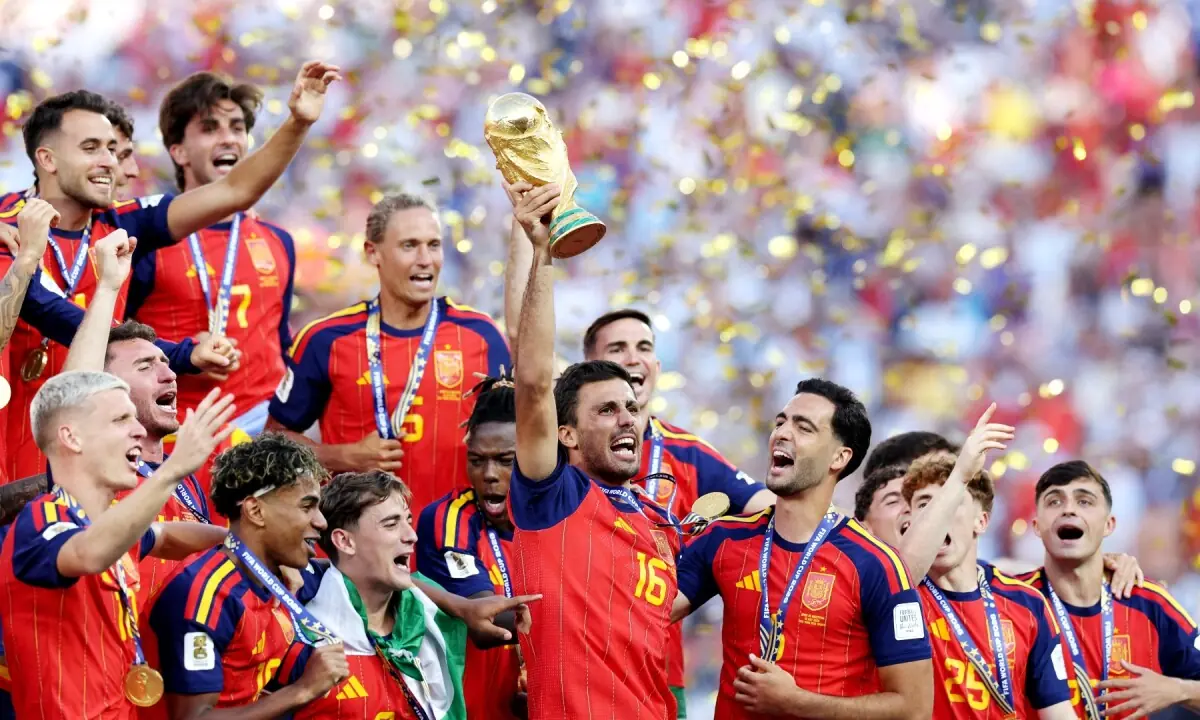
Spain did not merely outplay the defending champions; they controlled the game so completely that Argentina were reduced to chasing shadows.
The scoreline said Spain had beaten Argentina 1-0 after extra time. The match said something far more emphatic.
For much of the World Cup final in New Jersey, Spain did not merely outplay the defending champions. They controlled the game so completely that Argentina, despite the presence of Lionel Messi in what was expected to be his final World Cup match, were reduced to chasing shadows.
The victory gave Spain their second World Cup title, but it was the manner of the triumph that made it particularly significant. Against a team that had built its tournament on resilience, late comebacks and the individual brilliance of Messi, Spain offered something altogether different: control without panic, possession without sterility and pressure without recklessness.

Luis de la Fuente’s team represented a modern evolution of the Spanish footballing ideal. This was not possession for possession’s sake. Spain circulated the ball with purpose, pressed aggressively when they lost it and constantly moved Argentina’s defensive structure from side to side.

The result was a familiar but increasingly devastating Spanish pattern. Argentina were pulled towards the ball, only for Spain to move it elsewhere. Their opponents were made to run, then run some more. It was the same passing carousel that had left France dizzy in the semi-final, and Argentina never truly found a way off it.
Spain’s control began in midfield, where Rodri provided the authority and composure while Pedri and Fabián Ruiz gave the team movement, imagination and technical superiority. Argentina’s midfield, led by Enzo Fernández, was unable to impose itself on the match. By the later stages, the frustration had become visible, with Fernández eventually sent off after receiving a second yellow card.

The imbalance was reflected in the numbers. Spain enjoyed the overwhelming share of possession, created significantly more opportunities and largely prevented Argentina from producing the kind of transitions on which their attack had thrived throughout the tournament. Messi and Lautaro Martínez were repeatedly isolated, while Spain’s defensive line dealt with the occasional threat that did emerge.
Argentina had fought their way through difficult moments throughout the competition. They had survived, recovered and found ways to win. But Spain presented a different kind of challenge. There was little to recover from because Spain rarely allowed Argentina to establish any rhythm in the first place.
Even the injuries that weakened Argentina’s defensive stability early in the match could not fully explain their struggles. Spain had simply established a level of control that made Argentina look increasingly reactive. The defending champions were not beaten by one moment of brilliance. They were gradually suffocated by a team that was better organised, technically superior and more comfortable with the demands of the occasion.
The decisive moment finally arrived in the 106th minute. Ferran Torres, introduced from the bench, finished the move that Spain had spent so long threatening to create. It was Spain’s first goal in a World Cup final since Andrés Iniesta’s winner in 2010 and, given the balance of the match, a deserved reward for their sustained dominance.
Argentina tried to respond. Even with 10 men, they pushed forward in the closing stages, but their efforts produced little beyond half-chances. The magic that had carried Messi and Argentina to the title in 2022 never arrived.
Messi, appearing in a record third World Cup final and playing in what was expected to be his farewell tournament, was unable to change the course of the match. There was no late intervention, no moment that could tilt the contest back towards Argentina. This time, the collective was simply too strong for the individual.
Spain had been building towards this moment for years. Their triumph is a continuation of the philosophy that once made them the dominant force in international football, but it is also something new. The old Spanish team was built around the extraordinary midfield of Xavi and Andrés Iniesta. This one possesses a different energy, driven by a younger generation led by players such as Lamine Yamal and supported by a squad capable of combining technical excellence with physical intensity.
The victory also represents a changing of the guard. Messi’s World Cup story appears to have reached its final chapter, while Spain’s next one has only just begun.
Argentina arrived as champions and left beaten. Spain arrived as one of the tournament favourites and left as the team that had made the strongest case of all.
They did not need a classic final. They did not need chaos, drama or a succession of improbable comebacks. Spain won through control.
And by the time Ferran Torres struck in extra time, the final had already felt decided.


