



Pakistan has not made any spot LNG purchases after reducing its dependence on imported fossil fuels to 25% from 32%
A vessel at the Strait of Hormuz, off the coast of Oman’s Musandam province. PHOTO: REUTERS
As the second energy shock in four years roils global markets, the contrasting experiences of Pakistan and Bangladesh underscore the costs to emerging market countries from relying on fuel imports and the case for cleaner power sources.
After South Asian countries were rocked by widespread electricity outages and inflation in 2022 due to soaring liquefied natural gas prices following Russia’s invasion of Ukraine, a consumer-led solar revolution swept Pakistan, while Bangladesh signed long-term LNG deals to fuel its power plants.

The fallout from the war with Iran that began with US and Israeli airstrikes on February 28 has highlighted the consequences of these divergent paths.

Iran blocked the Strait of Hormuz in response, cutting off contracted long-term LNG supplies and prompting Bangladesh to buy 11 cargoes from the spot market for delivery from March to May.
Also Read: US-sanctioned supertankers enter Gulf despite blockade

Bangladesh paid an average of $21.35 per million British thermal units (mmBtu) for the cargoes, double the pre-war prices. That cost the country about $880 million, equal to nearly 15% of its average total monthly imports in the first eight months of the fiscal year ending in June.
In contrast, Pakistan has not made any spot LNG purchases after reducing its dependence on imported fossil fuels to 25%, from 32% before the Ukraine war. While power outages because of gas shortages could occur outside daylight hours when solar power is not available, they are expected to be minimal.
“Bangladesh can draw lessons from Pakistan’s success to insulate itself from fuel price volatility,” said Shafiqul Alam, analyst at the US-based energy think-tank Institute for Energy Economics and Financial Analysis.
Pakistan has become less dependent on imported fossil fuels
With rising air-conditioning use set to push power demand higher, Bangladesh will buy three more LNG cargoes for delivery in May. Dhaka has already sought $2 billion in external financing for fuel imports and trimmed public spending.
As its renewable capacity has largely remained stagnant since the Ukraine war, the country now gets 60% of its annual power from imported gas, coal and expensive coal-fired power from neighbouring India, compared with 42% in 2021.
Bangladesh’s reliance on imported fuel is increasing as its renewable additions have remained stagnant
Moment of reckoning for import-dependent economies
Bangladesh’s predicament is not unique. In Southeast Asia, fossil fuel subsidies to shield consumers from rising prices shot up to a record $105 billion in 2022, 60% above the previous peak, according to an International Energy Agency report on the region released in October 2024.
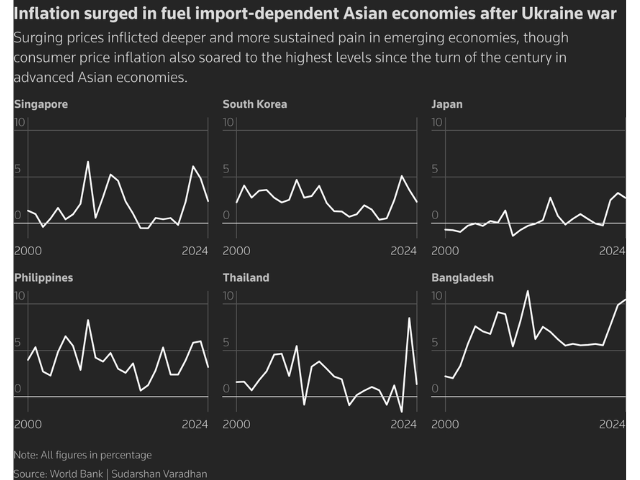
Across Asia’s energy-import-dependent economies, inflation rose to decadal highs after the Ukraine war, with emerging economies Thailand and the Philippines hit especially hard.
Surging prices inflicted deeper and more sustained pain in emerging economies.
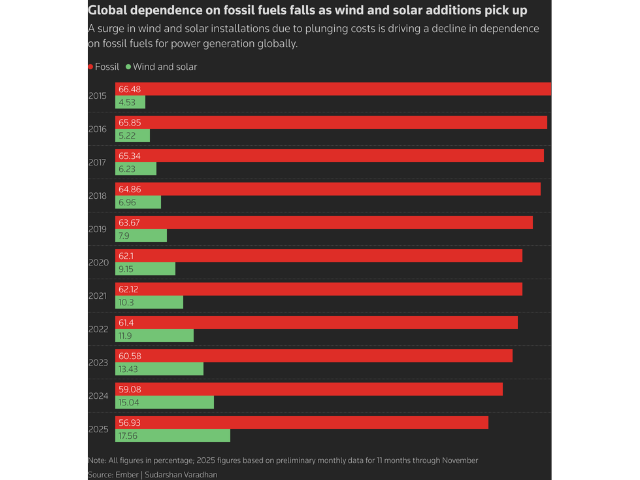
But unlike in Bangladesh, renewable additions across the world are surging. That resulted in global fossil-fuel-fired power output falling last month despite war-linked fuel supply disruptions and a rise in power demand, according to the Centre for Research on Energy and Clean Air (CREA).
Also Read: Israel, Lebanon to speak after ’34 years’, says Trump
A surge in wind and solar installations due to plunging costs is driving a decline in dependence on fossil fuel-fired power generation globally
Pakistan’s solar boom helped it slash $12 billion in oil and gas imports during the four years to February 2026, according to CREA and the Pakistan-based consultancy Renewables First, with cheap solar power now driving a shift from petrol to electric motorbikes.
Three in four people globally live in net fossil-fuel-importing nations, and a faster shift to clean power would also cut exposure to price shocks. In fossil-fuel-hungry Southeast Asia, swapping planned gas capacity for solar would slash generation costs by 60%, analysts from energy researchers Ember said in a report last month.
“To make such recurring global emergencies a thing of the past, it’s essential to use this moment to accelerate the global energy transition,” said Lauri Myllyvirta, lead analyst at CREA.
