



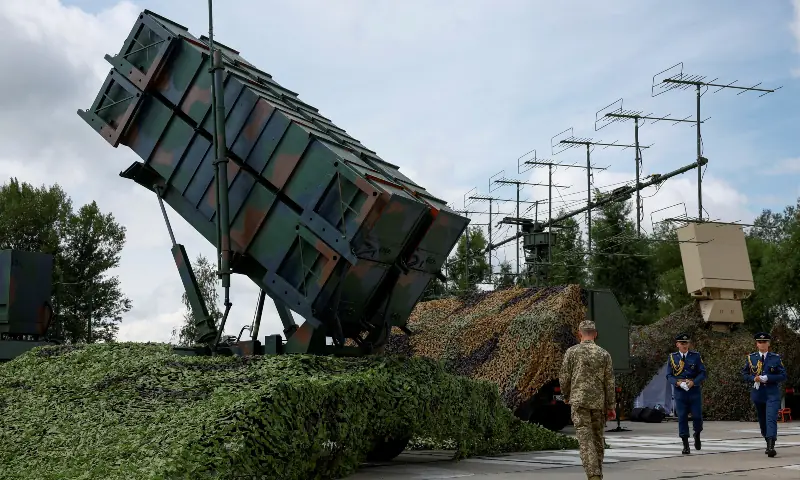
A pledge by President Donald Trump to allow Kyiv to produce US Patriot air defence missiles is a victory for Ukrainian President Volodymyr Zelensky but it could take at least a year to start producing them, defence experts say.
With its chronic shortage of interceptor missiles likely to continue until then, Kyiv faces tough choices over which targets are a priority to defend as Russia keeps pounding its cities and energy infrastructure.
Trump’s promise on Wednesday, when he met Zelensky during a Nato summit in Ankara, was a significant gesture of support that marked a huge improvement in their relationship since they clashed at the White House in February 2025.
Patriot interceptor missiles are vital for Ukraine’s defence at a time when Zelensky says Russia, whose battlefield advances have stalled, is trying to leverage its advantage in ballistic missiles by hitting Ukraine hard.

The Patriot is the only weapon in Kyiv’s arsenal capable of stopping Russian ballistic missiles. Ukraine has brought down only four of the 54 much-faster ballistic missiles launched by Russia this month.

But Trump’s pledge was vague. He acknowledged he had not spoken first to the companies that manufacture Patriot interceptors — Lockheed Martin and Raytheon.
Experts say the time needed to build an assembly plant and organise contractors means production of Patriot PAC-2 interceptors made by Raytheon, or the more sophisticated PAC-3 from Lockheed, will not start soon enough to ease Ukraine’s situation in the near future.

“Short term, the impact will be very limited,” said Fabian Hoffmann, a missile expert at the Norwegian Institute for Defence Studies in Oslo. “I would be very surprised if this is faster than 12 months. I would assume significantly longer.”
By way of comparison, Raytheon reached an agreement with European weapons manufacturer MBDA in 2024 to produce GEM-T interceptors for the PAC-2 system in Germany and the first deliveries are not expected before early 2027. Conversations for PAC-3 production in Germany have so far not borne fruit.
A Lockheed Martin spokesperson said the company was focused on supporting the US government and its allies, and said further comments on the proposal should be addressed to the White House. Raytheon did not respond immediately to a request for comment.
Production outside Ukraine?
Ukraine has managed to fast-track military development in the war since Russia’s 2022 invasion, but defence experts say building a system to down missiles travelling at several times the speed of sound is the toughest challenge in missile technology.
Serhii Beskrestnov, an advisor to Ukraine’s defence ministry, said on Telegram there was uncertainty over how long it would take subcontractors to scale production of scarce components.
One country that might be able to help Kyiv accelerate the process is Germany, which has developed a domestic production chain for PAC-2 interceptors.
Two sources familiar with the discussions said the new interceptors were likely to be manufactured in Germany or another European country, where it is safer, and production could be shifted to Ukraine when the war ends.
Zelensky said on Thursday technical teams would hammer out the details as quickly as possible but that he wanted production to start “in Ukraine as soon as possible”. He said a shipment of PAC-3 interceptors from the US was expected in “coming days”.
He has also asked other allies to provide missiles from their own stockpiles and under a Nato-coordinated financial arrangement providing for European allies and Canada to transfer funds to the US to procure US-made weapons for Ukraine.
Patriot missiles are not being produced in sufficient quantities to cope with Russia’s ballistic threat, as Russia is producing at least 700-800 Iskander ground-launched and Kinzhal hypersonic air-launched ballistic missiles a year, experts say.
Working on the principle that three Patriots are needed per ballistic missile to ensure an interception, they estimate some 2,400 interceptors would be needed per year if Russia’s output remains stable.
“Even with a licensed production facility in Ukraine, reaching that number will be very, very difficult, if not impossible,” Hoffmann said.
Lockheed delivered just over 600 PAC-3s last year and is aiming to scale its production to around 2,000 by 2030. A Ukrainian plant might produce 200 to 300 interceptors a year, Hoffmann said.
Plan B needed?
Zelensky has said Ukraine needs a Plan B.
“The only right option is an alternative to the PAC-3,” Zelensky said on Wednesday. He hopes European allies involved in a nascent missile defence project called Freya, being led by Ukrainian company Fire Point, will soon meet in France.
Fire Point is asking European companies to provide radar, data uplink and seeker solutions to bolt on to its existing missile technology, and hopes to have a cheaper alternative to the Patriot ready before year-end.
“Fire Point’s Freya project is a long shot but if it works, the reward is enormous,” said Jack Watling of the Royal United Services Institute think tank in London.
Watling said there were other European options that should be feasible, such as the SAMP/T NG system developed by Eurosam — a joint venture of MBDA and France’s Thales — which he said would just need some technical adjustment and calibration of its radar.
Zelensky said on Thursday he hoped Ukraine would receive these systems from France soon.
Kyiv has previously floated the possibility of a truce on long-range attacks but Moscow rejected this. Zelensky has also sought to bring Russia to the negotiating table by attacking its energy infrastructure, sometimes deep in Russia.
Kyiv’s choices look stark as Russia bombards Ukraine.
“You can only defend a very small number of the targets that you would like to defend, so you need to figure out which ones those are,” Hoffmann said.
Ukraine aims to increase the protection of energy, manufacturing and military infrastructure by placing them in protective concrete structures or underground, but Hoffmann said its best option may be to go more heavily on the attack.
