


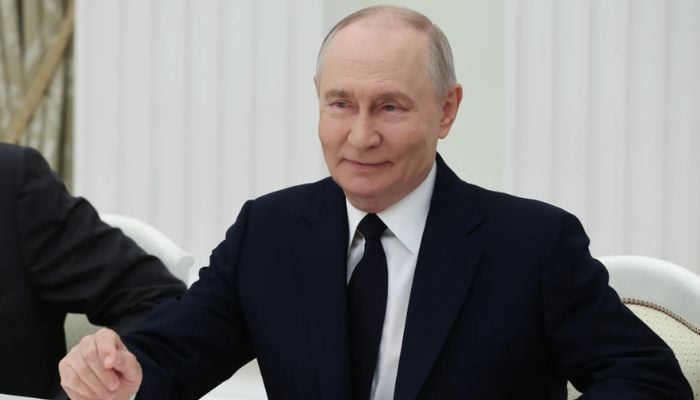
Russian President Vladimir Putin has signed a decree allowing the state to temporarily take over the critical infrastructure in the midst of growing threats of deep-range strikes from Ukraine
According to the newly issued decree, the decision is likely to be taken if private owners fail to protect from Ukrainian drone attacks or rebuild it after the damage.
The measure applies to energy, industrial, fuel and communications, logistic facilities and transport. Kremlin spokesman Dmitry Peskov stated that business owners fail to pay enough attention to anti-drone safety.
On the other hand, Deputy PM Denis Manturov mentioned that passing the decree is not equivalent to nationalization, but it is only a temporary move aimed at managing and solving specific security problems.

“This mechanism doesn’t imply widespread use — targeted, carefully considered decisions will be made at the highest level,” Manturov added.

The announcement comes after Britain announced plans to support Kyiv by providing classified information related to UK long-range missiles designed to increase the country’s domestic production and boost the security to counter Russian aggression.
Even the Russian embassy in London accused the UK of supplying drones to Ukraine used to strike Russian oil refineries and logistics with deep and long-range strikes.

Britain’s unwavering support for Ukraine also drew condemnation from Russia as the country warned of escalation in conflict.
On Tuesday, Andrei Fedorov warned that there might be a “semi-military” response against UK drone factories by “unknown sources” over sharing of military blueprints with Ukraine.
When asked about the nature of the semi-military response, the advisor said, “it could take the form of something that might happen with enterprises, with factories which are producing drones for Ukraine.”
“They could be attacked not by Russia, but by unknown sources,” he said.
Analysts also suggested that Russia is reeling from a severe economic crisis. Persistent, accurate Ukrainian long-range drone strikes have targeted vital oil facilities, causing fuel shortages, halting operations at refineries, and forcing Russia to raise taxes and increase domestic borrowing.
