


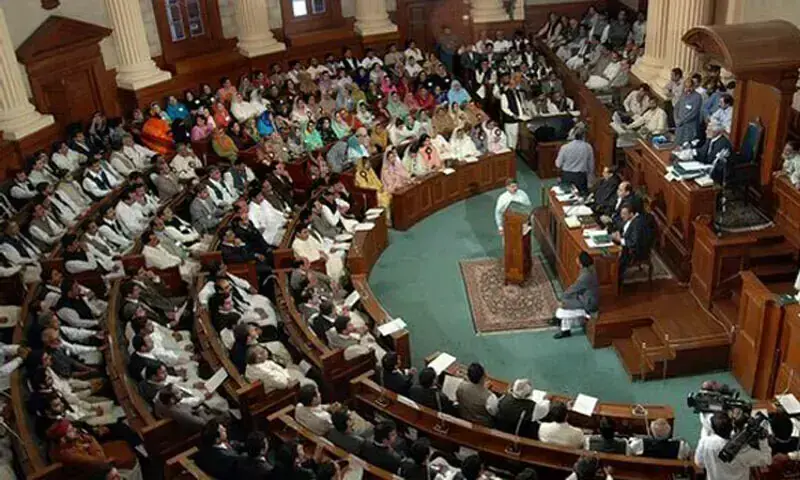
LAHORE: A high-level committee of the Punjab Assembly has declared that a controversial colonial-era law effectively criminalises poverty and must be abolished, it emerged on Monday.
The Committee on Law Reforms and Delegated Legislation met on Monday at the Punjab Assembly under the chairmanship of Speaker Malik Muhammad Ahmad Khan, taking up critical issues ranging from outdated criminal laws to police accountability.
A major highlight of the sitting was the review of Section 55(1)(b) of the Code of Criminal Procedure, 1898, which allows police to arrest individuals without warrant if they have “no ostensible means of subsistence.”
The committee described the provision as an outdated colonial relic that criminalised poverty instead of criminal conduct, and conflicted with fundamental constitutional rights.

A detailed reform proposal recommends complete omission of this clause, along with related provisions, to prevent misuse.

The proposed reforms also suggest tightening another clause, Section 55(1)(c), that empowers a station house officer to arrest a suspect.
The committee proposed replacing vague standards for arrests, such as the “repute” of a suspect, with objective criteria, such as prior convictions within five years and reasonable grounds of intent to commit a crime.

The committee noted that the existing law violated multiple constitutional protections, including the right to liberty, dignity, equality, and freedom of movement. Past court rulings also termed such arrests as abuses of authority, it noted.
Comparative legal examples were cited, highlighting that similar vagrancy laws had already been abolished or struck down in several jurisdictions worldwide, including neighbouring India.
The committee also expressed concern over delays in framing rules under various laws, noting that many statutes lack clear timelines for implementation. Members stressed the need for binding deadlines to ensure laws were operationalised effectively.
Public safety commission
The meeting also focused on the long-pending establishment of the Public Safety Commission at both provincial and district levels – an oversight body envisioned under the Police Order 2002 but never constituted.
Officials informed the committee that a summary for forming the selection committee had been forwarded, and the commission would be notified soon after its constitution.
The speaker stressed that police, as the primary law enforcement agency interacting with citizens, must be subject to independent oversight and accountability.
He emphasised that creating a citizen- or parliament-centric complaint mechanism was not only a legal requirement but a constitutional obligation, noting that international bodies – including the Human Rights Commission of Pakistan (HRCP), the European Union, and United Nations human rights mechanisms – had repeatedly flagged the absence of such systems in Pakistan.
Addressing earlier disagreements among departments, the committee cited findings of a subcommittee led by MPA Amjad Ali Javed, which – after consultation with the advocate general’s office – concluded that no legal barrier existed to establishing the Public Safety Commission under the existing law.
The speaker underscored that the absence of local government representatives could not be used as a reason to delay this critical reform.
Review of assembly procedure reforms
The committee also reviewed recent amendments to the Punjab Assembly’s Rules of Procedure, including 77 changes made in September 2024 and seven more in November.
Key reforms include: allowing speeches in any language; preventing rejection of private members’ bills on technical grounds; removing the five-hour limit on assembly sittings; introducing post-budget discussions as a formal rule.
The speaker directed the Finance Department to make post-budget reports more comprehensive and called for better implementation and awareness of these procedural reforms across institutions.
Home Department Secretary Dr Ahmad Javed Qazi acknowledged delays in progress and assured the committee of weekly updates going forward.