



Earlier this month, Justice Yahya Afridi, the last person who will hold the title of Chief Justice of Pakistan, handed down a judgment declaring that the Supreme Court and the Federal Constitutional Court (FCC) are coordinate apex courts, neither subordinate to the other. The judgment did not arrive in a vacuum. It answers a sequence of recent rulings from the new Federal Constitutional Court asserting, with mounting confidence, that it now sits at the top of the judicial pyramid.
To follow the dispute, one must begin with what the 27th Constitutional Amendment changed late last year.
Until then, Pakistan had one apex court. Whether the case concerned a presidential reference or a dispute over water among the provinces and the Federation, a missing person or a tenant who would not vacate, the final adjudicating authority before God was the Supreme Court. The Constitution and the structure of the judiciary together pointed every road upward to one place. The 27th Amendment created a brand-new court, the Federal Constitutional Court, which we will call the FCC. It split the apex in two and left an unresolved question between them.
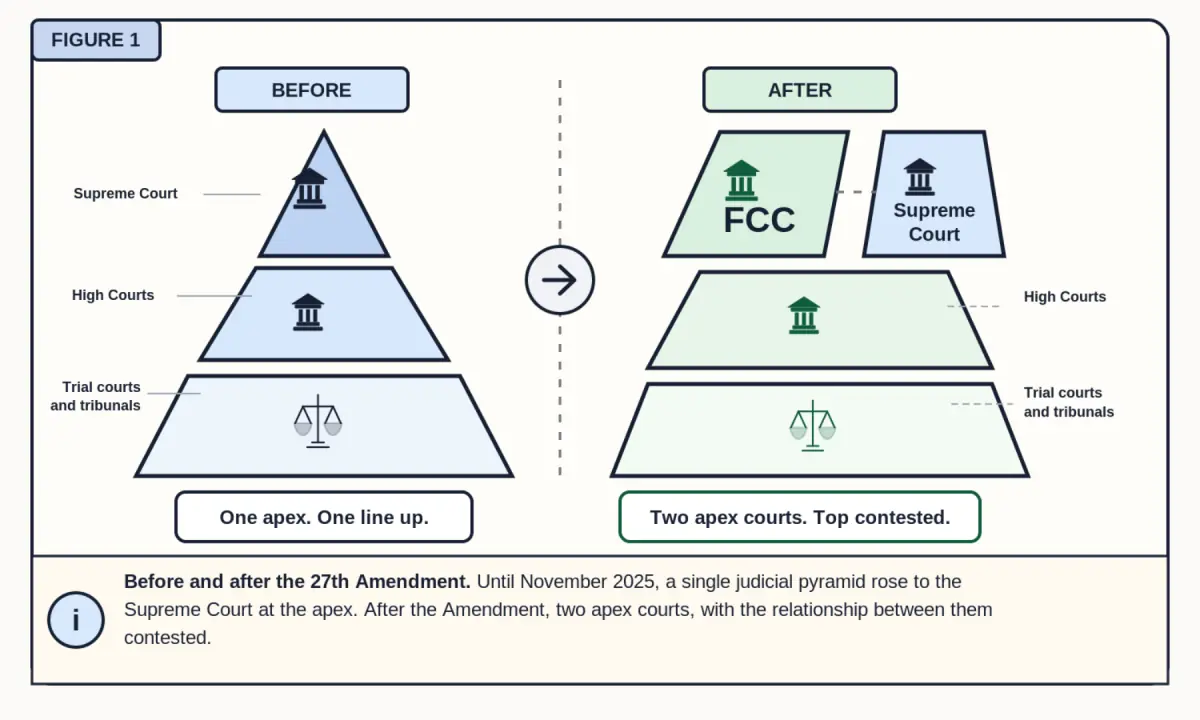
The official rationale offered for this reorganisation was that the Supreme Court had grown too consumed by political and constitutional matters, neglecting its ordinary work. A specialised constitutional court would absorb the political and constitutional cases. The Supreme Court, freed of that burden, would return to civil and criminal appeals and clear its backlog. The rationale, however, and the design diverge.

The one who holds the final word
Two terms help here. A court has original jurisdiction when the case begins there: a writ petition filed in a high court, a dispute between governments heard directly by the FCC. It has appellate jurisdiction when it hears appeals against decisions of courts below.

The Supreme Court’s appellate work was of two distinct kinds. The first was ordinary appeals worked up from the trial courts through the high courts. The second was appeals from the writ orders of those very high courts, which were constitutional cases dressed as appeals. The first was the court’s traditional bread and butter; the second was the substance, if not always the form, of its constitutional jurisdiction.
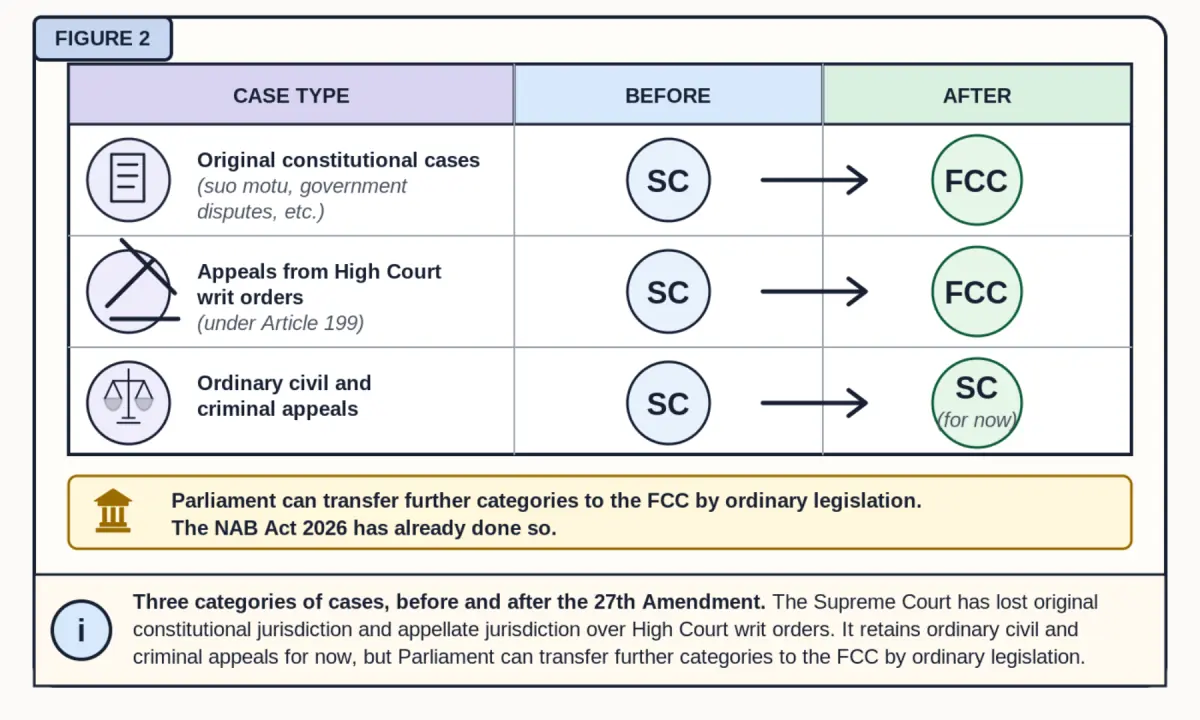
Notice the third row. The first two categories of work have moved to the FCC outright. The third remains with the Supreme Court for now. That qualifier matters. Article 175 empowers Parliament to confer on the FCC appellate jurisdiction through an Act of Parliament, by simple majority. In plain words, ordinary appellate jurisdiction can be moved from the Supreme Court to the FCC by ordinary legislation, one slice at a time. The rationale promised the Supreme Court its civil and criminal work, exclusively. The text guarantees no such bargain.

This is not a theoretical worry. Recently, the Parliament passed the NAB (Amendment) Act, 2026. A new Section 32A routes the second appeal in NAB cases from the high court directly to the FCC. This Appeal was with the SC before the Amendment. The Supreme Court has been written out of NAB altogether. The political utility of that route is hard to ignore in the present hybrid plus regime.
Criminal appeals involving the leadership of the PTI, including party founder Imran Khan, can now reach a court whose first chief justice and first batch of judges were appointed by the president on the prime minister’s advice. The same logic could be applied tomorrow to election appeals, anti-terrorism appeals and accountability appeals of every flavour. In theory, the Supreme Court could be reduced to rent disputes and family matters. It no longer controls its own jurisdiction.
The deeper source of the FCC’s supremacy, however, lies in a single sentence of Article 189. The law provides: “Any decision of the Federal Constitutional Court shall, to the extent that it decides a question of law or is based upon or enunciates a principle of law, be binding on all other courts in Pakistan, including the Supreme Court.”
The reach of this language is enormous. It is not confined to constitutional questions. It binds the Supreme Court to the FCC’s interpretation of any question of law, including the most ordinary statute. Whoever holds the final word on interpretation holds the law itself.
There is more
The FCC’s appellate jurisdiction extends to any case from the high courts involving “a substantial question of law as to the interpretation of the Constitution.” That sounds like a high bar. In our peculiar legal tradition, where ordinary and constitutional law are interwoven beyond easy separation, it is a low one. In the hands of a competent lawyer, almost any case can be made to raise a constitutional question, and the FCC sets the threshold itself. Our high courts have long demonstrated, through writ jurisdiction, that a court without formal appellate authority can still exercise a thorough de facto supervision over the courts below.
The architectural mismatch deepens the concern. Germany, Italy, France and the other countries usually invoked in defence of separate constitutional courts are civil law jurisdictions. Their ordinary and constitutional law sit in different boxes by design. Ours do not. The common law system we inherited from the British and share with India has, for nearly a century, made the two strands inseparable. India, faced with periodic proposals to create a separate constitutional court, has consistently declined. The 27th Amendment grafts a civil law architecture onto a common law trunk; the boundary disputes we are now watching are precisely what such a graft was always likely to produce.
The numbers tell the rest. On November 13, 2025, the Supreme Court had 56,608 cases pending. By December 24, 22,910 had been transferred to the FCC, almost 40 per cent of its docket gone in five weeks.
Most of that volume flowed through petitions for leave to appeal under Article 185(3), a stream that included a large body of writ petition appeals, in substance, the Supreme Court’s constitutional work. The most visible loss is original constitutional jurisdiction in matters of public interest involving fundamental rights. Suo motu notices were taken under this jurisdiction. Some 243 such cases were initiated between 2005 and 2021, modest in number but immense in influence. Original constitutional jurisdiction and Suo motu placed petrol prices and missing persons under judicial scrutiny and sent two prime ministers home. That power, too, has migrated.
Precedent shaped our law because it gave it certainty and predictability, the two oldest virtues of any legal order. The line of judgments running from the Privy Council through the Federal Court of Pakistan and into the Supreme Court could be modified only by a larger bench than the one that laid it down. A full court judgment of all 17 (now 34) sanctioned Supreme Court judges was, for practical purposes, inviolable. The FCC inherits none of this discipline. It begins with no precedent of its own. Under Article 189, it is not bound by the Supreme Court’s. A bench of two FCC judges can, in principle, overturn a full court judgment of 34, or an 80-year-old line of authority that has long sustained property rights, criminal procedure, or fundamental freedoms.
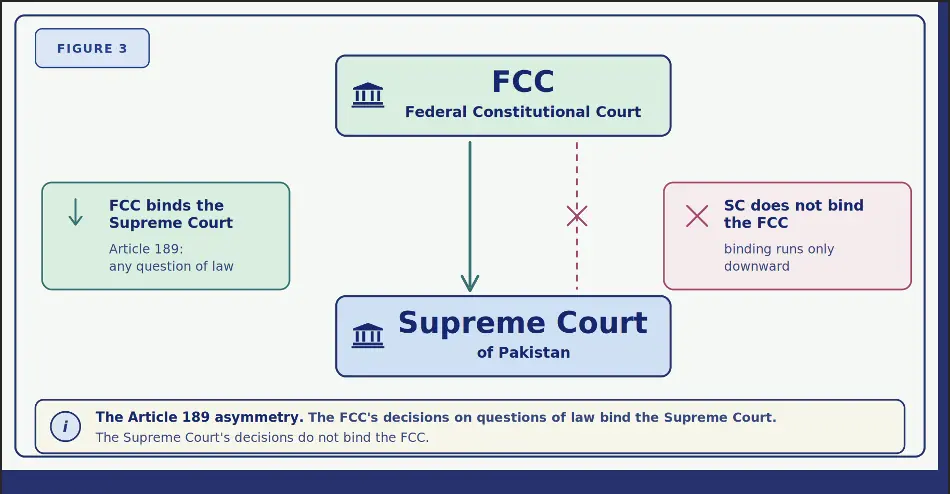
Against all of this, the Supreme Court’s recent answer is to claim coordinate status. The argument was authored personally by Chief Justice Afridi. As a reading of Article 189, it is strained; the text speaks of hierarchy on its face, and the legislature is now legislating as though the hierarchy were settled. As a position, it is also belated. At the time of the 26th and 27th, three of the chief justice’s brother judges asked him to convene a full court. He did not. Two of them resigned the day the 27th Amendment became law. He did not. He chose Chief Justiceship at the time of the 26th Amendment, and later, a transitional clause kept the title of Chief Justice of Pakistan and the chairmanship of the Judicial Commission with him for the rest of his term. The argument his judgment now makes is the argument his Court could have made, with far greater force, in November 2025.
A kingdom cannot have two kings. A legal order cannot have two supreme courts. The Supreme Court of Pakistan today is supreme in name. The court whose interpretation of law binds everyone, including the Supreme Court itself, is the Federal Constitutional Court. Its correct title should be the Supreme Federal Constitutional Court of Pakistan.
