



• Condemns attacks by non-state actors against kingdom
• Stresses Islamabad will honour defence commitments with Gulf partners
• Insists defence agreements don’t undermine Pakistan’s role as mediator
• India to be invited to SCO summit in Pakistan next year
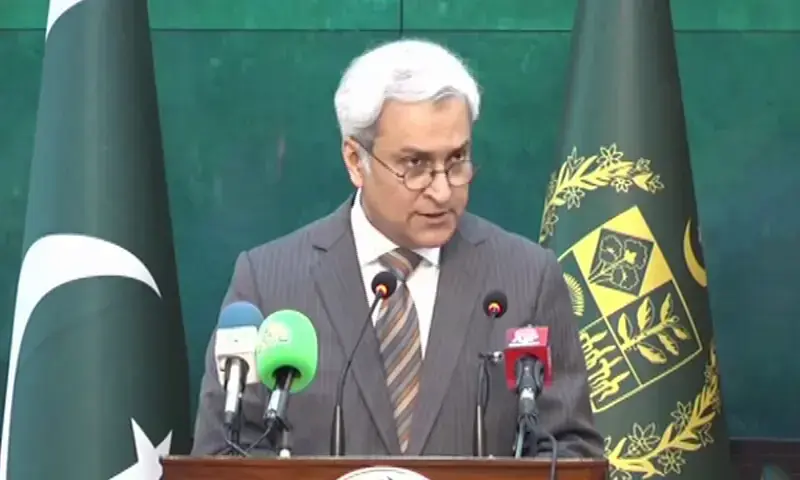
ISLAMABAD: Pakistan on Thursday endorsed Saudi Arabia’s air strikes in Iraq as an exercise of its right to self-defence, while reaffirming that it would honour all defence commitments undertaken with its Gulf partners. The country also insisted that those arrangements did not diminish Islamabad’s role as a mediator in the Iran-US conflict.
“The Kingdom of Saudi Arabia has the right to self-defence under Article 51 of the UN Charter, and we respect that right,” Foreign Office spokesperson Tahir Andrabi said at the weekly media briefing.
The remarks came two days after Saudi Arabia and the United States carried out coordinated strikes against installations of Iraq’s Popular Mobilisation Units, accusing elements within the umbrella force of launching attacks on Saudi oil facilities.

Referring to the regional situation, Mr Andrabi said: “The developments in the Gulf, the Strait of Hormuz and Red Sea are worrying. The attacks, particularly by non-state actors against Saudi Arabia, are utterly condemnable.”

The latest remarks build on Pakistan’s warning issued last week after Yemen’s Houthi rebels announced a maritime blockade targeting shipping linked to Saudi Arabia.
Islamabad had then described attacks on Pakistani maritime interests as a “red line”, warning that any hostile action against Pakistani-flagged vessels or commercial shipping would be treated as an attack on Pakistan. The country also simultaneously reaffirmed its commitment to Saudi Arabia’s security and the uninterrupted flow of lawful maritime commerce through the Red Sea and Bab al-Mandeb.

Last year, Islamabad and Riyadh concluded a Strategic Mutual Defence Agreement, which became operational earlier this year as Pakistan simultaneously embarked on a diplomatic effort to mediate between Iran and the United States.
More recently, Kuwait ratified a separate Defence Cooperation Agreement signed in 2023, while Islamabad also maintains defence cooperation arrangements with Bahrain and Jordan.
Asked whether the agreement with Kuwait carried obligations similar to the Strategic Mutual Defence Agreement with Saudi Arabia, Mr Andrabi replied: “Obviously, it is not similar in a sense that one is called the strategic mutual defence, and the other defence cooperation agreement. So, the name is self-explanatory.” He also hinted that Pakistan’s defence ties with Bahrain and Jordan could evolve further.
“As regards Jordan and Bahrain, we have robust defence cooperation with these countries. If tomorrow there is a need to formalise it in a new agreement of defence cooperation, you will be informed about it in due course,” he said.
Reaffirming Islamabad’s commitment to its regional security partnerships, Mr Andrabi said: “We will implement all our defence cooperation agreements, not just with Saudi Arabia, but with all our Gulf partners. We will fulfil all our obligations.”
He, however, drew an important distinction regarding the scope of those arrangements. “The substance of this agreement is geared towards peacetime cooperation. When war takes place, obviously the two sides see how far these agreements are to be implemented,” he said.
Despite Pakistan’s growing network of defence agreements in the Gulf, Mr Andrabi maintained that they did not conflict with Islamabad’s continuing diplomatic engagement aimed at reducing tensions between Washington and Tehran.
“Amid the prevailing tensions and hostilities, Pakistan reiterates that dialogue and diplomacy remain the only viable path forward,” he said. He said Pakistan remained actively engaged with regional and international stakeholders and continued to encourage both sides to return to the framework established under the Islamabad MoU.
“Pakistan is engaged and will continue to play its role. The negotiations are ongoing to normalise the situation in the Strait of Hormuz and de-escalate. We are doing our utmost to bring both parties back to Islamabad MoU so that all irritants can be removed in the light of its spirit. We are hopeful for de-escalation and peaceful settlement of the issue,” he said.
He added that Pakistan continued to urge both sides “to exercise maximum restraint and fully adhere to their commitments to resume technical-level talks for the implementation of the Islamabad MoU, in line with the Pakistan-Qatar Joint Statement of 21 June 2026”.
Rejecting suggestions that Pakistan’s defence commitments could undermine its credibility as a mediator, Mr Andrabi said: “Our role as mediator is not compromised by the fact that we have defence agreement. The defence agreement in no way cuts down our role as mediator. The two operate in their own streams. I think you should have enough confidence in Pakistani institutions to take into account all these nuances.”
India to be invited to SCO summit
The FO also said India would be invited to the SCO Heads of State Summit, which Pakistan will host next year, describing the invitation as an obligation of the host country under the bloc’s established procedures.
“As regards the SCO Summit, yes, all member states of the Shanghai Cooperation Organisation will be invited at the level of the heads of state or government,” Mr Andrabi said while responding to a question about inviting Indian Prime Minister Narendra Modi to the event.
“This is an obligation on the part of Pakistan as the host. We will invite all heads of state and government to the summit meeting,” he added, noting that invitations would be issued in accordance with SCO procedures.
Pakistan will assume the rotating chairmanship of the SCO Council of Heads of State after this year’s summit in Bishkek, Kyrgyzstan.
Islamabad previously hosted the SCO Council of Heads of Government meeting in October 2024. Mr Modi was invited to that event but did not attend and was instead represented by External Affairs Minister S. Jaishankar.
Separately, Mr Andrabi confirmed that Pakistan and India had recently exchanged assignment visas for diplomatic personnel posted to their respective high commissions, but he downplayed any suggestion that the move reflected an improvement in bilateral relations. “This was an administrative arrangement to facilitate the routine posting and transfer of officers from capitals to the high commissions,” he said.
The reciprocal issuance of visas enables a new batch of diplomatic officials to assume assignments at the two missions, which have been operating with sharply reduced staff since the military confrontation between the two countries in May 2025.
Both high commissions continue to function under chargés d’affaires following the downgrading of diplomatic ties.
Published in Dawn, July 31st, 2026


