


Troops will discharge their assigned responsibilities under established framework of defence cooperation
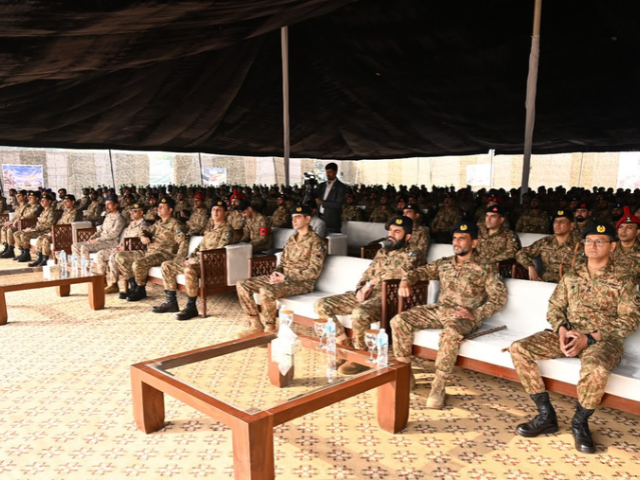
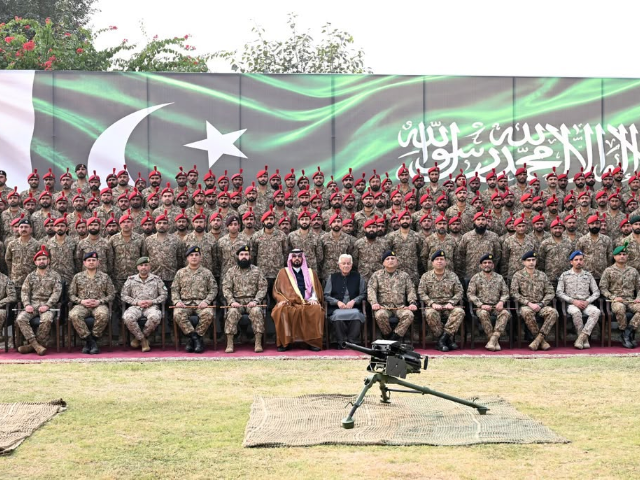
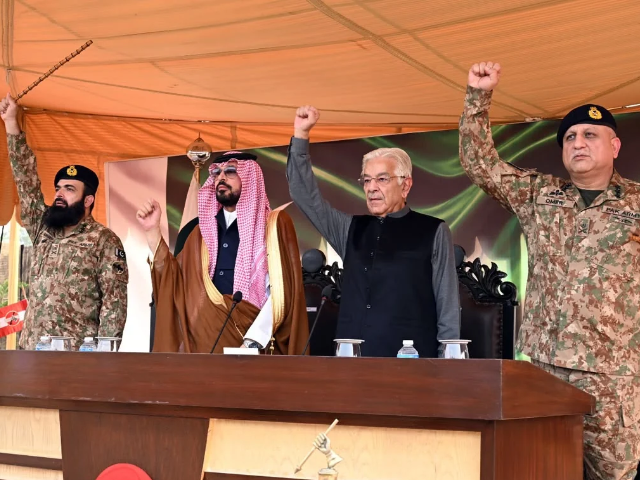
Defence Minister Khawaja Asif attends a send-off ceremony for Pakistan Army troops departing for Saudi Arabia. PHOTO: ISPR
A contingent of Pakistan Army troops departed for Saudi Arabia after a send-off ceremony attended by Defence Minister Khawaja Asif on Saturday, reflecting Islamabad’s commitment to safeguarding the kingdom’s “security, sovereignty, and territorial integrity,” the military’s media wing said on Sunday.
The development comes after foreign and defence officials from Pakistan, Saudi Arabia and Türkiye met in Islamabad on November 27 under the Makkah defence pact to discuss regional security, including Houthi attacks on Saudi Arabia. The three sides reaffirmed their collective resolve to continue and intensify efforts to support the kingdom in safeguarding its security, sovereignty and territorial integrity in accordance with the collective defence provisions of the Makkah Agreement for Joint Defence (MJDA).

According to the Inter-Services Public Relations (ISPR), the deployment reflected Pakistan’s “unwavering commitment to the security, sovereignty and territorial integrity of the Kingdom of Saudi Arabia, rooted in the longstanding strategic partnership and fraternal bonds between the two brotherly countries”.

“Pakistan remains steadfast in its commitment to safeguarding the Kingdom’s security and the sanctity of Haramain Sharifain,” the ISPR said.

It added that the troops would “discharge their assigned responsibilities within Saudi territory, under agreed commitments and the established framework of defence cooperation”.
The ceremony was held in Rawalpindi a day ago and was attended by Saudi Ambassador to Pakistan Dr Rajeh Tami Albugamy, Chief of General Staff Lieutenant General Omer Ahmed Bokhari and Commander Lahore Corps Lieutenant General Muhammad Umer Bashir.
The statement said the deployment would “contribute towards further strengthening the Kingdom’s defensive capabilities amid emerging security concerns”.
The ceremony also underscored the “enduring bonds of brotherhood, mutual trust and strategic cooperation between Pakistan and Saudi Arabia”, the ISPR said.
It reiterated Pakistan’s “steadfast resolve to stand by the Kingdom in safeguarding its sovereignty and territorial integrity”.
Read: Pakistan, Saudi Arabia and Turkiye condemn Houthi attacks, pledge support for kingdom’s security
Pakistan, Turkiye and Saudi Arabia signed the MJDA at a trilateral summit in Makkah on August 7, pledging to strengthen collective security, deepen defence cooperation and promote peace and stability in the region and beyond. The Turkish parliament on November 5 approved a bill ratifying the Makkah Agreement on Joint Defence between Turkiye, Pakistan and Saudi Arabia, clearing the way for the trilateral security pact to take effect.
Renewed Houthi attacks on Saudi Arabia have drawn repeated condemnation from Pakistan. On November 20, the Foreign Office called a strike on a tower in Riyadh’s King Abdullah Financial District a “grave violation” of Saudi Arabia’s sovereignty, warning that attacks on civilian and economic infrastructure threatened regional peace and security.
The condemnation followed an attempted attack on a Saudi Aramco building in Riyadh on November 9, which Pakistan said showed a “reckless disregard” for human life and regional security.
The Houthis have been firing at Saudi airports and oil infrastructure since Yemen’s frozen civil war was reignited in July amid the US-Iran war. On the ground in Yemen, the group has seized swathes of territory from the Saudi-backed government, forcing it to stage a major retreat at the weekend.
On October 26, Pakistan strongly condemned “reprehensible” Houthi ballistic missile attacks on October 24, which had targeted the Makkah and Madinah regions of Saudi Arabia, including areas in the vicinity of the holy sites.
On October 24, Saudi Arabia’s Civil Defence briefly issued alerts warning of potential danger in Taif and Yanbu, as well as the holy city of Makkah and its second-largest city, Jeddah. A Saudi-led coalition fighting Yemen’s Houthis said it destroyed two ballistic missiles fired by the group towards Taif and Yanbu, as fighting between the sides continued.
Read more: Makkah pact trio to meet in Islamabad
The condemnations came following the September 2025 Strategic Mutual Defence Agreement between Pakistan and Saudi Arabia, which established a framework for joint defence, and the subsequent trilateral Makkah Joint Defence Agreement signed on August 7 involving Turkiye.
According to the Makkah agreement, an armed attack against any one of the three signatory states would be regarded as an attack against all three, establishing a framework for collective deterrence and expanded defence cooperation. The agreement has since been followed by efforts to translate its commitments into closer military coordination.
The Saudi-led coalition said the Houthis had launched 20 attacks on King Khalid International Airport in Riyadh in October, killing 17 people and injuring 333 others. Abha airport in southwestern Saudi Arabia was also targeted amid renewed hostilities.
Yemen’s civil war reignited in July after a UN-brokered truce collapsed, months into a wider Middle East war. Saudi Arabia and the Yemeni government have since claimed hundreds of strikes on Houthi-held territory. The Houthis say the attacks have killed civilians, including women and children. Reuters could not independently verify those claims.
Also read: Pakistan condemns ‘reprehensible’ Houthi attacks in Makkah, Madinah regions
The Saudis entered the Yemen war in 2015 at the head of an Arab coalition to try to force the Houthis out of the Yemeni capital , Sanaa. The war became a bloody stalemate, with hundreds of thousands of Yemenis killed by fighting and famine.
A 2022 ceasefire reached by the Saudis and the Houthis unravelled this summer, culminating in a lightning Houthi advance that took the Red Sea chokepoint of Bab el-Mandeb from Saudi-backed government forces.
