



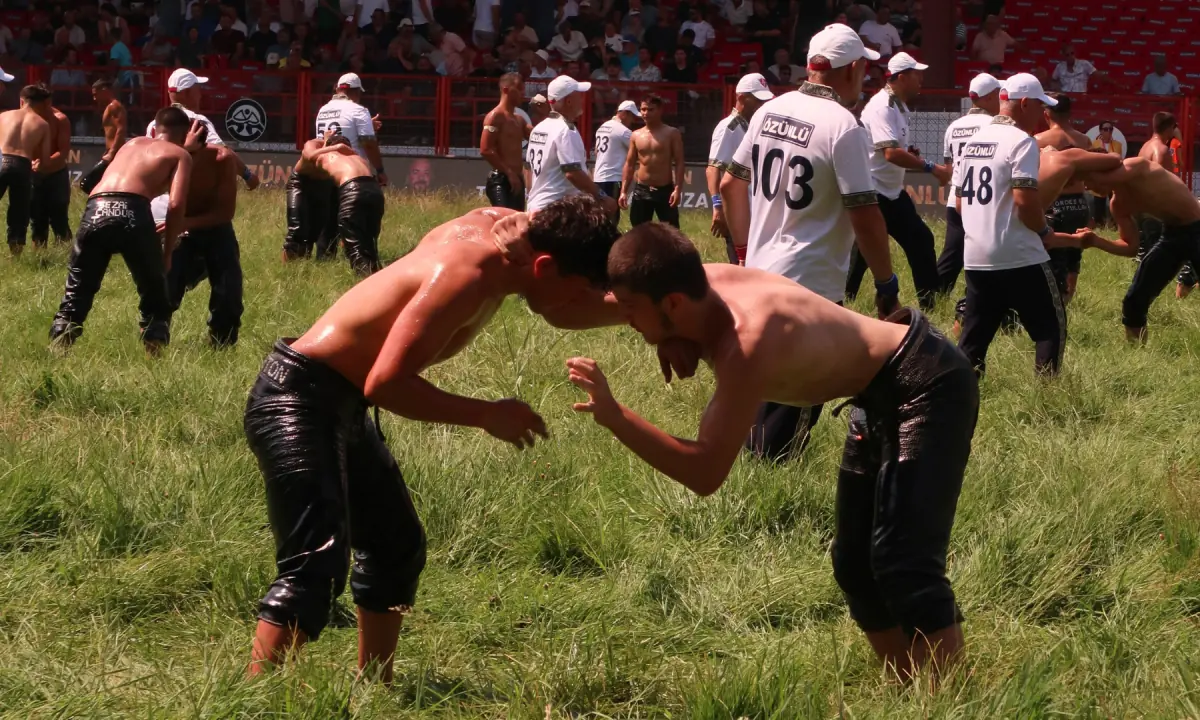
Even before the pehlwans square off in the mud, the air is already wrestling with a mix of bruised earth and olive oil. Men of all age and build, gleaming like magazine models from head to toe, prep for a day under the July sun in Edirne.
For over six centuries, men have gathered in this northwestern Turkish city for Kırkpınar, the yağlı güreş or oil wrestling festival for what is considered the national sport. It has been around for so long that it was ancient by the time the Olympics were revived in 1896.
“People say it’s all tall tales about the history of this festival. But whether you believe it or not, it’s all true,” says 59-year-old Yakup Kaya, as he weaves the taxi through Edirne’s cobbled streets and Ottoman-era lanes towards Sarayiçi Er Meydani, where Kirkpinar comes alive.
Legend has it that in 1361 Suleyman Pasha, the son of the second Ottoman sultan, Orhan I, and his army of forty soldiers, marched through the Eastern Thracian province of Edirne. To kill time, the men were paired off to wrestle. But one of the pairs, said to be brothers, went on fighting for days and even torchlight nights, until both men died of exhaustion. Their fellow warriors buried them under an old fig tree and when troops returned the next season, they found water had sprung at the spot. They named this spot Kırkpınar or Forty Springs.

The Guinness World Records puts it down as one of the oldest running festivals, and Unesco has listed it as an Intangible Cultural Heritage of Humanity. “This 665-year-old cultural heritage doesn’t only hold importance for Türkiye,” says Edirne Mayor Filiz Gencan Akın, “but also for the entire world.“

‘The humble men’
This year, as he has for decades, journalist Gökhan Tuzla has come to cover the festival which has attracted 840 wrestlers this time. The men train for months in punishing routines, wait an entire year, and arrive with the deference of pilgrims.

Before every match begins, the pehlwan walks onto the Er Meydanı and kisses its ground as an acknowledgment that he comes from this earth and will eventually return to it. “Kırkpınar does not produce champions,” says Tuzla. “It produces ‘kibar adamlar’ (humble or refined men, depending on your semantics). You cannot wrestle in oil and leather under the sun in mud for three days straight and leave arrogant. The earth does not allow it.”
Outside the meydanı, camps are full of pehlwans who have travelled from across Turkiye. “They could have stayed in hotels,” the journalist explains. “They choose the ground and open air. They believe this is exactly where they belong.”
Muhammet Ali Karakuş from Antalya is 21 years old and has just competed in his fourth Kirkpinar. His grandfather and father wrestled on the same field. “Güreş (wrestling) has changed me as a person,“ he says. “I have become more patient, closer to nature. It has taught me what strength actually means.”
This year Edirne’s municipality awarded the champion 26-year-old Erkan Taş ₺1,655,000 (approx. $35,000). The winner also receives a king’s ransom from the Kırkpınar Ağası, ‘ağa’ being the title for a man of authority, wealth, or standing. This is an Ottoman tradition of civic patronage in which a wealthy man takes charge to carry the mantle of heritage the community cannot afford to lose.
The Kirkpinar Ağası is the festival’s patron every year. He is neither elected nor appointed but chosen through an auction on the field where the wrestlers compete, as the crowd cheers for higher bids. The Ağası is given his own place in the ceremonial box and everyone in Edirne knows his name that week.
Turkish businessman Ufuk Özünlü has been Kirkpinar’s Ağa for three consecutive years. This year, Özünlü bid ₺46,666,666, just over a million dollars, to secure the ağalık for next year’s 666th Kirkpinar. His third consecutive win in 2026 has earned him permanent ownership of the golden ağalık belt, a title Kırkpınar reserves only for those who commit three years in a row.
“In Ottoman culture, this was the highest thing a wealthy man could do,” explains Tuzla, “not build something with his name on it, but carry something that already had one.” The event is a partnership between the municipality that provides the vision and the infrastructure, and the Ağa who draws the spectacle. Neither works without the other.
The Turkish state employs wrestlers directly in municipalities, governor’s offices, and government departments, not to push paperwork but to train, compete, and pass the tradition to the next generation. “Without state support, without the municipality stepping up, you cannot even buy a wrestler his outfit, let alone feed him,” Tuzla says. “A pehlwan has to eat—milk, honey, eggs, meat. He has to stay in good shape every single day.”
From akharas to graveyards
Of course, any Pakistani will also know the word pehlwan, for the sport arrived in the subcontinent through the Mughal courts. It survived the British who tried to replace it with cricket, and made it to Partition in 1947 with roughly three hundred functioning akharas across the country. That number has, however, dwindled since then.
“It is quite ironic,” says Pakistan’s wrestling team coach, Ghulam Fareed, in Lahore. “Most medals Pakistan won after hockey are in wrestling.” Wrestling remains Pakistan’s most decorated Commonwealth Games discipline with 47 medals, 21 of them gold. At the Olympics, it is hockey that has historically defined Pakistan’s international identity. But at the Commonwealth Games, it has always been the pehlwans.
Kushti, dangal or mud wrestling survives in private akharas, where a pehlwan who draws a crowd can take home anywhere between Rs500,000 to Rs1,000,000 from a single event, depending on his fitness and fame. Lahore was once the beating heart of the subcontinent’s kushti tradition. The pehlwans now train in graveyards whose soft earth is a substitute for the mud of the akharas which are fewer and farther between.
In a country where cricket swallows all the attention, and even the national sport, hockey, gets less air time, the akharas have no illusions about being a priority. Every colony in Multan once had an akhara where women sent their children to develop discipline, health and character. That world has been replaced by mobile phones and gyms.
It is small wonder then that parents who once brought their sons to the mud pit are now nudging them toward the mat, where the internationally recognised Olympic format is fought. “Parents bring their kids but are skeptical about them playing in the mud or in the traditional wrestling attire,” says Fareed.
In Turkiye, Tuzla hasn’t seen new wrestlers in twenty years. “This should be taken seriously,” he says. “The masters are disappearing. Nobody is teaching anymore. Not like before.”
Keeping the doors of his akhara open is a challenge for Muhammad Ali Pakka Pehlwan, who represented Pakistan in India, Turkiye and Dubai and now sees the same future for his son. His 70-year-old academy is training almost thirty men of all ages and backgrounds in Aam Khaas Bagh with the youngest pehlwan just seven years old. Most of them are aiming for the sports quota jobs in the army (since gutted at WAPDA and the Pakistan Railways). Others may go on to fight in private dangals for money.
“Recently the MDA [Multan Development Authority] came to close this place down,“ Pakka says. He sarcastically asked the officers where they thought the pehlwans would practice? On the road? Unfortunately, the akhara is on government land and a Rs20 million plot is not something a pehlwan can afford. The MDA officer eventually backed down and let them stay, but the insecurity has set in.
A few blocks away, another pehlwan, Hamid Khan, remembers the time when kushti still basked in glory. His father, Zamman Khan Pehlwan, was a Sitara-i-Pakistan recipient and, as the Punjab Wrestling Association once put it, perhaps the last living soul truly adept in its art. He had taken the family name abroad, coaching wrestlers in Australia and New Zealand in 1968-69. Zamman died in 2008 at 85, before he could watch his son contest the final of the country’s prestigious Rustam-e-Pakistan. Hamid currently runs the Zamana Health and Wrestling Club, one of Punjab’s largest akharas, drawing students from across the region.
Meanwhile, the ground outside the Er Meydanı is lined with colorful tents. Loud Turkish music and whistles fill the air. It blends with the sharp scent of freshly brewed rakı and roasted döner meat. People hold hands and dance in a circle. Seventy-nine-year-old Ahmet Üsta has traveled from Bursa for the past 25 years without fail with his friend Doğacan. He sits on a stool beside a low table filled with beyaz peynir, thin slices of watermelon, lavash, and a half-filled glass of rakı. From time to time, he tosses scraps of döner to his cat, who has come on these trips.
In Edirne, the word pehlwan carries prestige, a centuries-old legacy, and in some way, even financial security. In Lahore, it carries a mortgage on an akhara that may not survive the next municipal notice. Same word. Same sport, same rules. But the ground beneath them could not be more different.


