



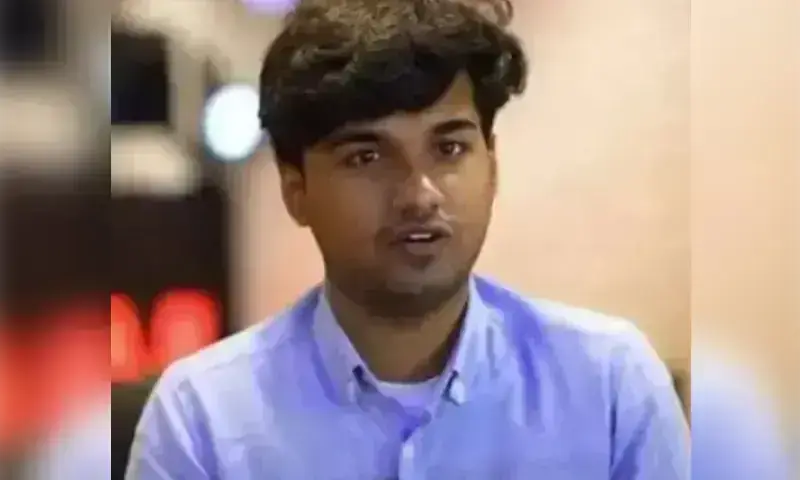
A new investigation team formed by the Sindh IGP on Monday initiated formal proceedings into the murder of business owner Mir Raza Ali, following the findings of a second post-mortem examination.
Owner of eatery Wafflix, Ali had gone missing on July 28, and his body was found a day later with a gunshot wound in bushes in Karachi’s Gulistan-i-Jauhar.
The deceased’s family, along with their lawyer, Jibran Nasir, met members of the new investigation team at the DIG Crime office. The team also met investigators from the previous team and obtained records related to the case.
DIG Crime and Investigation Amir Farooqi, who heads the new team, told Dawn that the investigators heard the family and their lawyer in detail about the circumstances surrounding Ali’s murder.

“The police will keep the family informed of all steps being taken to solve the case,” he said.

He said the new team had obtained the investigation records from the previous team to review the entire case file.
Sindh Home Minister Ziaul Hassan Lanjar said earlier today that the provincial government had deferred the decision on the formation of a judicial commission to probe the Mir Raza Ali murder case.

Lanjar made the announcement on X, saying that Karachi Mayor Murtaza Wahab had spoken to Ali’s family, who had expressed “confidence in the new police team” constituted to investigate the case and was of the view that it should conduct the probe.
“Therefore, the decision of establishing a judicial commission has been deferred for the time being,” the home minister said.
While his family was convinced that he was kidnapped, tortured and murdered, police had previously been building the case around the possibility that he died by suicide.
A murder charge was eventually added to the first information report after the exhumation and a second postmortem of Ali’s body revealed that he had suffered multiple injuries and was shot in the back, ruling out the possibility of suicide.
Controversy fueled by ‘miscommunication’
Sindh Inspector General of Police (IGP) Javed Alam Odho said that the investigation into the murder should be conducted in a better manner, expressing hope that the new investigation team would consider all available evidence.
Speaking to the media in Sukkur, he said the government, public and police were all concerned about the case and stressed the need to examine it “with an open mind and open heart”.
He said action had been taken against officers found guilty of misconduct and negligence during the investigation.
IG Odho said the controversy surrounding Ali’s murder had been fuelled by “miscommunication”.
“I have strictly instructed the entire investigation team to keep communication open and transparent this time, whether with the deceased’s family or the media,” he said.
On Sunday, PPP leader Faryal Talpur recommended a judicial commission to probe the case, saying it should examine all aspects of the incident and bring the facts to light.
A few hours after Talpur’s statement, Lanjar and Wahab had reached Ali’s residence, met with his father, Mir Hussain Ali, and assured the family that they would be provided complete justice. Talking to the media after the meeting, Lanjar had said a decision had been taken to conduct a judicial inquiry, under the supervision of a Sindh High Court judge, into the murder case.
However, Jibran Nasir, the family’s lawyer, posted on X that they had not requested or consented to any judicial commission.
“Nor do we believe it’s required at this stage. A new investigation team has been formed, which the family will meet tomorrow. The Sindh government should not try to create hurdles/confusion in the name of ‘facilitation,’“ he said.
He had earlier also objected to the initially constituted police team probing the case and demanded that it be replaced.
Speaking to the media on Saturday after the results of the second autopsy came out, he had said that he and the family had “no faith” in the investigation team.
Subsequently, the Sindh inspector general of police’s office notified on Sunday the reconstitution of the investigating team probing the case. The order to this effect said the new investigation team was formed in light of Ali’s second postmortem report, which contradicted the one released after his first postmortem.
The same day, Karachi police chief Azad Khan also suspended Sharea Faisal Sub-divisional Police Officer (SDPO) Muhammad Arshad Afridi and Gulistan-i-Jauhar Station House Officer (SHO) Kamran Qureshi with immediate effect for failing to preserve the crime scene and conduct a proper crime-scene investigation after Ali’s body was found.
The city police chief also ordered the case be transferred to Zaman Town Police Station from Ferozabad Police Station, where the case was initially registered.
Controversy over autopsy
The latest developments in the case follow a controversy between the Karachi police surgeon and investigators over alleged loopholes in the medico-legal report regarding Ali’s first post-mortem examination.
Karachi Police Surgeon Dr Summaiya Syed told a private news channel last week that the post-mortem findings of Ali’s body had raised several questions, as some observations in the report did not appear to match the available photographs.
The police surgeon, whose assessment was based only on the post-mortem report and photographs as she had not examined the body herself back then, had said the reported entry wound, bullet trajectory and exit wound did not correspond with one another.
The police surgeon noted that entry wounds were typically smaller than exit wounds in firearm cases. She also said that gunshot residue, commonly found on the hands in suspected suicides, was not tested for in this case.
Her interview prompted the police authorities to issue a statement, terming such observations as having the potential to adversely affect the ongoing investigation.
The statement, however, said that exhumation of the body could be done on the medical board’s recommendation for further clarification by a committee of medico-legal experts with the court’s permission.
On August 6, a judicial magistrate had allowed the exhumation of the body on an application filed by Ali’s father, directing the police surgeon and the Sindh health secretary to constitute a medical board for the exhumation.
The Sindh health department then constituted an eight-member board, with Dr Syed as the convener. However, in the early hours of August 7, the board was reconstituted through an order issued by the director general of the Sindh health department.
While Dr Syed remained the convener of the new five-member board, its members were changed.
But Ali’s family rejected the new board, which also resulted in the deferment of the planned exhumation on Friday. Meanwhile, Nasir accused the authorities of trying to bury the facts.
The Sindh government then restored the original medical board, following which Ali’s body was exhumed on Saturday.
After a second postmortem of the body, Dr Syed told Dawn that multiple injuries were found on the head and face. “Fractured rib on the back, which is the entry wound of the gunshot [that] exited from the front,” she said.
She said the body bore “injuries in the right flank and feet [and] congealed black substance present in the mouth and throat”.
