

Lawyers Action Committee terms JCP judge appointment process ‘horse trading’, announces nationwide movement – Pakistan



ISLAMABAD: The Lawyers Action Committee (LAC) on Saturday rejected the Judicial Commission of Pakistan’s (JCP) process for appointing judges to the country’s high courts, describing it as “horse trading” and a “horrific” appointment process.
“While the adverse fallout of the 26th and 27th constitutional amendments continues to wreak havoc on Pakistan’s justice system, the current process of appointing judges to the high courts is particularly horrific,” the committee said in a resolution adopted at its meeting in Islamabad.
The committee also nominated veteran lawyer and former Supreme Court Bar Association president Ali Ahmed Kurd to lead a movement it plans to launch on a range of issues confronting the country.
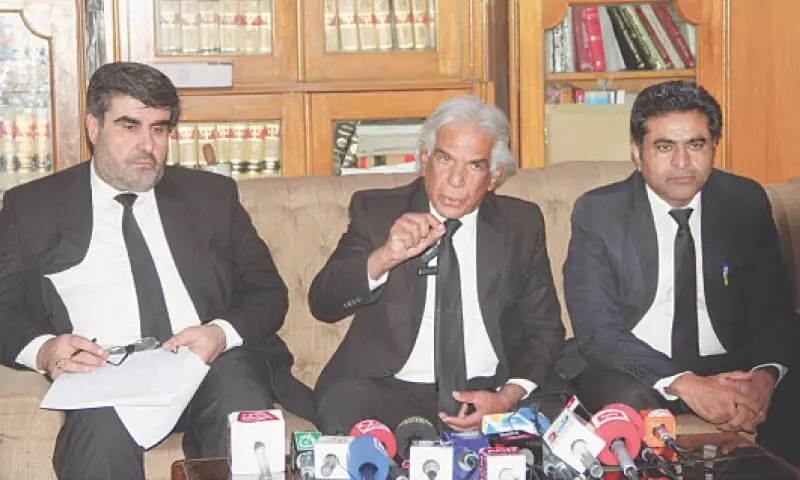
“I have accepted the leadership of the movement with a heavy heart at the insistence of my colleagues, particularly because the people of the country have lost faith in the justice system,” Kurd told reporters at the Supreme Court.
He was accompanied by senior lawyers Hamid Khan, Salahuddin Ahmed and Abid Shahid Zuberi. Kurd was one of the central leaders of the 2007 lawyers’ movement launched after then-president Pervez Musharraf removed chief justice Iftikhar Muhammad Chaudhry, a move widely challenged as unconstitutional.

Kurd said the fresh movement would similarly seek to mobilise the public, arguing that the people were the real stakeholders in the country’s justice system.

He announced that the LAC’s first public meeting would be held in Khyber Pakhtunkhwa and said the committee also planned to hold a programme in London at the invitation of overseas Pakistanis to highlight the issues underpinning the movement.
The resolution urged JCP members who “still possess a conscience” to refrain from participating in a “horse-trading exercise” and to speak out against the “farce”.
It regretted that appointments to the high courts had become akin to nominations to the Senate, alleging that they were either granted as rewards for political loyalty or secured through financial influence.
“When high court judges obtain their positions not on the basis of competence or integrity, but through their ability to manoeuvre among different groups and political parties within the Judicial Commission of Pakistan, the future of justice in Pakistan is surely doomed,” the resolution said.
It also described the interview process as a “mockery”, alleging that interviews were being held in camera while several JCP members had been excluded from the interview committee, allowing “blatantly unqualified candidates” to be selected.
The committee also expressed concern over the deteriorating security situation in Balochistan and the loss of dozens of lives in frequent terrorist attacks.
The resolution added that the pursuit of a “hard state” had alienated large sections of the population in these regions, resulted in the loss of lives and security, and fuelled long-standing resentment that was being exploited by others.
The committee also called for the constitution of a fact-finding commission for troubled regions to identify their issues and grievances and hold public consultations on possible solutions.
The resolution alleged that the continued incarceration of lawyers Imaan Mazari and Hadi Ali Chattha, along with political figures including former premier Imran Khan, Dr Yasmin Rashid, Mahrang Baloch and Ali Wazir, reflected a lack of ideas for dealing with dissenting voices. It also criticised the silence and “complicity” of the judiciary, the legal fraternity and political parties in the face of “blatant injustice”.
It said the prevailing situation was “entirely unsustainable” and was leading the nation towards an irreversible catastrophe that no amount of posturing on the world stage could disguise.
The resolution also condemned persistent attempts by the Pakistan Bar Council (PBC) and provincial bar councils to allegedly obstruct and rig bar association elections where they feared an unfavourable outcome. It demanded that all bar elections be held on time in accordance with the law and with Nadra verification.
It further demanded that purported advocates with fake degrees or those holding other jobs be removed from the rolls, and that a complete ban be imposed on voting by individuals holding dual memberships in different bar associations.
The resolution said the LAC also voiced its support for the ongoing sit-in at Babarlo in Sindh over the disappearance of Priya Kumari and others, and called on the Sindh government to respect minority rights and address their legitimate grievances.


