



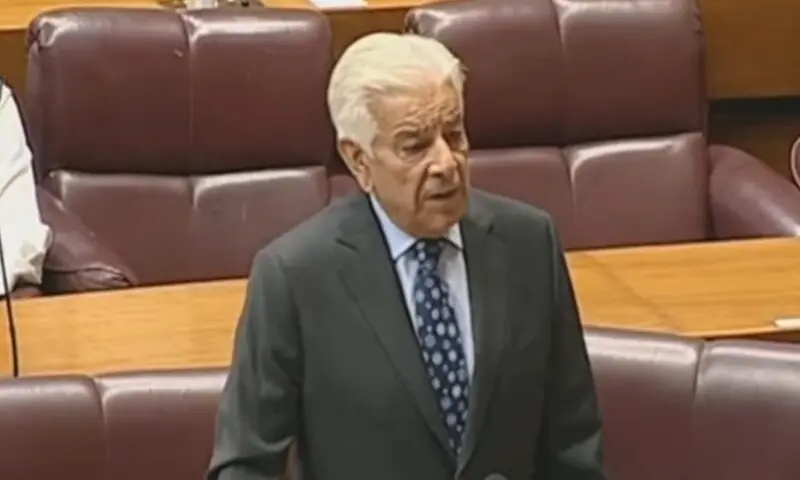
As tensions persist in Azad Jammu and Kashmir (AJK), Defence Minister Khawaja Asif on Thursday urged the now proscribed Joint Awami Action Committee (JAAC) to let the people of the region decide whether the 12 refugee seats should be abolished.
The regional administration and the JAAC remain at odds over various issues, most notably the committee’s demand to abolish the 12 seats in the region’s Legislative Assembly that are reserved for refugees from Indian-occupied Jammu and Kashmir who settled in mainland Pakistan after 1947.
Speaking on the floor of the National Assembly, the defence minister called on the JAAC to raise the issue in the upcoming elections, scheduled for July 27, and “take the issue to the public”.
He questioned why the group was intent on deciding the issue pre-emptively, suggesting that it might be an attempt to shape the assembly “as per their will”.

Asif noted that Kashmiri refugees settled in Pakistan had paid a “heavy price” to migrate to the country, and that the JAAC had no right to demand the “taking away of their right to vote”.

“The AJK that we have today is due to the sacrifices made by the Pakistan armed forces and people from across the country, not just Kashmiris,” the defence minister said, asserting that 250 million Pakistanis had a “stake” in the region.
He held that there was a story in every Pakistani household of the sacrifices made for the disputed region.

“Does that mean nothing? I do not want to take names, but what have they sacrificed for Kashmir? They do not have any stake, nor have they invested anything in the liberation of Kashmir,” the defence minister said.
The defence czar warned that if people took the law into their own hands, the government could not be expected to “stay silent”.
He also recalled that Kashmiri refugees in his constituency did not have access to basic facilities such as electricity and gas due to uncertainty surrounding their status. However, “we had their status finalised”, he said, reiterating that the way forward was dialogue, not confrontation.
“I wonder if this hatred has been imported from across the line,” Asif said, in an apparent reference to the Line of Control (LoC).
He maintained that the group could not “take away the identity” of Kashmiri refugees, advising that the matter should be resolved in the Legislative Assembly.
“How could you exclude them from the electoral process?” the defence minister said.
Asif remarked that the status “Azad” in AJK had been secured and protected by Pakistanis.
“The word Azad would not have been there if it were not for Pakistan,” he said, adding that the armed forces stationed atop mountains protecting Kashmir were all Pakistanis, including Punjabis, Baloch, Pashtuns and Sindhis.
Unrest in AJK continues
Earlier reports suggested that activists and supporters of the proscribed JAAC had reached the outskirts of Rawalakot from multiple directions, determined to proceed through the town towards the regional capital of Muzaffarabad.
On Tuesday night, a large number of protesters from Mirpur, Kotli and Bhimber districts, including the town of Dadyal, had managed to enter the territorial limits of Poonch district via Tatta Pani amid reported clashes with law enforcers. Several casualties were reported in the violence, but there was no official confirmation.
On Wednesday, the protesters, who had stayed overnight at different locations in Hajira tehsil, resumed their journey towards Khaigalla, some 10 kilometres from Rawalakot, where another rally from Sudhnoti district joined them.
Witnesses and official sources said that by evening, the crowd had reached Chehr Bazar and camped in the industrial area near the Eidgah, on the eastern side of the town.
Another group of protesters from the Mang and Thorar areas of Poonch district had separately camped at the bus terminal on the southern side of the town. A third, relatively smaller group from Bagh district had stationed itself at a high school in Kotehri village on the northern side.
Residents said Rawalakot, like the rest of AJK, observed a complete shutdown on Wednesday, with public transport off the roads and only negligible private traffic visible.
Throughout the day, announcements were made over mosque loudspeakers in Rawalakot, directing citizens to restrict movement and warning that anyone attempting to enter the town from outside would be responsible for any repercussions.
According to local sources, law enforcement personnel had blockaded roads leading into the city and taken positions at several locations to thwart any attempts by protesters to enter.
A senior government official told Dawn that Umar Nazir Kashmiri, considered a hardline JAAC leader, had reportedly submitted a “six-point petition” to the “decision-making authorities” in an effort to defuse the situation.
The demands included the withdrawal of the Home Department’s notification proscribing the group, conditions related to the deaths during the protests and cases registered over them, the lifting of any restrictions on movement, and the initiation of negotiations.
The petition further stated that, pending a decision, both law enforcement personnel and protesters should remain at their respective positions. The official added that the JAAC leader had assured the authorities that protesters would not move forward.
No JAAC leader was available to confirm or deny the claim.
Proscribed
Last Friday, following the announcement of the JAAC’s June 9 strike, the AJK government declared the body a proscribed organisation, stating that it was “engaged in terrorism” and had acted in a manner “prejudicial to peace and security” of the state.
A day later, AJK authorities launched a crackdown on the JAAC, arresting scores of its leaders and activists from different areas. Sedition proceedings against two of its leaders have also been ordered, and a Rs10 million reward for information leading to the arrest of four leaders has been announced.
Tensions in the region particularly flared up after a violent protest in Rawalakot, during which at least four law enforcement personnel and seven civilians lost their lives.
Islamabad has also dispatched federal paramilitary forces to reinforce the region’s thinly stretched police force, and intending visitors have been advised to postpone their trips until June 20.
