



Iran’s missiles are ‘locked on American targets’ as ceasefire frays around the Strait of Hormuz
Members of the Islamic Revolution Guards Corps (IRGC) navy participate in an exercise in the south of Iran, in this picture obtained on January 17, 2023. PHOTO: REUTERS
The Islamic Revolutionary Guards Corps Navy Command warned the US against further strikes on Iranian ships, according to IRIB News Agency. They posted on their official X account saying, “Any attack on Iranian oil tankers and commercial vessels will result in a heavy attack on one of the American centres in the region and enemy ships”.
Brigadier General Seyyed Majid Mousavi, Commander of the IRGC Aerospace Force, also warned on his social media, “The IRGC Aerospace Force’s missiles and drones are locked on American targets in the region and the aggressor enemy ships and are awaiting the command to fire”.

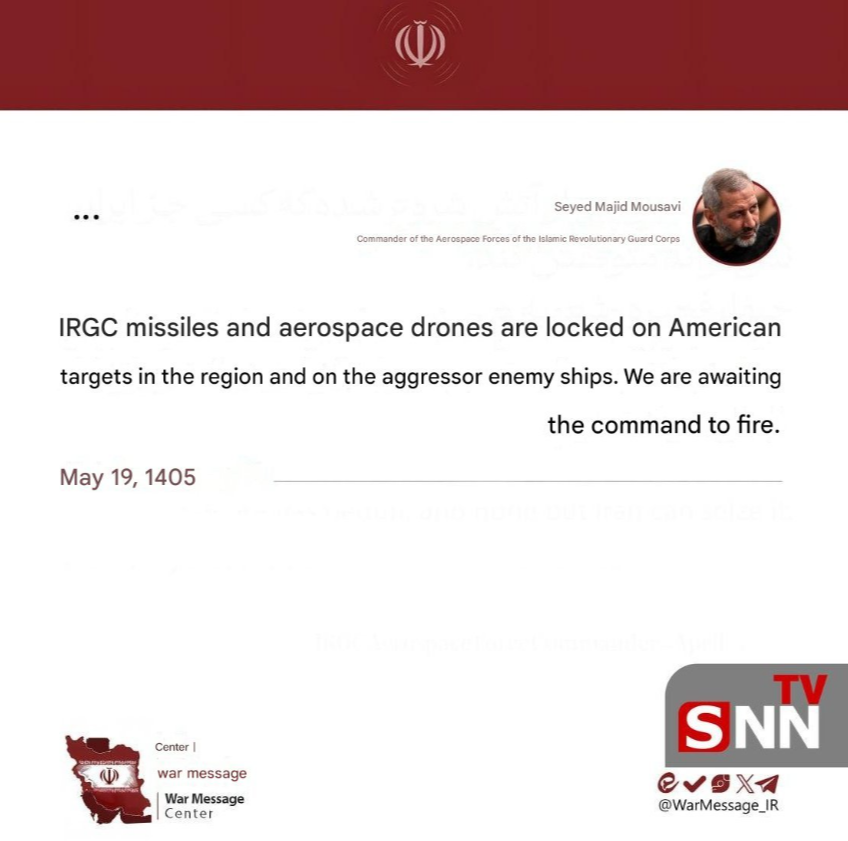

PHOTO: X
Relative calm prevailed around the Strait of Hormuz early on Sunday after days of sporadic flare-ups, as the United States waited for Iran’s response to its latest proposals to end more than two months of fighting and begin peace talks.

US Secretary of State Marco Rubio met Qatari Prime Minister Mohammed bin Abdulrahman al‑Thani in Miami on Saturday and discussed the need to continue working together “to deter threats and promote stability and security across the Middle East,” the State Department said in a statement, which did not mention Iran.
A reporter for French broadcaster LCI, Margot Haddad, said on Saturday that Trump had told her in a brief interview that he still expected to find out Iran’s answer “very soon”.
Rubio said on Friday that Washington expected a response within hours. But there have been no signs of movement from Tehran on the proposal, which would formally end the war before talks on more contentious issues, including Iran’s nuclear program.
Qatari tanker approaches vital strait
With US President Donald Trump due to visit China this week, there has been mounting pressure to draw a line under the war, which has ignited a global energy crisis and poses a growing threat to the world economy.
A Qatari tanker of liquefied natural gas was sailing toward the strait on Saturday en route to Pakistan, according to LSEG shipping data, a move sources said was approved by Iran to build confidence with Qatar and Pakistan, both mediators in the war.
If completed, it would mark the first transit of a Qatari LNG vessel through the strait since the U.S. and Israel started the war on February 28.
Tehran has largely blocked non-Iranian shipping through the narrow strait, which before the war carried one-fifth of the world’s oil supply.
Recent days have seen the biggest flare-ups in fighting in and around the strait since a ceasefire began a month ago, and the United Arab Emirates came under renewed attack on Friday.
On Friday, there were sporadic clashes between Iranian forces and US vessels in the strait, Iran’s semi-official Fars news agency reported.
The US military said it struck two Iran-linked vessels attempting to enter an Iranian port, forcing them to turn back.
A bulk carrier reported being struck by a projectile northeast of Doha, the UK Maritime Trade Operations said on Sunday. A small fire was extinguished, with no casualties or environmental impact, UKMTO said. Authorities were investigating the source of the projectile.
Vessels whose states follow US sanctions against Iran will face difficulties crossing the Strait of Hormuz, Iranian Army Spokesperson Mohammad Akraminia said on Sunday, according to semi-official Tasnim news agency.
Iranian lawmakers have said they are drafting a bill to formalise Iran’s management of the strait, with clauses including forbidden passage to vessels of “hostile states”.
Ceasefire holding despite flare-ups, Trump says
Washington imposed a blockade on Iranian vessels last month. But a CIA assessment indicated Iran would not suffer severe economic pressure from a US blockade for about another four months, according to a US official familiar with the matter, raising questions about Trump’s leverage over Tehran in a conflict that has been unpopular with voters and US allies.
A senior intelligence official characterised as false the “claims” about the CIA analysis, which was first reported by the Washington Post.
Trump said on Thursday the ceasefire was holding despite the flare-ups, while Iran accused the US of breaching it.
“Every time a diplomatic solution is on the table, the US opts for a reckless military adventure,” Foreign Minister Abbas Araqchi said on Friday.
The US has found little international support in the conflict. After meeting Italian Prime Minister Giorgia Meloni on Friday, Rubio questioned why Italy and other allies were not backing Washington’s efforts to reopen the strait, warning of a dangerous precedent if Tehran were allowed to control an international waterway.
Britain, which has been working with France on a proposal to ensure safe transit through the strait once the situation stabilises, said on Saturday it was deploying a warship to the Middle East in preparation for such a multinational mission.
