



This summer has brought on a nightmare for students across Pakistan and a PR bloodbath for the Cambridge examinations board. Its Mathematics paper leaked hours before hundreds of thousands of teenagers were supposed to attempt it across the country on April 29. The memes were eviscerating: Next time, print out the leaked .pdf and when the invigilator hands you the question paper, say, ‘It’s OK, I’ve brought my own’.
In truth, though, no one was laughing. “It was a bit of doom and gloom,” said Lahore student Hamza Nasir*, describing the mood outside the hall after his AS Level Mathematics P1 exam. Some students who had no idea about the leak were livid and others were celebrating its veracity.
This is the third time leaks have ruined exam season. Each year, in May-June and November, Pakistani students sit for the Cambridge Assessment International Education (CAIE) exams in subjects that range from English Literature to Islamiyat. Grades 10 and 11 prepare for the Ordinary or O Levels and grades 12 and 13 sit the Advanced Subsidiary or AS and Advanced Levels. Results are announced by August and tie in with university admissions.
The CAIE reported the cases to the National Cyber Crime Investigation Agency (NCCIA) under the Prevention of Electronic Crimes Act, 2016. “The theft and unauthorised sharing of examination papers is a breach of confidentiality and, potentially, criminal breach of trust,” said CAIE to Dawn. “We’re investigating both incidents thoroughly through digital forensics, analysis of online platforms, and cooperation with law enforcement.”

The first complaint was filed on May 7 for the Mathematics Paper 12 breach. The second complaint was filed on May 14 on the broader misinformation campaign. False information about other exam papers, particularly the AS Level Business Studies, was spreading like wildfire. For its part, the Inter-Board of Coordination Commission announced it would seek a report from CAIE.

The NCCIA has sent evidence to the platforms where the leaks circulated and is expecting to hear back from some on May 27, Director-General Syed Khurram Ali told Dawn. The agency has asked Cambridge to check if this was an inside job as well.
Parents flooded the examiner with screenshots, complaints and questions as the misinformation spread, especially for the Business Studies exam of May 5. “Upon review, it became apparent that such material consisted of content extracted from examinations conducted in previous years,” the CAIE told Dawn. The fabricated and manipulated images and material were apparently generated through artificial intelligence and other editing tools.

Cambridge receives thousands of reports about alleged exam leaks every year, but most of them are false. “This is a real problem,” it said. “Fraudsters claim to have exam papers for sale in order to deceive students financially. Students panic and pay money for fake papers. Beyond the waste of money, there are bigger risks: students risk cancellation of their grades if caught with unauthorised materials. Some fall victim to identity theft or blackmail.”
CAIE country director, Uzma Yousuf, acknowledged the strain. “If you are a student approaching your exams, the last thing you need is this kind of uncertainty,” she said in a statement shared with Dawn. “I want you to know that we see you… We see the extra revision you may feel compelled to do. We see the uncertainty you are living with. And we want you to know that every action we are taking is designed to protect you and your future.” She sympathised with parents concerned about fair assessments and reassured schools that they would be given timely information about any replacement exams.
The craziest bit was that it didn’t stop. One paper leaked after another, all a day before the exam dates. As I talked to students about it, I found out that the exam papers are being openly sold online starting from $100 each, going up to $400 per exam. So I decided to try and buy one myself.
STEP 1: Join the Discord server
Anant Nanda*, an A Level student from Lahore, shared with me three invitation links to the “most popular leak servers”. All of them were Discord links circulating in O/A Level WhatsApp groups.
Discord is a free group-chatting platform launched in 2015 originally for video gamers to talk to each other while playing online. It was adopted by thousands of groups during the pandemic and morphed into a general-use platform.
It took me less than five minutes to download Discord on my phone and create a profile. I joined all three servers shared by Nanda, and chose the one with the highest number of members (7,839).
STEP 2: Answer the questions
Users on Discord are organised into virtual communities known as “servers”, which are divided into channels by topic. Servers exist for nearly every imaginable interest, from gaming and music to study groups and exam discussions. Finding these communities is often as simple as Googling ‘[topic] Discord server’.
Discord’s appeal is semi-anonymity. You don’t have to join with your real name. Servers can be invite-only, and many are not visible if you search through Discord’s own discovery system, making them more private than other social media spaces. This was the case with the Cambridge Leaks (CL) server I entered.
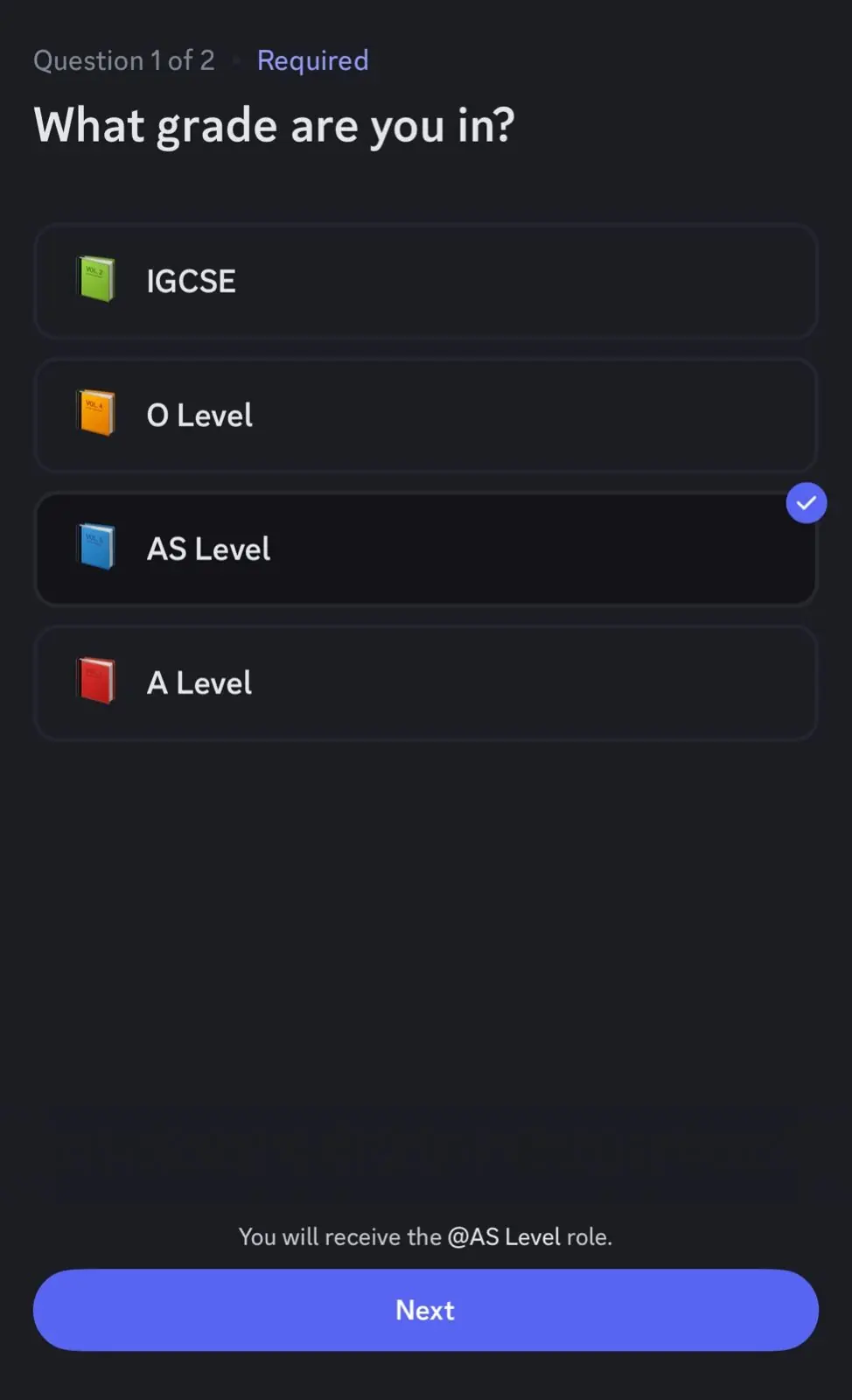
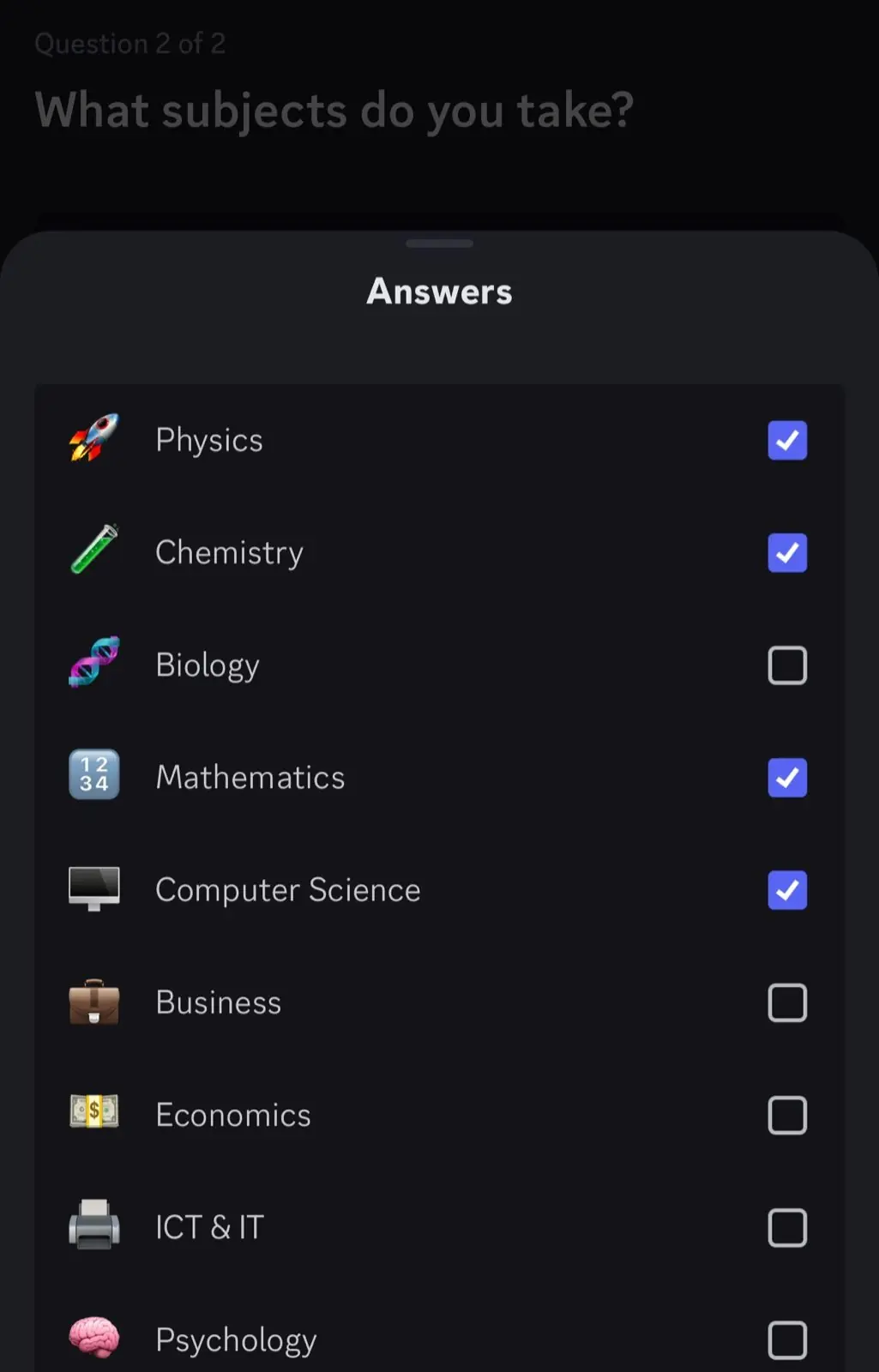
As soon as I joined CL, a question box popped up to ask if I was an O-, AS, A- Level or an IGCSE student. I picked AS Level. That led to Question 2 with a drop-down menu of subjects. Once I selected my subjects, I was free to access the server.
It displayed five categories.
- Server Guide
- Channels & Roles
- A channel to verify the exams bought. This was helpful for someone like me who was new to Discord.
- A channel called IMPORTANT had all the important information, announcements, alerts, and a link to a backup server, in case the current server needed to be shut down.
- Two channels called ‘website’ and ‘website-codes’ with two categories called ‘MARKET’ and ‘PAPERS’.
STEP 3: Go to the website
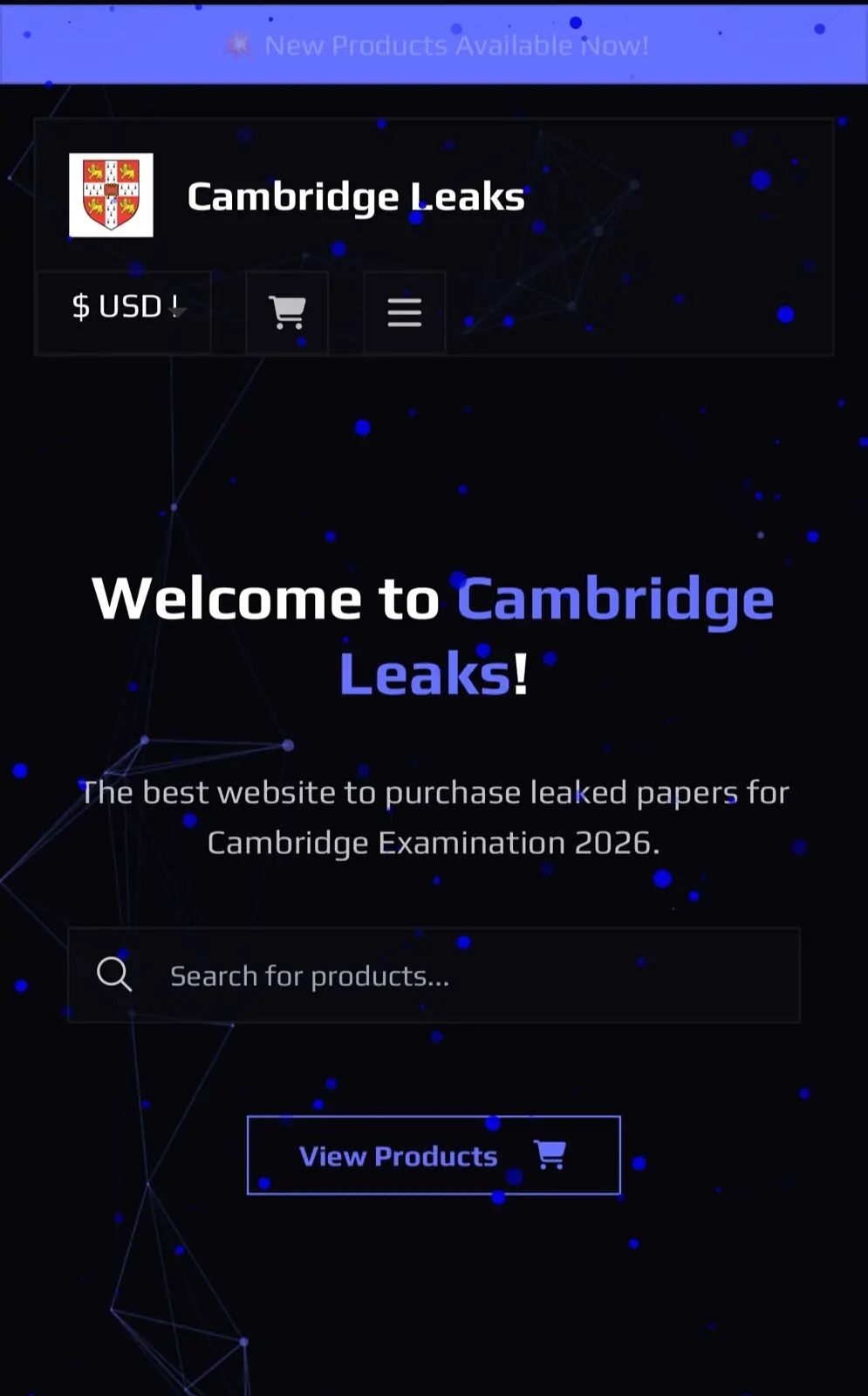
I was greeted with a warm message: “Welcome to Cambridge Leaks! The best website to purchase leaked papers for Cambridge Examination 2026.” Some statistics were provided to lend the site credibility. It had sold 32 products to 17 customers out of which nine gave their purchases an average rating of 4.89.
At the top of the website page, sits a mini-shopping cart icon or a ‘$USD!’ button under the logo. Below the welcome statement sat a purple “View Products” box and a grey search engine bar.
STEP 4: Select the exam you want to buy
The Product page gave me a colour-coded menu of subjects: Biology, Chemistry, Physics and Mathematics. The price range was mentioned below in purple, in the left corner of each title card.
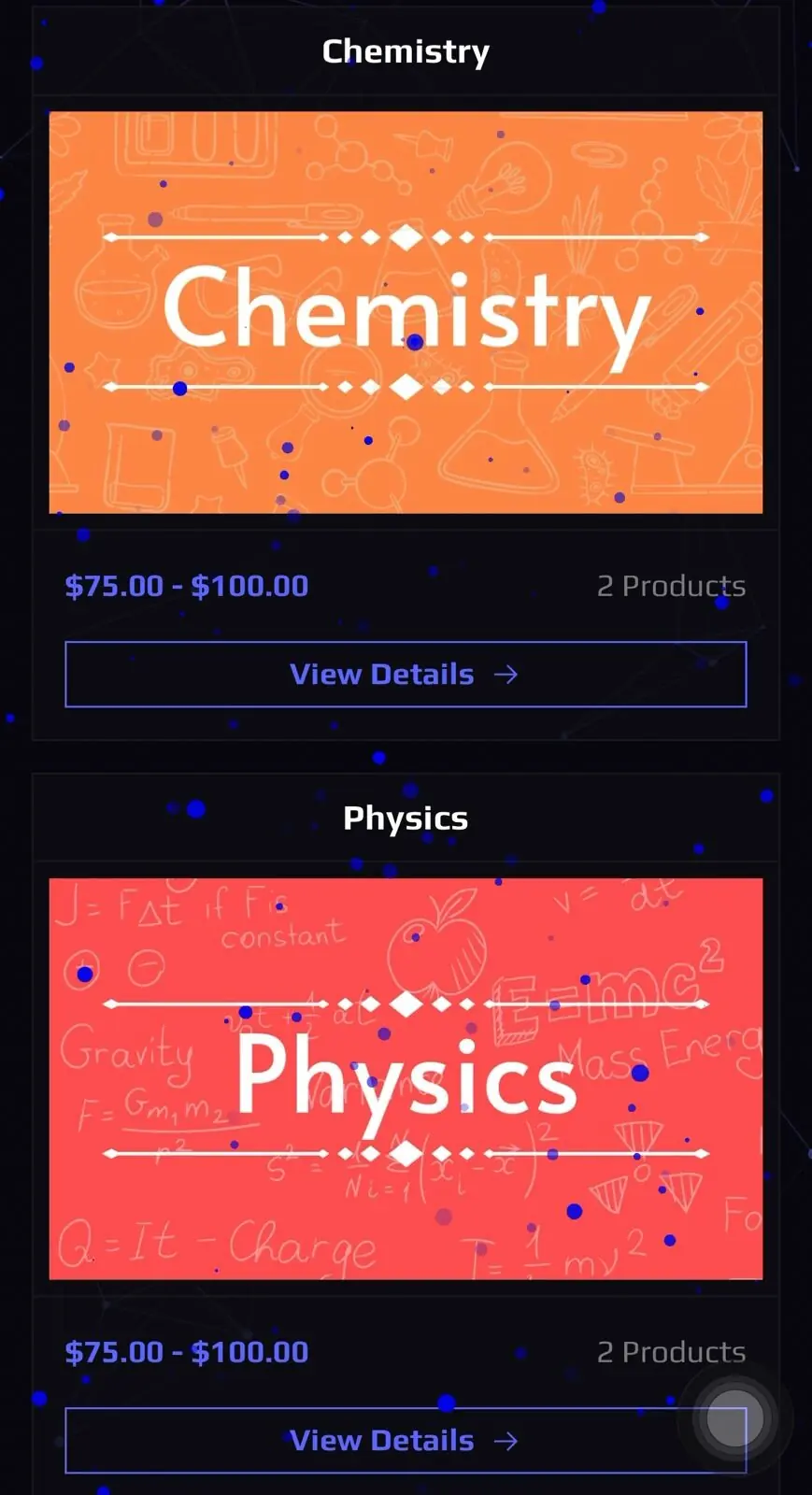
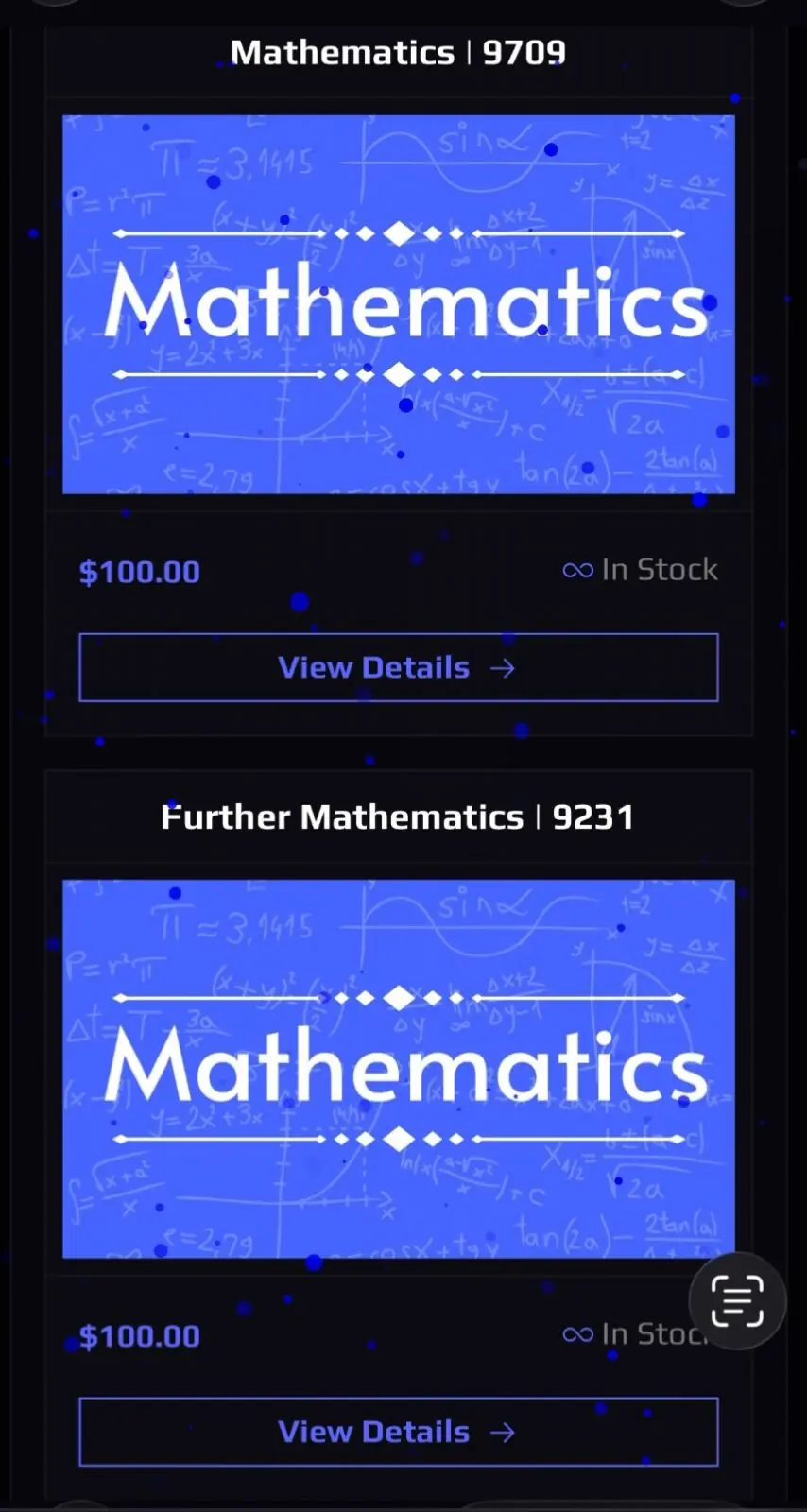
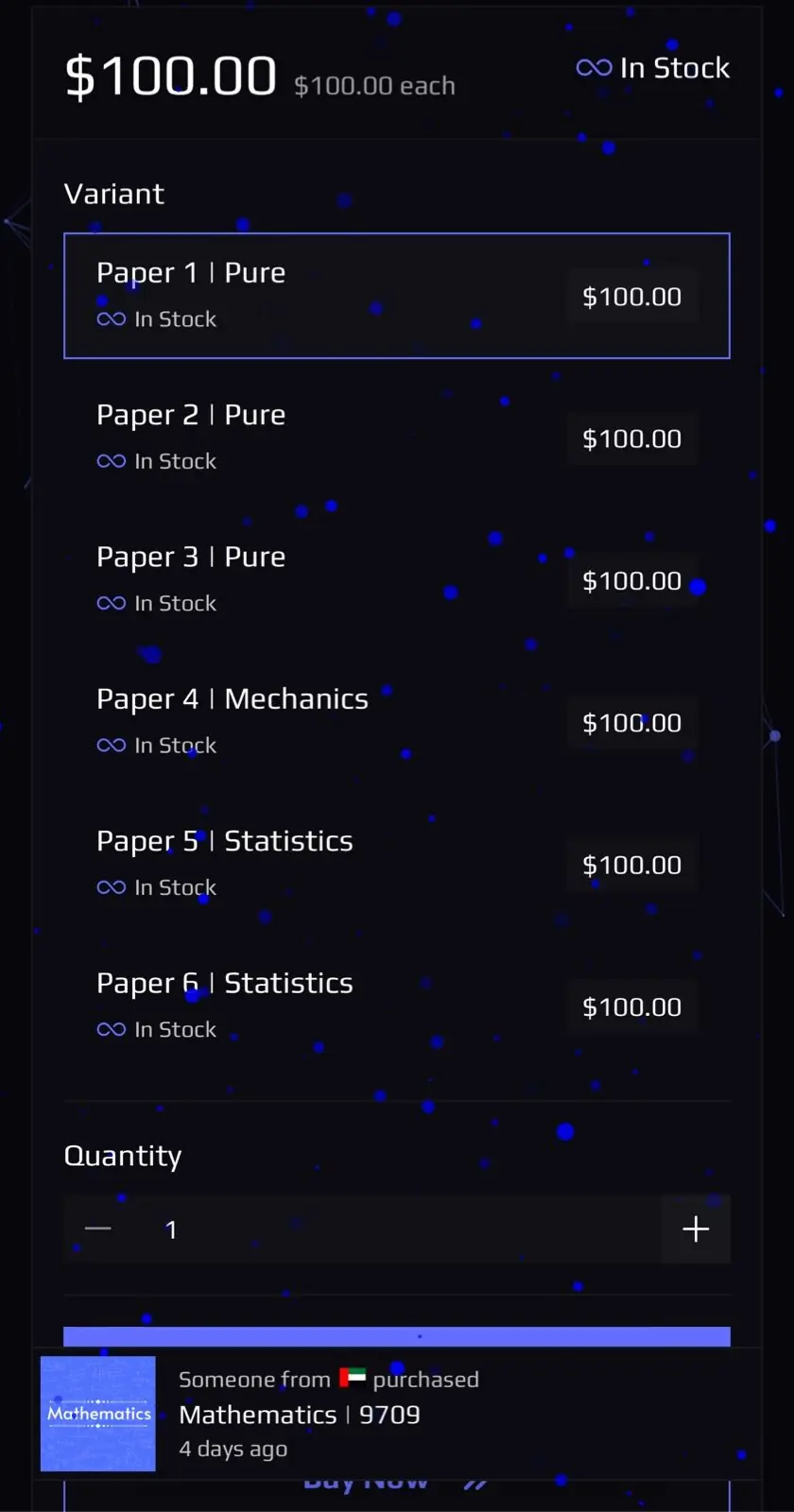
I scrolled down to the blue Mathematics title card and tapped “View details”. It redirected me to four more title cards labelled Mathematics|9709, Further Mathematics|9231, Mathematics|0580, and Additional Mathematics|0606, all priced at $100 each and all in stock.
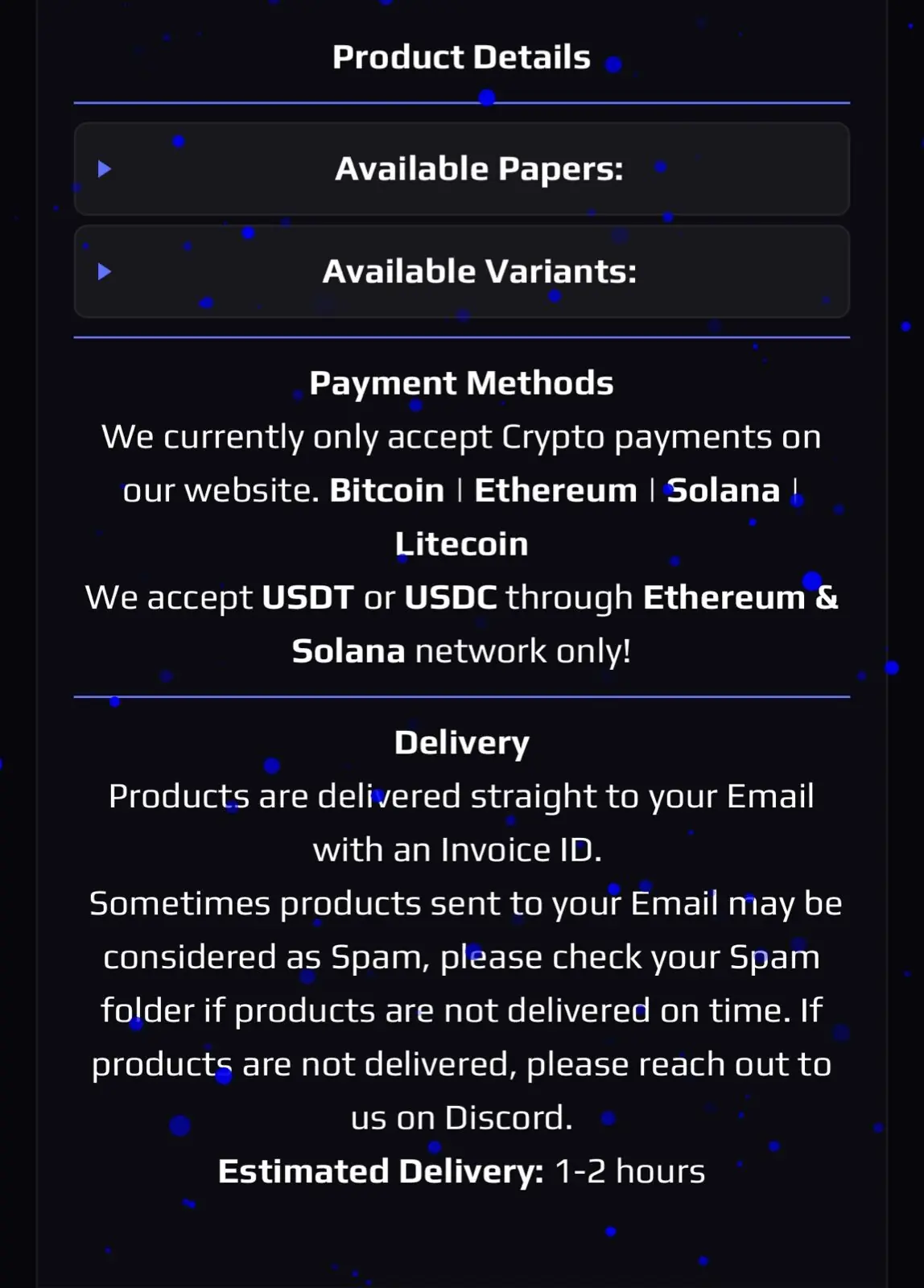
I chose Mathematics 9709. According to the expandable menu, both variants of all six Math exams were available. As I was going through the payment methods, a box popped up saying, “Someone from [UAE flag] purchased Mathematics 9709 four days ago.”
STEP 5: Pay for your exam paper
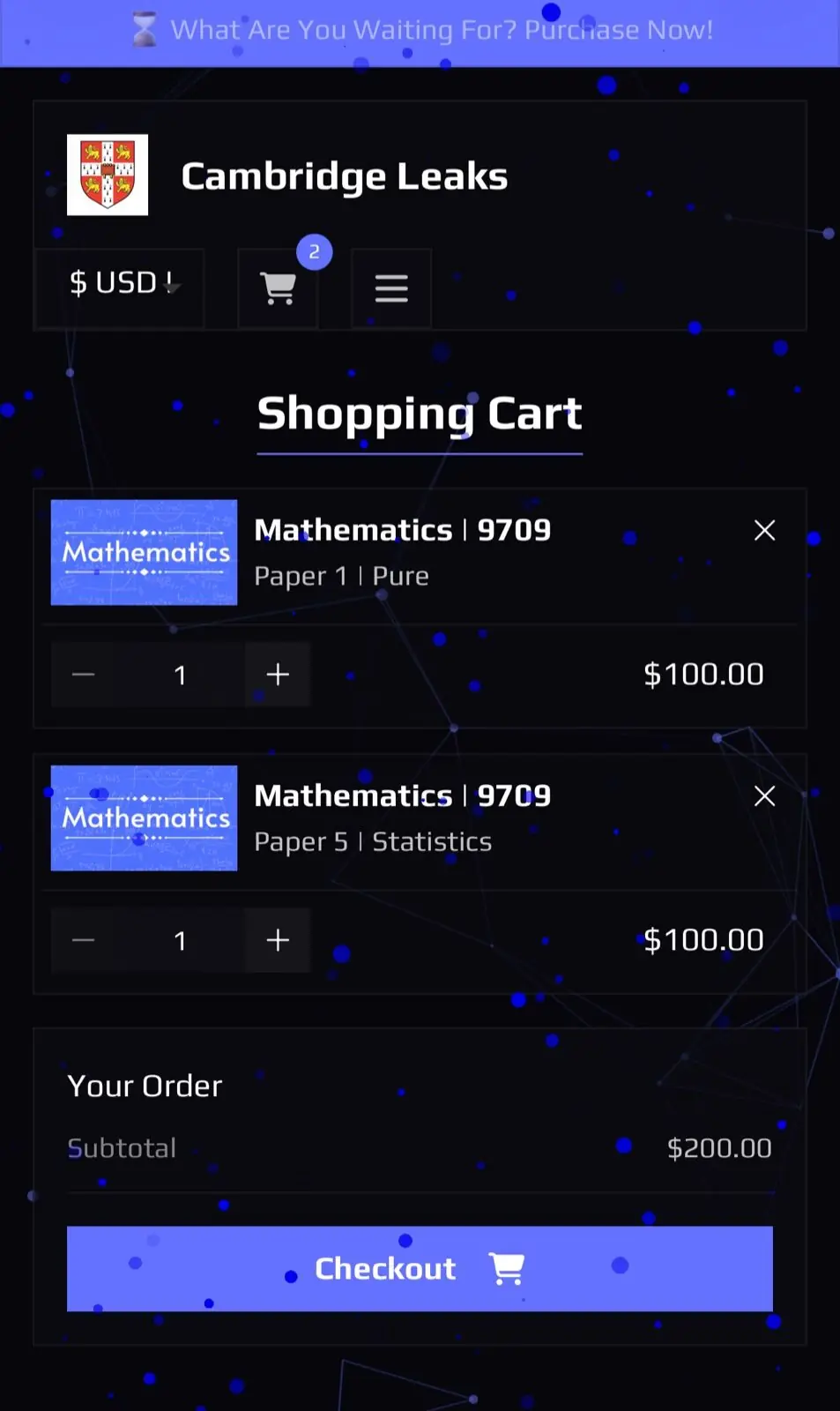
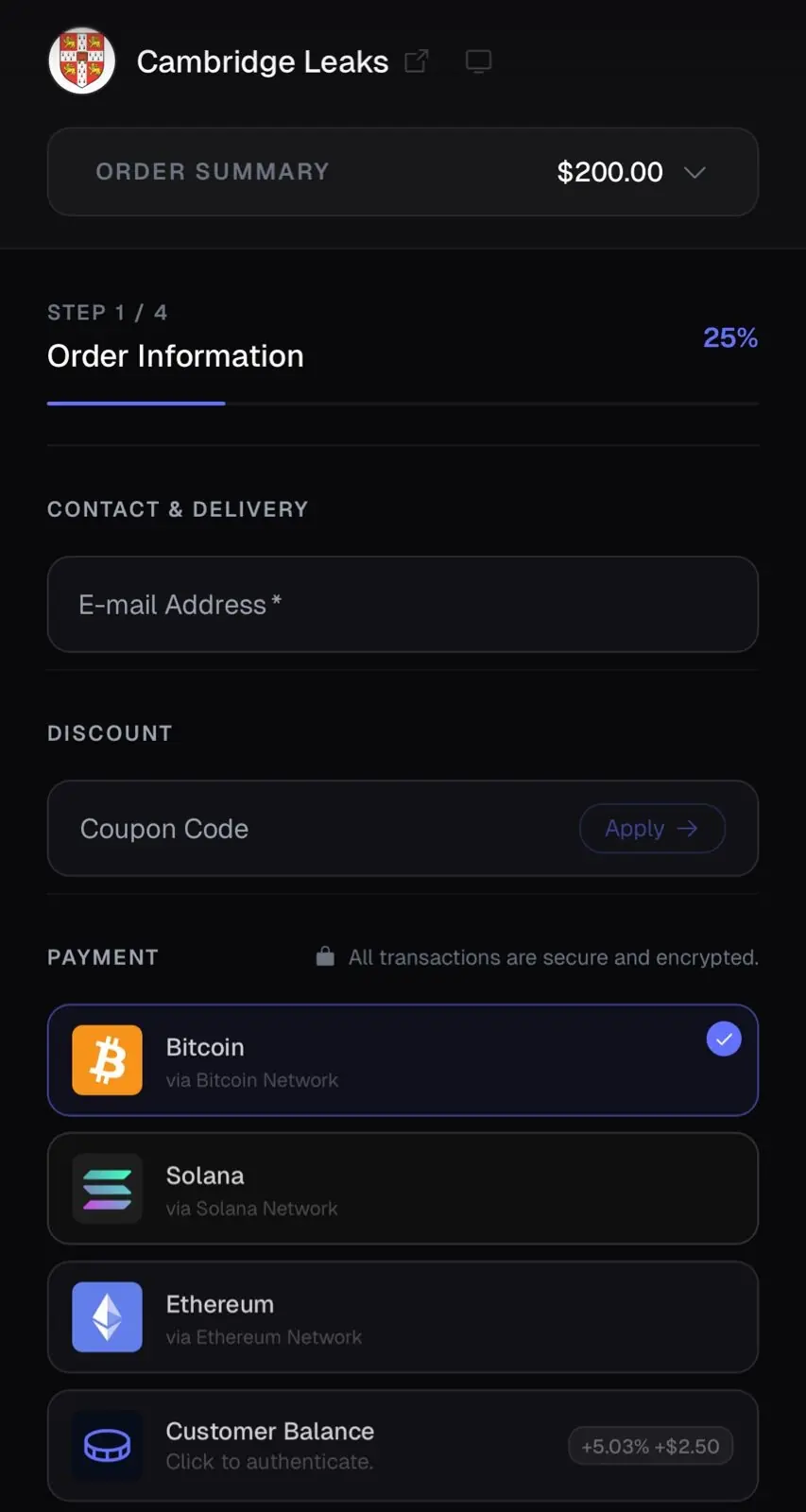
I decided to buy Mathematics Paper 1. I added it to cart along with Statistics Paper 5 and proceeded to pay. The payment page is where my curiosity took a dip. I didn’t have a discount code, nor did I have any customer balance, Bitcoin, Solana, or Ethereum to pay with. As a journalist in Pakistan, I tend not to have $200 lying around for a news story, let alone any money in crypto. I thought this was the end of the experiment and I’d have to log off but I was wrong.
The ticketing method
You can also buy a leaked paper by raising a ticket, a route which helped me get in touch directly with CL’s staff and manager. All I needed to do was go to the “Purchase” channel and tap the green “Click to Purchase” box. This opened a purchase form which asked for the paper’s code, method of payment (crypto or credit card), and my region.
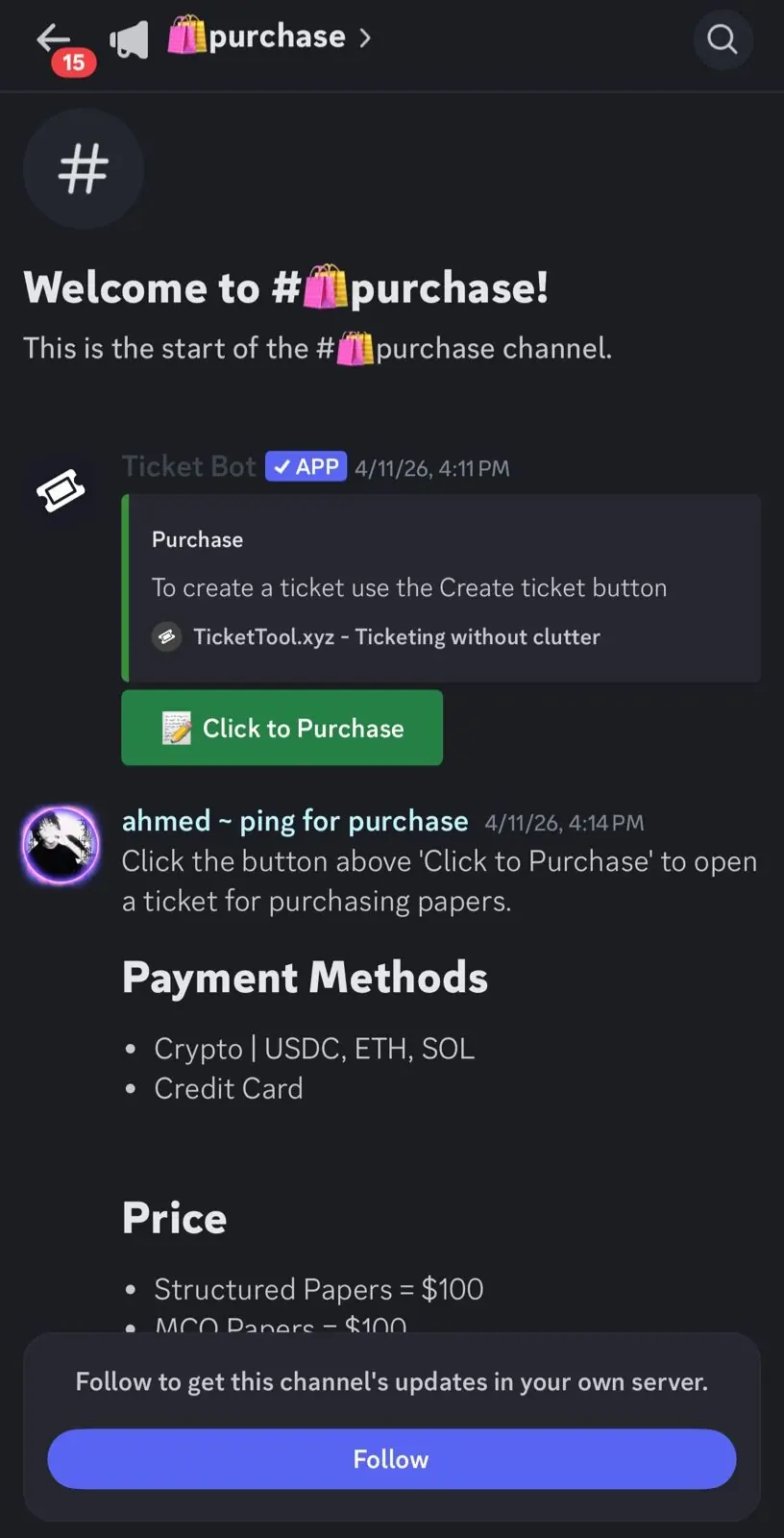
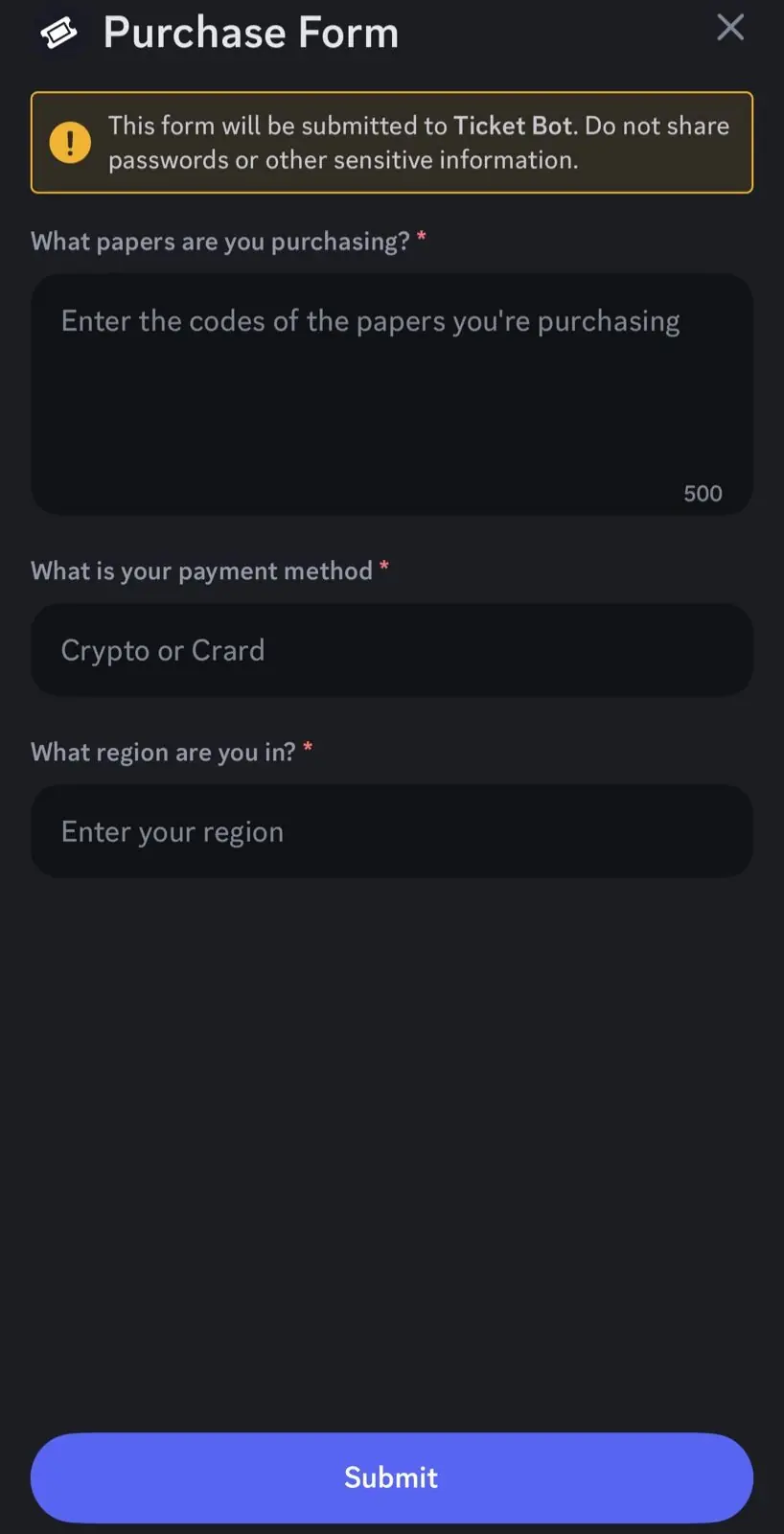
As soon as I entered the details, a ticket number was generated. A separate chatbot popped up to talk about payments with the CL staff. I pretended to be a lost, anxious student trying to buy an exam for the first time. I said I had zero idea about payments, the credibility of the exams, and digital security.
One of the CL staff members who chatted with me at “thecambridgeplug [PING FOR HELP]”, reassured me that the papers were authentic as his ‘boss’ has connections with schools and exam centres in his country. The boss pays them a large sum of money to have the papers opened early, which he scans and sends to his staff, who then sell them online for him. “It isn’t some random person,” he said. “When I say he has connections with the schools and exam centres, I mean that he knows the authorities in said schools and exam centres personally.”
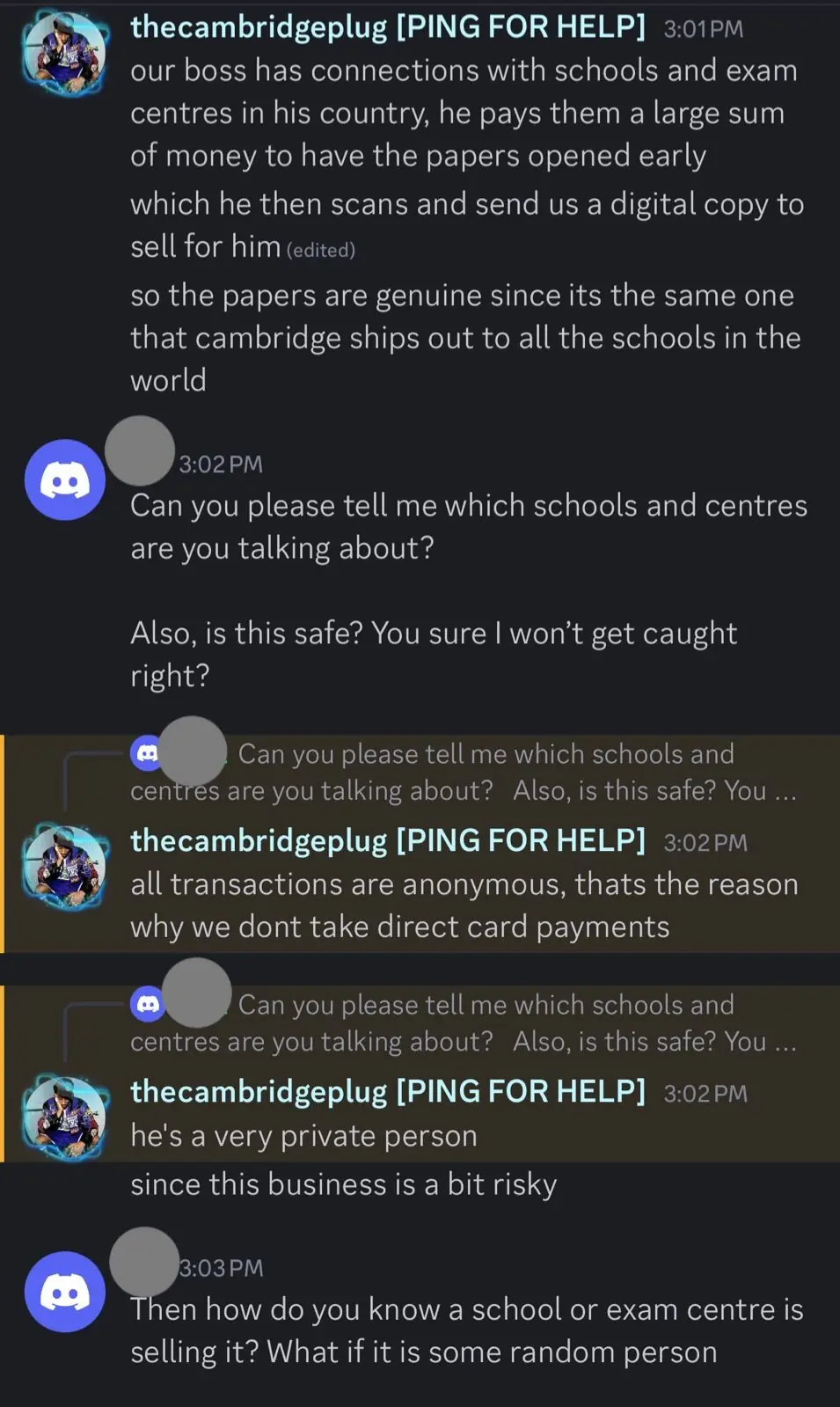
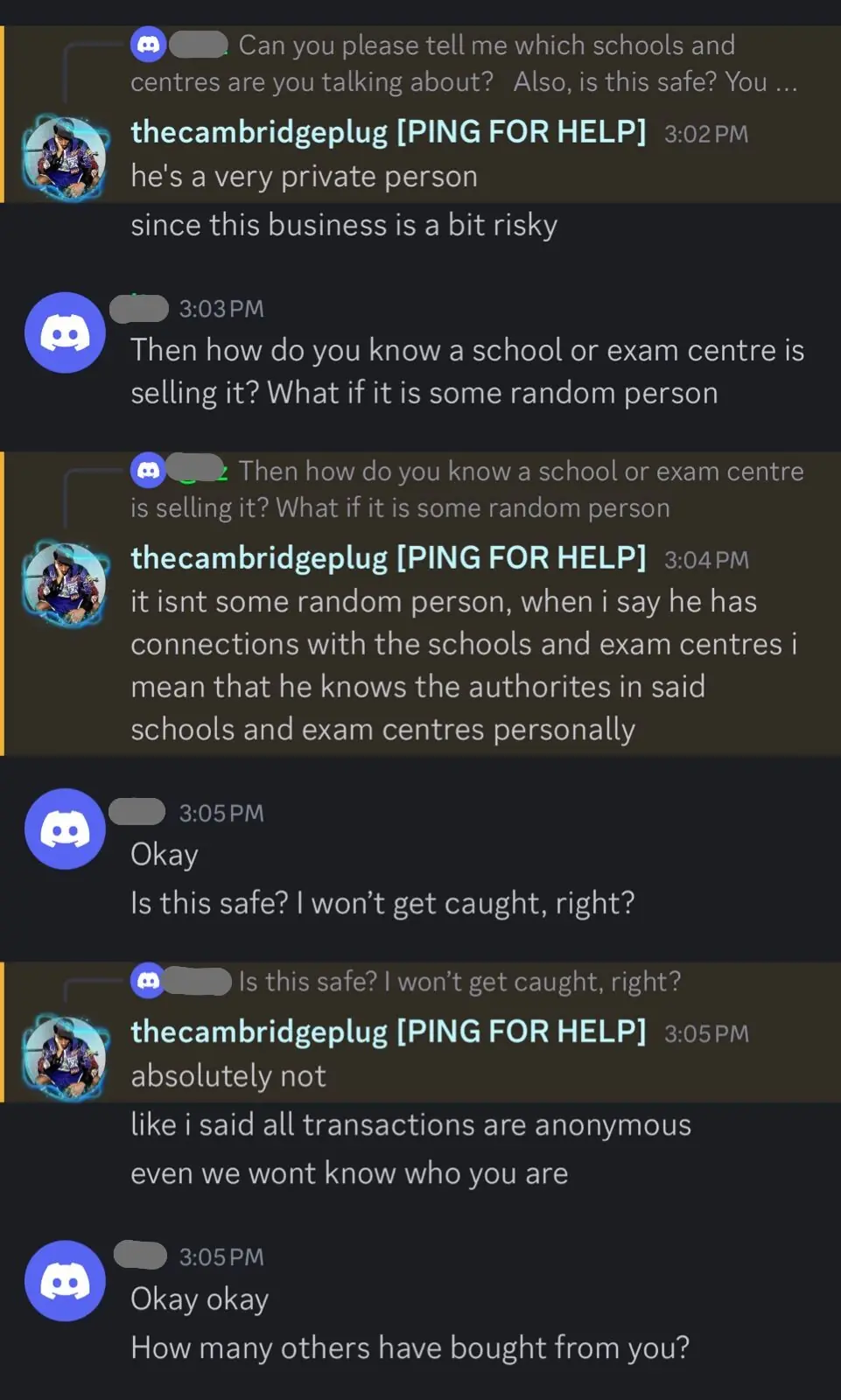
In half a day, CL had already sold the Mathematics 9702/42 to 10 people, with the staff member projecting more buyers as people usually contact them a day before the exam. Even though they don’t keep a count, my ticket number 1611 indicated that at least 1,610 people had been in line.
I discovered that Binance was not the only mode of acceptable payment to buy leaked exams. Card payments through Rewarble and gift cards, such as Valorant cards, are accepted as well. None of them are traceable and maintain buyer and seller anonymity.
An open market
The Discord-like Reddit and encrypted messaging app Telegram are two mainstream markets for the papers, sometimes at an even lower price. When Nanda came across a leaked Computer Science (9618/12) exam taking rounds on WhatsApp groups, he and his friends tried to dig deeper. The prominent watermark, @satboard, on the leaked exam helped him find a Telegram private channel, SATBoard.
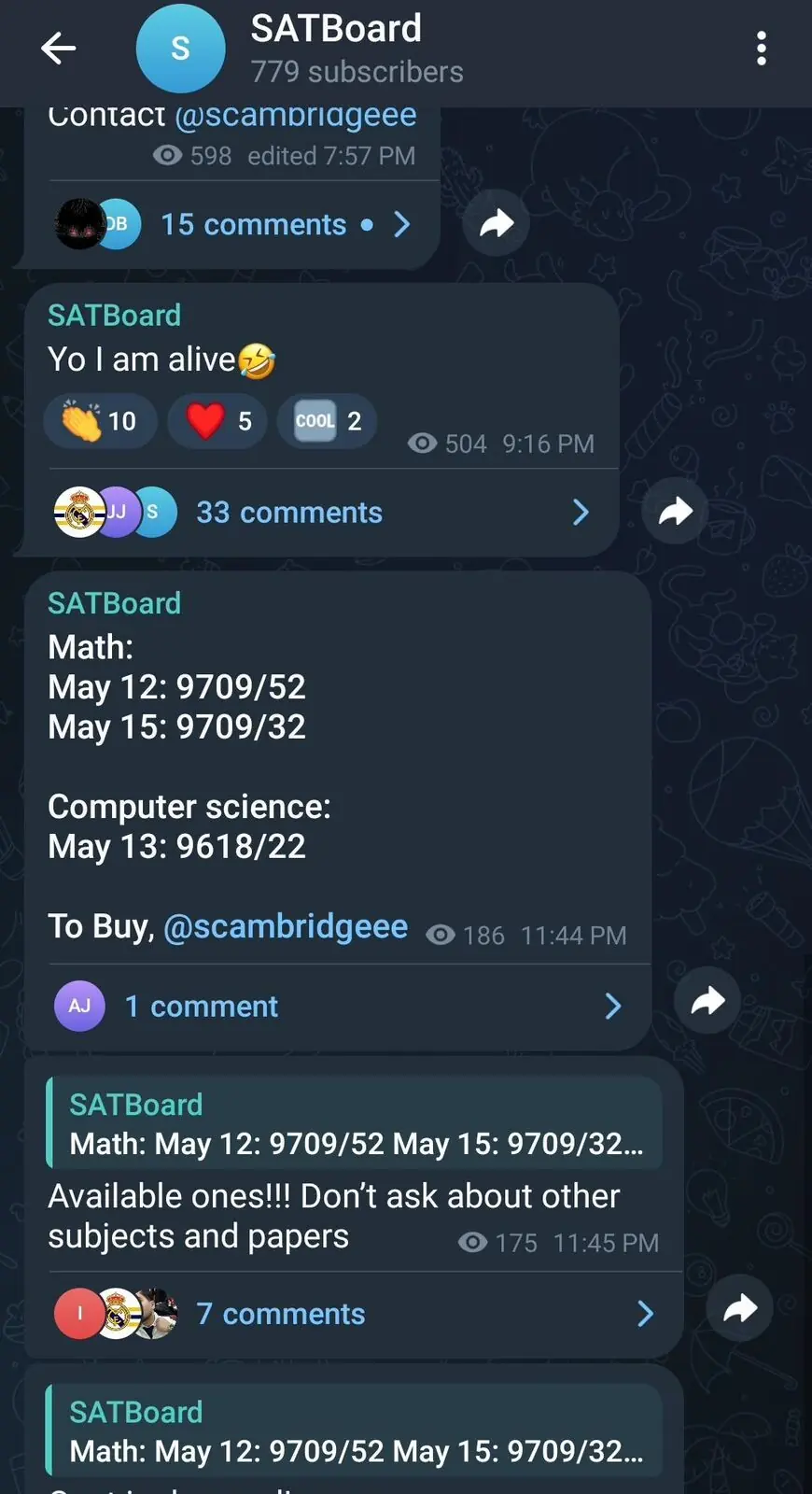
The channel was created on May 8, with 765 subscribers, selling each paper for $300. However, its subscribers skyrocketed to 3,000 as soon as the leaked CS paper with its watermark went viral on student WhatsApp groups. Soon after the authorities started to take notice, all the messages were deleted from this Telegram channel. The seller made another group where only select buyers were allowed in. HN wasn’t one of them.
Pressure to give in
WhatsApp groups, Reddit threads and Discord channels are congested by real and fake exam papers claiming to be authentic. The leaked CS paper was authentic, as was the Mathematics paper, Business Paper 2, and Chemistry Paper 2, which leaked at 5am on the day of the exam. Legit question papers are not the only ones circulating. The effect is that instead of spending time on preparation, students are feeling pressured to sift through a pool of leaked papers, trying to find the right one.
Humair Nasir*, another student from Lahore, is appearing for six composite A Level exams this year. He received the leaked Mathematics P1 around 3am on the same day of the exam but he brushed it off. As the invigilator started distributing the paper in the hall, however, stifled laughter proved him wrong. The Mathematics S1 paper was no different. But Nasir decided not to look. His mother felt differently. She insisted he go through the leaked papers when he received them, arguing that he might as well use them. Since he didn’t, she is worried his grades will suffer, ruining his chances of admission to the National University of Sciences and Technology. Needless to say, she does not want to pay for her son’s exams again.
The psychological impact
The scandal over the past three years has battered CAIE’s reputation and given students heartache, but most of all, it is affecting futures. Ayesha Waqar*, who prepared with her Maths tutor till midnight each day, suffered during the first leak in June 2024. She re-sat the exam in November 2024 while simultaneously taking her second year A Level classes.
By 2025, she was relieved to be on her way out of the system. But when she woke up to a flood of screenshots of leaked questions, just like a year before, her nerves snapped. “It was so unusual that a lot of people showed up 10 to 15 minutes into the exam,” she said. “For the CAIEs, it is common practice to show up well before the exam starts. But a paper leak just never crossed my mind.” It all made sense now. She felt then that no matter how well she prepared, a leak could affect her grade.
That year, Cambridge decided to give an average result based on other questions on the paper. Waqar refuses to believe, however, that only one part of the paper got out. She could have chosen to re-sit the exam, but decided to just accept the grade she was given in the end. She let go of a scholarship from a Turkish university and chose to stay in Pakistan for any university willing to take her with the grades she had. “The same thing happened this year. I am just glad I didn’t wait another year and chose to step away from this rigged system,” she said.
Families with more than one child in the system are beside themselves with rage at the cost and stress. “Such situations kill competition, which in turn kills the will to inquire, and naturally that kills the purpose of education,” said Nawal Vaswani whose elder son and now the younger one have both been through leaks. He questioned the value of CAIE exams if his children are left so disheartened.
Teachers such as Ahmed Saya, who has taught Mathematics in Karachi for over 20 years, recalled dismissing news of a leak in 2024 as a joke. It was almost unheard of in those days. Everyone knew that exam papers arrived at the centres in sealed packets and were opened only at the start of the examination. “And if it is getting leaked, what is Cambridge doing to put a stop to this?” he asked. This time, the entire solved Mathematics P1 was available on YouTube a day before the exam. “It is almost like they [Cambridge] have zero control over the Math papers now.”
Cambridge had assured teachers and institutions last year that no more papers would be leaked after their investigation last year, added Saya. However, after what happened this year, he demanded that Cambridge must reveal the culprit and make their investigation findings transparent. Dawn unsuccessfully attempted to reach out to Nixor College’s Dean Nadeem Ghani and tuition centre owner Professor Imran Merchant.
Even as I write this, a student who recently created a WhatsApp group to gather evidence tells me that parts of questions are now being circulated in written form, labelled as “guess papers”, a newer, harder-to-trace method of distribution that Cambridge has not yet addressed. My phone buzzed as I concluded this story. It was a notification from a Discord server called “Neither _gap(backup)”. The message said: “What papers do U guys need next lmk in tickets back after a bit delays! @everyone.”
They are not hiding. They are not worried. They are just taking orders.
