



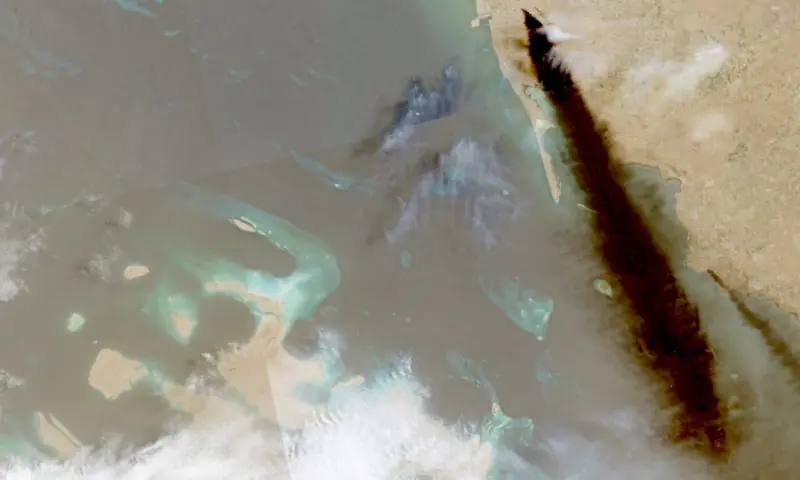
Strikes by Houthi rebels on Sunday killed at least 11 people, a medical source in the Yemeni port city of Mokha told AFP, after an earlier drone salvo targeted a Saudi oil refinery on the Red Sea coast.
A years-long truce in Yemen’s civil war between the Houthis and the internationally recognised government appeared to collapse last month as fighting between regional allies of the United States and Iran flared.
The breakdown of the UN-backed 2022 accord came as the rebels announced a maritime blockade of Saudi Arabia, hitting Saudi tankers in the Red Sea and the kingdom’s oil infrastructure, in parallel with Iran’s blockade of the Strait of Hormuz.
A medical source in Mokha, held by Yemen’s internationally recognised, Aden-based government, said three civilians and eight military personnel had been killed in the Houthi attacks.

A further 32 individuals were wounded, six of them civilians, the source added, explaining all the civilian casualties had been a result of strikes on Mokha’s port.

Two military sources with the government forces earlier confirmed at least eight troops had been killed in the strikes and more than 40 personnel were injured.
The Houthis’ military spokesman Yahya Saree claimed the group had targeted “Saudi enemy” troops and equipment in the area with missiles and drones.

The two military sources with the Aden-based government confirmed the Houthis attacked Yemen’s Mokha with several waves of missile and drone barrages.
One of the two military sources said the Houthis also targeted pro-government forces and installations outside Mokha and sites on islands near the Bab al-Mandeb Strait, the shipping chokepoint at the southern entrance to the Red Sea.
The same military source said some locations targeted by Houthis housed Saudi troops but no casualties had been reported among military personnel from the Gulf kingdom.
Residents in government-controlled Mokha confirmed to AFP they heard blasts in the area, with one saying they “heard explosions from drones and air defences over the port and city”.
Another resident said they heard “six consecutive explosions” in the port.
Aramco oil facility targeted
Earlier in the day, Saudi Arabia’s energy ministry said civil response teams had brought under control a fire at the Jazan refinery, without giving the cause of the blaze.
“Saudi Aramco’s industrial security firefighting teams extinguished a fire that broke out at dawn today, Sunday, at one of the facilities belonging to the Saudi Aramco refinery in Jazan, without any injuries,” the ministry said.
Saree claimed that Houthis attacked the facility operated by Saudi Arabia’s state-owned oil firm in response to incursions by drones from the kingdom into northwest Yemen.
The facility was also targeted by Yemen’s Houthi rebels in July. Aramco had shut down the refinery as the attack damaged the plant’s Integrated Gasification Combined Cycle (IGCC) complex and tank farm area, according to a note from consultancy IIR seen by Reuters.
The Jazan refinery processes 400,000 barrels of crude oil per day and produces refined products including gasoline and ultra-light sulfur diesel.
Aramco chief Amin Nasser said last week that recent attacks on the company’s facilities had caused some production interruptions but that he was confident operations could be restored quickly. He said the attacks had no material operational or financial impact.
The Houthis control vast swathes of Yemen, including the capital Sanaa and areas on the border with Saudi Arabia’s Red Sea provinces.
The Yemeni threat to shipping and Saudi oil facilities comes in parallel with Iran’s blockade of the Strait of Hormuz, which has become the central flashpoint between Tehran and Washington amid efforts to end the Middle East war begun by the US and Israel in February.
In July, the Houthis had announced a maritime blockade of Saudi Arabia, hitting Saudi tankers in the Red Sea.
Pakistan had condemned the Houthis’ threats to Saudi Arabia and to trading with the kingdom via the Red Sea. It also warned that it had the right to self-defence if its “maritime interests” were targeted in “any hostile act”.
Last week, Saudi Arabia unveiled plans for a multinational maritime defence coalition to protect shipping and energy supply routes in the Red Sea. Fourteen countries, including Pakistan, have voiced support for the coalition.
On Friday, Pakistan, Saudi Arabia and Turkiye signed a joint defence agreement under which an attack against one of them would be treated as an attack against all of them.
