




• Trump expects deal to be finalised ‘in a day or two’
• Calls PM, army chief ‘fantastic people’
• Asserts Lebanon conflict separate from Hormuz deal; Iran insists Hormuz opening linked to Lebanon ceasefire
• Dar says Islamabad wants ‘permanent’ end to war, urges both sides to show flexibility
• US-Iran draft deal may include $20bn for uranium rollback
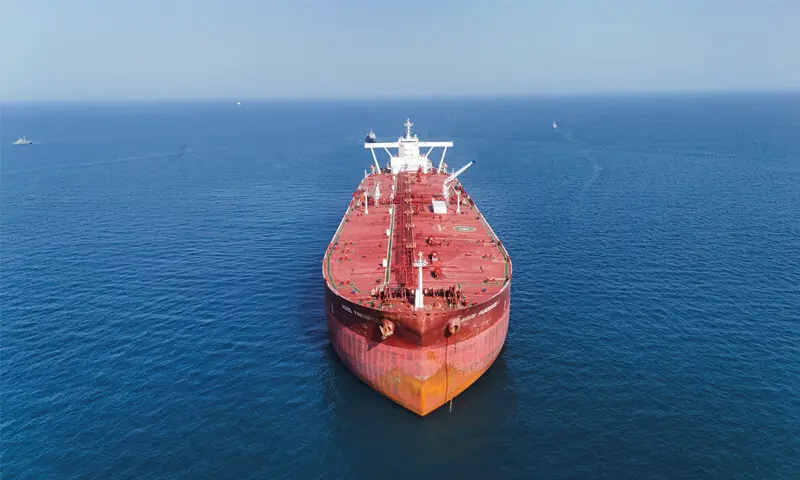
WASHINGTON: US President Donald Trump appreciated Iran and praised Pakistan on Friday, declaring that the Strait of Hormuz was “fully open and ready for full passage” but a US naval blockade on Iran would remain in place until an agreement was finalised, soon after Iranian Foreign Minister Abbas Araqchi announced the Strait was open for “all commercial vessels” till the time the Lebanon ceasefire was in place.
The US and Iranian negotiators are expected to meet over the weekend and are closing in on a three-page framework to end the conflict, a report by Axios said, as Trump expressed optimism that a deal could be reached “in the next day or two”.

The dual framing by Trump, however, appears aimed at presenting a rapid de-escalation in one of the world’s most sensitive shipping lanes while simultaneously projecting leverage over Tehran, with the mention on ‘naval blockade’, during the next round of negotiations.
“The Strait of Hormuz is completely open and ready for business and full passage, but the naval blockade will remain in full force and effect as it pertains to Iran, only, until such time as our transaction with Iran is 100% complete,” Trump wrote on his Truth Social platform.

“This process should go very quickly in that most of the points are already negotiated.”
Trump praised regional partners and claimed a breakthrough in maritime tensions. He thanked Pakistan and its leadership, writing: “Thank you to Pakistan and its great prime minister and field marshal, two fantastic people!” In another post, he declared, “A great and brilliant day for the world!”
“Iran has agreed to never close the Strait of Hormuz again. It will no longer be used as a weapon against the world!” he said. Interestingly, he claimed, “Iran, with the help of the US, has removed, or is removing, all sea mines.”
Iran’s Foreign Minister Araghchi had earlier declared, “In line with the ceasefire in Lebanon, the passage for all commercial vessels through Strait of Hormuz is declared completely open for the remaining period of ceasefire.” Military vessels are still banned from the waterway, a senior Iranian military official told state media.
A spokesperson for Iran’s president, Seyyed Mohammad Mehdi Tabatabaei, lashed out at the “baseless statements of the enemy”, shortly afterwards, Al Jazeera reports. He said, “The conditional and limited reopening of a portion of the Strait of Hormuz is solely an Iranian initiative, one that creates responsibility and serves to test the firm commitments of the opposing side. If they renege on their promises, they will face dire consequences.”
However, while insisting that the maritime arrangement was separate from other regional conflicts, Trump stated, “Again! This deal is not tied, in any way, to Lebanon, but we will make Lebanon great again!”
While calling on Washington and Tehran to “show flexibility”, Foreign Minister Ishaq Dar said Pakistan wants a “permanent termination” of the US-Israeli war on Iran. Islamabad’s “objective is not ceasefire extension. Our main objective is the permanent termination of war,” and an agreement between the parties, Dar said, according to Anadolu Agency. “More than 80pc of the work has been done. And a couple of things are (remaining)… both parties have to show flexibility,” he added.
Earlier, Trump said, “Israel will not be bombing Lebanon any longer. They are prohibited from doing so by the USA. Enough is enough!”
Meanwhile, Lebanese President Joseph Aoun said his country was on the verge of a “new phase” of “permanent agreements”, after the ceasefire went into force. “Now, we all stand before a new phase,” Aoun has said in his first speech to the nation since the truce, adding, “it is the phase of transition from working on a ceasefire to working on permanent agreements that preserve the rights of our people, the unity of our land, and the sovereignty of our nation.”
Frozen assets, uranium
On the other hand, Trump said the US would retain uranium and related materials from its military operations: “The USA will get all nuclear ‘dust’, created by our great B2 bombers — no money will exchange hands in any way, shape or form. This deal is in no way subject to Lebanon, either.”
According to Axios, the United States and Iran are working towards a three-page draft framework aimed at ending the conflict, with negotiations said to have made significant progress in recent days.
One proposal under discussion involves the release of up to $20 billion in frozen Iranian assets in exchange for Tehran surrendering its stockpile of enriched uranium and agreeing to a moratorium on enrichment activities.
While Trump has expressed confidence that an agreement could be finalised soon, Axios reported that multiple US officials and other sources briefed on the negotiations said that “gaps still remain on critical issues”.
President Trump had earlier indicated both sides were likely to meet this weekend for a second round of talks aimed at finalising an agreement. The discussions are expected to take place in Islamabad, possibly on Sunday, according to a source familiar with the mediation effort. Pakistan is mediating the process, with behind-the-scenes support from Egypt and Turkiye.
A key priority for the Trump administration remains ensuring that Iran does not retain access to its stockpile of nearly 2,000kg of enriched uranium stored in underground facilities, including about 450kg enriched to 60 per cent purity.
Following the Axios report, Trump wrote on Truth Social that “no money will change hands”, although he did not directly address the reported proposal involving unfreezing Iranian funds.
Separately, sources said, the US had considered releasing around $6bn to allow Iran to purchase food, medicine and other humanitarian supplies, while Iranian negotiators had reportedly sought as much as $27bn in earlier stages of the negotiations. The latest figure under discussion between the two sides is about $20bn, according to the same sources. One US official described the cash-for-uranium idea as “one of many discussions” still on the table.
‘Step in right direction’
Later, UN Secretary-General António Guterres welcomed Iran’s announcements that the Strait of Hormuz is completely open for all commercial vessels for the remainder of the ceasefire.
“This is a step in the right direction,” he wrote in a social media post.
He said the UN position on this issue remains clear: “We need the full restoration of international navigational rights and freedoms in the Strait of Hormuz, respected by everyone.”
The UN chief hoped that this measure, together with the ceasefire, would contribute to creating confidence between the parties and strengthen the ongoing dialogue facilitated by Pakistan.
Diplomatic efforts reportedly involve multiple regional actors, including Gulf states and Pakistan, alongside indirect US-Iran negotiations aimed at stabilising maritime security and regional tensions.
Additional input from agencies
Published in Dawn, April 18th, 2026
