



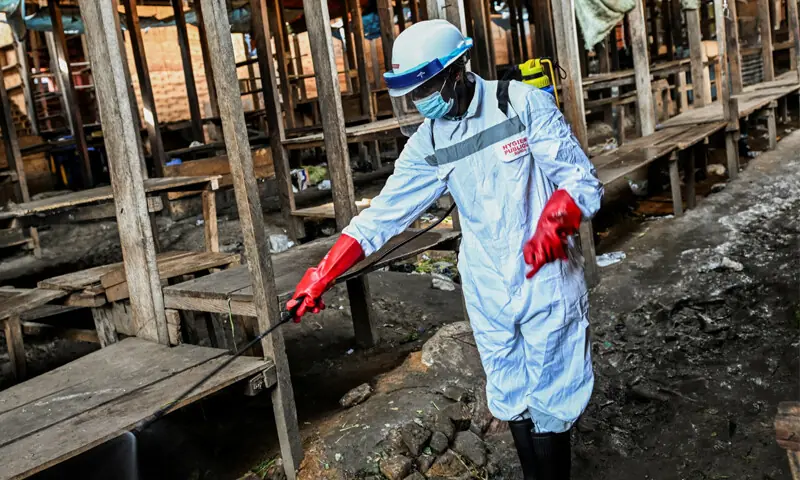
• Health ministry directs provinces, Border Health Services to remain on alert
• Red Cross announces death of three volunteers in DRC
• Uganda confirms three new cases, bringing total to five
• Viral disease ‘threatens 10 nations’, including Kenya and Rwanda
ISLAMABAD: Pakistan has intensified screening measures at airports across the country, along with other precautionary steps, amid the recent Ebola virus outbreak in Africa, the health ministry said on Saturday, a day after the World Health Organisation (WHO) upgraded the risk assessment for the disease.
According to a handout, the ministry said the spread of the Ebola virus outbreak was limited to the Democratic Republic of Congo (DRC) and Uganda, and the risk to Pakistan was “extremely low” due to limited travel links with the affected countries.
It added that Federal Health Minister Mustafa Kamal had directed authorities to implement precautionary screening protocols at all airports to prevent the possible spread of the virus.

The ministry further stated that the National Institutes of Health (NIH) and the WHO office in Pakistan were continuously monitoring the situation.

The ministry directed all provinces and the Border Health Services to remain on alert. It also noted that Pakistan possessed the capacity to diagnose Ebola and said directives had been issued to ensure all necessary arrangements and preparedness measures were in place.
It said the WHO had recommended enhanced precautionary surveillance measures, but not advised any travel restrictions.

“No Ebola case has ever been reported in Pakistan or its neighbouring countries,” the ministry said.
It added that citizens travelling to African countries had been advised to review the relevant travel and health advisories issued by those countries before departure.
Ebola is a deadly viral disease that spreads through direct contact with bodily fluids. It can cause severe bleeding and organ failure. There are no approved vaccines or therapeutics for the Bundibugyo strain of Ebola behind the current outbreak.
There have only been two previous outbreaks of Bundibugyo, in Uganda in 2007 and the DRC in 2012.
Speaking to Dawn, the head of the Centre for Disease Control (CDC) at NIH, Dr Mumtaz Ali Khan, said the institution possessed the facility to test Ebola samples.
“The same capacity is also available at reference laboratories in different parts of the country and NIH has decided to provide them with testing kits,” he said.
“The positive thing is that the virus is so far limited to Africa, and we have just a few direct flights from Pakistan to Africa,” he said.However, Dr Mumtaz said a number of ships arriving at Pakistan’s ports from Africa were also being screened.
He said health practitioners and hospital staff were also being trained to deal with suspected cases.
Three deaths
The Red Cross announced on Saturday that three volunteers had died in the Democratic Republic of Congo after apparently contracting Ebola while on duty there in March.
The central African country has been gripped by an outbreak of the deadly viral disease which the WHO has declared an international public health emergency. The International Federation of Red Cross and Red Crescent Societies (IFRC) said the volunteers were from the DR Congo Red Cross in Ituri, the northeastern province which is the outbreak’s epicentre.
They worked for the Mongbwalu branch of the organisation in Djugu territory, Ituri. “Alikana Udumusi Augustin, Sezabo Katanabo and Ajiko Chandiru Viviane are believed to have contracted the Ebola virus on duty, while carrying out dead body management activities on March 27 as part of a humanitarian mission unrelated to Ebola,” the IFRC said in a statement.
Fresh cases
Meanwhile, three new Ebola cases have been confirmed in Uganda, health authorities said.
The new cases bring to five the total confirmed in Uganda since the current outbreak was discovered in the east African country on May 15. One person has died. The health authorities named the patients as a Ugandan driver, a Ugandan health worker and a woman from the DRC, the epicentre of the outbreak.
“Three new cases of the Ebola Virus Disease have been confirmed in the country,” the Ugandan health ministry said in a statement on X. All three are alive.
The African Union’s health agency warned that more countries on the continent were at risk of being affected by the Ebola virus, in addition to the DRC and Uganda. “We have 10 countries at risk,” said Jean Kaseya, head of the Africa Centres for Disease Control and Prevention, listing Angola, Burundi, the Central African Republic, the Republic of Congo, Ethiopia, Kenya, Rwanda, South Sudan, Tanzania and Zambia.
Kaseya said “high mobility and insecurity” in the region were helping spread the disease.
There are 82 confirmed cases and seven confirmed deaths in the vast, unstable DRC, alongside almost 750 suspected cases and 177 suspected deaths, the WHO said on Friday. It also raised the risk from Ebola in the DRC to “very high”.
With input from Agencies
Published in Dawn, May 24th, 2026
