


Govt appoints Yahya Akhunzada to K-P administration, Dr Muhammad Fakhr Alam Irfan as chief secretary
ISLAMABAD:
Khyber-Pakhtunkhwa (K-P) Governor Faisal Karim Kundi on Sunday said the state was determined to rid the province of terrorists, as he chaired the first meeting of the provincial advisory council following the imposition of emergency and governor’s rule in K-P.

The federal government imposed emergency and governor’s rule in Khyber-Pakhtunkhwa (K-P) after President Asif Ali Zardari signed the summary on the advice of Prime Minister Shehbaz Sharif, following the federal cabinet’s approval of the recommendation.

“Pakhtuns are the biggest victims of terrorism. Therefore, it is the government’s resolve to rid the people of K-P of terrorism and provide them with an environment where their children can go to school, conduct business, travel and dream of a better future. My first priority will be peace and public security,” Kundi said while chairing the first meeting of the provincial advisory council.
“Our fight is against terrorism, the mindset and networks that sustain it, and the environment that allows it to flourish and weakens the rule of law,” Kundi said.

He underscored that restoring peace, strengthening security, ensuring stability and accelerating development in K-P were his foremost priorities, stressing that the extraordinary administrative measures taken in view of the prevailing situation were aimed at strengthening state institutions and eliminating terrorism, not targeting any political party, individual or section of society.
Kundi stated that he was speaking not merely as the provincial governor but as someone who understood K-P’s suffering, challenges and public aspirations, further adding that his sole objective was to take the province back towards peace, security, stability and development.
He further stated that the people of K-P had paid a tremendous price for terrorism, with police officers, military personnel, Levies personnel, government employees, religious scholars, teachers, traders and ordinary citizens sacrificing their lives.
“Mothers have lost their sons, children their parents, and families their loved ones. The time has come for the people to receive their right to peace after these sacrifices”.
Kundi said that to break the terrorist ecosystem, the state would also have to act against facilitation networks, financial support, extremism, illegal weapons, drugs, unlawful movement and other mechanisms sustaining terrorism, further noting that the effective implementation of the National Action Plan and other relevant counterterrorism measures would remain a priority.
Restoring law and order, improving governance and implementing the National Action Plan top the agenda as KP Governor Faisal Karim Kundi chairs the newly formed 11-member advisory council. He stresses closer coordination with the federal government to combat terrorism and deliver… pic.twitter.com/EPK7jZuRcH
— Pakistan TV (@PakTVGlobal) October 11, 2026
“The law will take action against anyone who commits terrorism, and it will also reach those who facilitate it,” he said, clarifying that the action would not target any nation, language, region or political affiliation, but would be directed exclusively against elements violating the law.
Kundi said his first priority would be “peace and public protection”, with particular emphasis on effective counterterrorism operations, further adding that the state must stand firmly behind police personnel confronting terrorists and ensure that neither they nor their families are left unsupported. “The capacity of the police and the Counter Terrorism Department will be strengthened through improved resources, training, technology, intelligence support and modern weapons”.
Kundi outlined that his second priority would be to strengthen the “writ of the state” in conflict-affected districts, whose residents had endured terrorism, displacement, inadequate basic facilities and prolonged deprivation, while pledging greater attention to ensuring these areas received their due share of development, education, healthcare, employment, roads, electricity, water and administrative services.
“The state’s duty is to give greater attention to areas where deprivation is greater,” he remarked.
Kundi identified “public service delivery” as his third priority, saying a government should be judged by the facilities it provides rather than its statements, further adding that his administration would focus on improving government hospitals, schools, roads, municipal services, healthcare, education and justice. “The state exists for the citizen, not the citizen for the state.”
Addressing young people, Kundi said the province’s future lay in education, employment, sports, technology, business opportunities and a society in which young people could realise their ambitions. “The state’s responsibility is to give young people not guns, but pens, books, skills, employment and hope.”
“We will make it a land of peace. We will make it a land of development. We will make it a land of opportunities,” he added.
Earlier, the federal government formed an 11-member advisory council to oversee administrative affairs in K-P and ordered the immediate establishment of an Area Development Secretariat (ADS) in 12 designated districts to improve law and order, public safety, strengthen governance and promote development.
According to the order, the K-P governor would perform the functions of the provincial government on behalf of the federal government, with assistance from an 11-member advisory council.
خیبرپختونخوا کے لیے 11 رکنی مشاورتی کونسل تشکیل دے دی گئی
Disclaimer: For news reporting and informational purposes only. Views or actions expressed by subjects do not imply endorsement by Express News . Shared in the public interest in compliance with community guidelines.… pic.twitter.com/TjJJMvpvET— Express News (@ExpressNewsPK) October 11, 2026
Read: Emergency, governor’s rule imposed in K-P after president signs summary on PM Shehbaz’s advice
The council comprises Tariq Mahmood Pasha, Dr Aamir Abdullah, retired Lieutenant General Nigar Johar, Samar Bilour, Dr Sarfaraz Ali, Aamir Javed, Dr M Irshad, Kefayatullah, Tayyab Qureshi, Usman Saifullah Khan and Asif Rafiq.
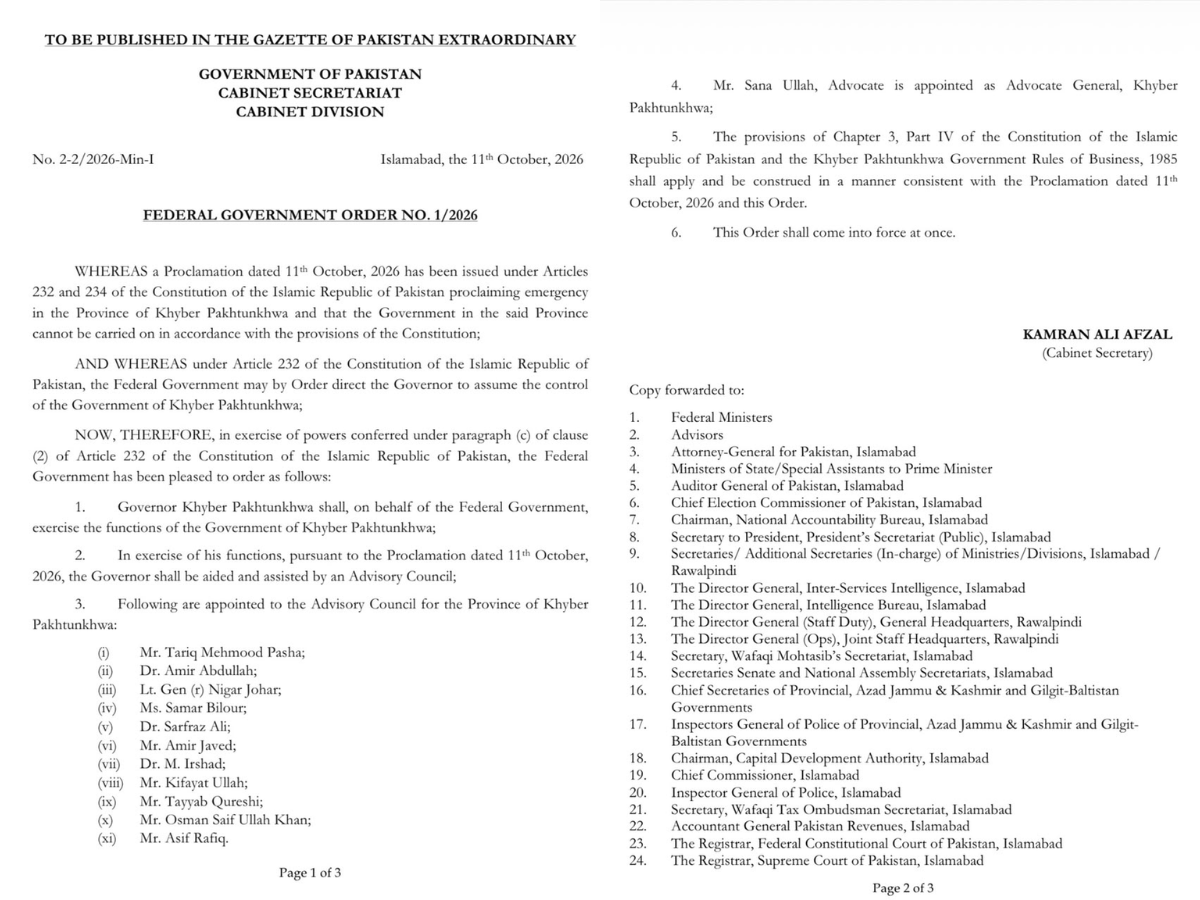
The federal government has also appointed Sanaullah Advocate as the Advocate General of K-P, according to the order.
The order stated that provincial government affairs would be conducted in accordance with the relevant constitutional provisions and the K-P Government Rules of Business, 1985, in a manner consistent with the federal directive.
Govt orders establishment of Area Development Secretariat in designated districts of K-P
In a federal government order issued in a Gazette notification, the federal government notified that the ADS would operate under the supervision of the Area Representative and Development Council (ARDC).
According to the order, the designated districts included Dera Ismail Khan, Tank, Lakki Marwat, Bannu, Bajaur, Mohmand, Khyber, Kurram, Orakzai, North Waziristan, Upper South Waziristan, and Lower South Waziristan.
The federal order noted that the ARDC would comprise prominent figures from the designated districts and would be headed by a chairman, further adding that the appointment of the ARDC chairman, vice chairman, spokesperson, and members would be carried out in accordance with the prescribed procedure and tenure.
It added that the ADS would be headed by the additional chief secretary (Designated Districts) of K-P, who would also serve as the administrator for these districts, while stating that the provincial government officers and personnel from other agencies deployed in the designated districts would remain under the administrative and operational control of the ADS.
The federal directive said that the prime minister may, from time to time, order further postings and transfers in the designated districts based on the administrator’s recommendations, further noting that the administrator would exercise all “administrative, managerial, and law enforcement powers” of the provincial government within the designated districts.
It further said that the administrator, in the designated districts, would have the authority to establish organisational structures for governance, security, and development, and to oversee the district administration, law enforcement agencies and relevant departments.
According to the federal order, the administrator would also be empowered to issue directives to the civil administration, police, and military authorities, adding that the administrator would be able to issue orders regarding the “operational, organisational, and administrative affairs of the ADS”.
The administrator would also have the authority to “issue orders for the allocation and transfer of funds”.
It added that law enforcement and security matters in the designated districts would be improved through coordination with federal agencies, the armed forces, and provincial institutions, further stating that departments might be restructured, and necessary measures taken, to ensure public safety, economic stability, relief operations, and the provision of essential services.
The federal order underlined that “orders, notifications, directives, and measures” issued by the administrator would hold the same legal status as those issued by the provincial government.
It added that under the federal order, the provisions of the Constitution—specifically Chapter III, Part IV, and Article 175, Clause (3)—as well as the K-P Government Rules of Business 1985, would not apply to the designated districts.“This Order shall come into force at once,” the notification stated.
