



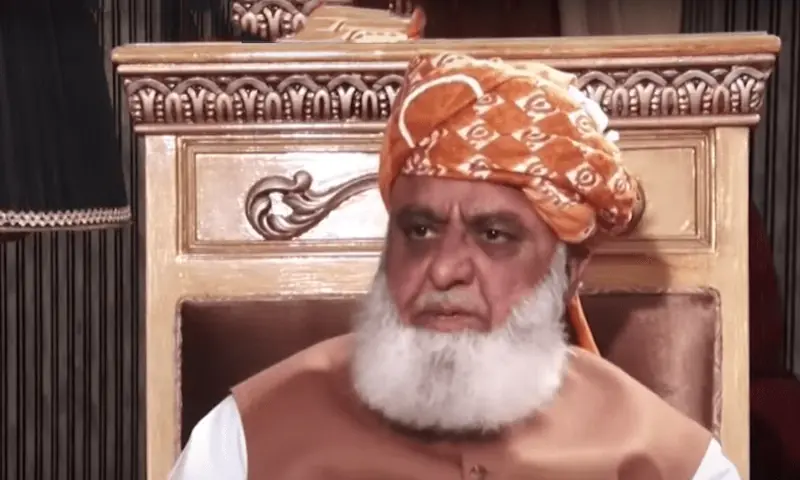
• JUI-F leader says criticism not aimed at institution
• Insists he has utmost respect for martyrs, recalls how many comrades have fallen prey to terrorism
ISLAMABAD: JUI-F chief Maulana Fazlur Rehman on Sunday refused to apologise for his controversial remarks about security personnel, saying he had no disagreements with state institutions; rather his misgiving were with those “at the helm of affairs”.
In a no-holds-barred address to a party lawyers’ convention in the federal capital, the JUI-F chief slammed what he termed “a propaganda campaign” against him.
The Maulana was alluding to his remarks at a political gathering in Kasur last week, where he spoke about security and terrorism in Khyber Pakhtunkhwa and Balochistan, where he reportedly made certain comments about security personnel.


The statement had drawn widespread condemnation from political circles, and a number of ruling party ministers and leaders called on him to apologise for his remarks, and withdraw them.
The JUI-F chief, however, maintained that he did not intend to disrespect soldiers or the institution; rather, his criticism was aimed at those who were in charge of policymaking.

The veteran politician said he had only reminded the security institution of its responsibilities and that it should operate within its constitutional jurisdiction.
The JUI-F leader claimed that his remarks were being misconstrued to malign him and his party, reiterating that a difference of opinion should not be taken as “enmity” against the state.
He asserted that he would not backtrack from his remarks under pressure, adding that the facts cannot be changed by vilifying him.
The Maulana said he had always honoured martyrs and paid tribute to their sacrifices, adding that politics should not be played over their honour.
Respecting the families of the martyrs is our collective responsibility, he said, recalling that several of his comrades had also fallen victim to terrorism.
According to the JUI-F chief, the supremacy of the Constitution is the source of the state’s strength, and respect for any institution is linked to its constitutional role. Criticism of policies should not be equated with hostility towards the state, he said, adding that solutions to national issues lie in dialogue and sound policies.
The Maulana also touched upon another contentious issue in his speech — the delay in the registration of religious seminaries.
He said an agreement had been signed in 2004-2005 for the registration of these religious schools, but there was no progress in this regard.
He also claimed that the current government was a “product of electoral rigging”, and insisted that his party was offered to become part of the government in Balochistan, and replace the PTI in Khyber Pakhtunkhwa, but they had turned down both offers.
The JUI-F leader said terrorism was on the rise in Khyber Pakhtunkhwa’s southern districts and called for an in-camera parliamentary session to be convened on the issue so lawmakers could at least learn about the gravity of the security situation.
Published in Dawn, July 20th, 2026
