





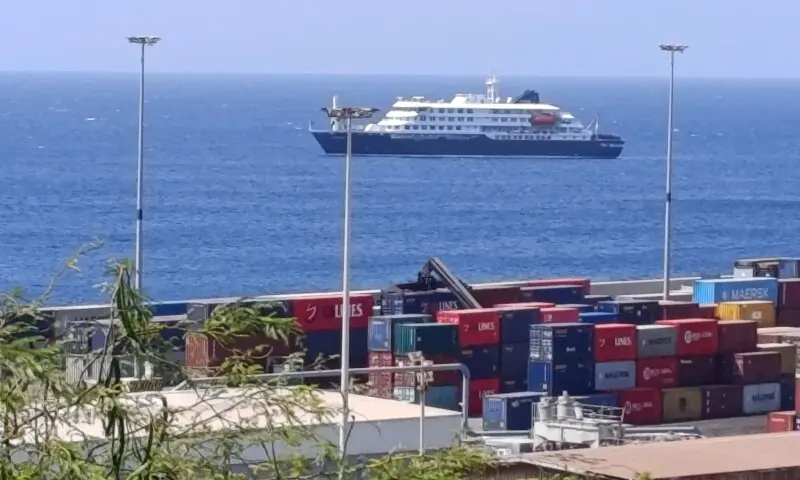
Groups of passengers and crew disembarked from a cruise ship hit by a deadly hantavirus outbreak on Sunday to be evacuated to their home countries where they will isolate according to national protocols to prevent further spread of the disease.
Government planes carrying Spanish and French nationals landed in Madrid and Paris, where the passengers were transported to hospitals, according to the two countries’ governments.
One of the five French passengers showed symptoms during the repatriation flight, French Prime Minister Sebastien Lecornu said on X.
Planes to Canada, the Netherlands, Turkey, the UK, Ireland, and the United States were due to depart by 8:30 local time on Sunday, with the final flights departing on Monday.
The passengers will be tested upon arrival and then either taken to local hospitals or quarantine facilities or transported home for isolation.

The World Health Organisation has recommended a 42-day quarantine for all passengers from the boat from Sunday, its director of epidemic and pandemic management Maria Van Kerkhove said in a briefing.
The Spanish passengers will be kept in hospital for the full 42 days, while French passengers will be hospitalised for 72 hours, then allowed home to self-isolate for a further 45 days, according to the respective governments.
“Our recommendation is daily health checks, at home or in a specialised facility. It’s up to countries to develop their policies, but our recommendations are very clear,” Van Kerkhove said, highlighting that the incubation period for the virus was up to six weeks.
‘This is not Covid’
The virus, usually spread by rodents but also transmittable person-to-person in rare cases of close contact, was first detected by health officials in Johannesburg on May 2 while treating a British man who fell ill and was taken into intensive care, 21 days after another passenger had died.
The man’s health has since improved, a WHO official said on Sunday.
The WHO said the first passenger who died on the ship may have been infected before boarding, possibly during travel in Argentina and Chile.
Eight people no longer on the ship have fallen ill, according to a WHO tally from Friday, of whom six are confirmed to have contracted the virus. Three have died — a Dutch couple and a German national.
Four remain hospitalised in South Africa, the Netherlands and Switzerland. On the remote island of Tristan da Cunha, a British overseas territory, a suspected case is being treated by a team of medical specialists parachuted in by the UK military.
Still, health officials urged calm, reminding a public scarred from the experience of the Covid-19 pandemic that this virus was far less contagious and posed little risk to the general population.
A woman in Spain who was tested for the virus after sharing a flight with one of the victims tested negative.
“This is not Covid, and we don’t want to treat it like Covid,” acting US CDC Director Jay Bhattacharya said in an interview with CNN on Sunday, adding the 17 US passengers from the ship would be given the choice of isolating at home or at a facility in Nebraska.
Spain’s health ministry also downplayed the risk to the broader population. It added that rodents had not been detected aboard the ship.
Crew, ship set to sail on to Netherlands
The luxury cruise ship left for Spain on Wednesday from the coast of Cape Verde after the WHO and European Union asked the country to manage the evacuation of passengers after the outbreak was detected.
Passengers were taken from the ship to shore in small boats and transported to Tenerife airport in military buses, without coming into contact with the public.
Thirty crew members will remain on board and sail to the Netherlands on Monday evening where the ship will be disinfected.
“Thank God we are all fine … I hope we’ll get through the quarantine process smoothly and be able to see family and friends again,” Turkish birdwatcher Emin Yogurtcuoglu, a passenger on the ship, wrote in a public post on Instagram.
All passengers considered high-risk contacts: EU agency
Europe’s public health agency said ahead of the ship’s expected anchoring on Sunday off the Spanish island of Tenerife that all passengers on the cruise ship were considered high-risk contacts as a precautionary measure.
Passengers without symptoms will be repatriated for self-quarantine via specially arranged transport, not regular commercial flights, by their respective countries, the European Centre for Disease Prevention and Control (ECDC) said on Saturday as part of its rapid scientific advice.
Although at disembarkation, passengers will be considered high-risk, not all will necessarily be considered high-risk upon return to their home countries, the ECDC said.
The agency urged symptomatic passengers to be prioritised for medical assessment and testing on arrival, adding they may isolate in Tenerife or be medically evacuated home, depending on their condition.
UK army in ‘daring’ parachute op to aid suspected Hantavirus patient
Earlier on Sunday, British military personnel carried out an airborne operation to deliver urgent medical support for a suspected Hantavirus patient on a South Atlantic island, ministers said.
An army specialist team parachuted onto the island of Tristan da Cunha, Britain’s most remote overseas territory, a defence ministry statement said.
One of three British nationals diagnosed with suspected hantavirus linked to the outbreak on the MV Hondius cruise ship is on the island.
The team of six paratroopers and two military clinicians, all from the 16 Air Assault Brigade, descended from a Royal Air Force (RAF) A400M transport aircraft “in a daring parachute drop”, the statement said.
Vital oxygen supplies and other medical aid were air-dropped almost simultaneously.
The urgent response came after confirmation by the UK Health Security Agency (UKHSA) on Friday of a suspected infection in a British national on the island.
Tristan da Cunha, a group of volcanic islands with a population of around 220 has no airstrip and is accessible only by boat.
With oxygen supplies at critically low levels, officials said an airdrop was the only viable option to deliver care in time and support the island’s two-person medical team.
Foreign Secretary Yvette Cooper paid tribute to the armed forces for an “extraordinary operation”.
The drop involved a long-range flight of nearly 6,800 kilometres from RAF Brize Norton in central England to Ascension Island, followed by a further 3,000-kilometre flight to Tristan da Cunha, the statement said.
