



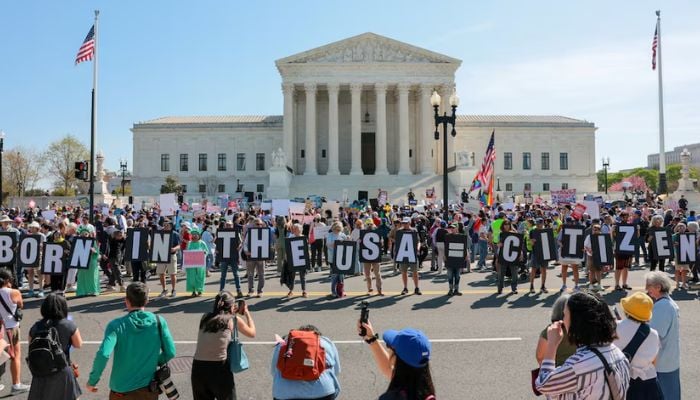
The US Supreme Court is set to rule on a landmark legal challenge to the long-standing practice of birthright citizenship in the United States.
The ruling will decide whether to let President Donald Trump restrict birthright citizenship, a rule that grants those born in America citizenship.
At the heart of this issue lies the case titled Trump vs Barbara that revolved around the constitutionality of Executive Order 14160, signed by the President shortly after his inauguration in January 2025.
The order directs federal agencies to deny birthright citizenship to children born in the US if neither parent is a US citizen or a legal permanent resident as a green card holder. However, a lower court blocked the executive order.

What is birthright citizenship & its relation to 14th amendment
At the core of the case is the Citizenship Clause of the 14th amendment, stating, “All persons born or naturalized in the United States, and subject to the jurisdiction thereof, are citizens of the United States and of the State wherein they reside.”

The 14th amendment was added to the charter in 1868 following the Civil War. The purpose of the addition is to grant citizenship for formerly American-born enslaved people.
Position of Trump administration
According to the Trump administration, the “subject to the jurisdiction thereof” clause requires more than mere presence in the US and it also excludes children of immigrants who reside in the country illegally or living on temporary visas.

So citizenship should only be granted to those whose “primary allegiance is to the United States,” including citizens and permanent residents. President Trump’s legal team also argues that “birth tourism” has created a loophole that undermines national sovereignty.
As per the teamteam, allegiance is only possible through acquiring lawful domicile, defining it as “lawful, permanent residence within a nation, with intent to remain.”
On the contrary, the challengers argued that the 14th amendment’s text is clear and it grants everyone US birthright citizenship
They maintain that “subject to the jurisdiction” has historically included almost everyone physically present in the US with very narrow exceptions, such as children of foreign diplomats.
What’s at stake?
If the Supreme Court issues a ruling in the favor of the Trump administration, the federal agencies will stop accepting the automatic-granted citizenship rights, giving a blow to those children whose parents lack specific legal status.
The case also proves to be a test of presidential authority and will reshape how an executive order can redefine a constitutional guarantee. It will raise concerns over the overarching powers of the executive over fundamental rights.
Experts estimate the directive could affect the legal status of up to 250,000 babies annually and potentially require millions of families to provide proof of citizenship status for their newborns.
