



THE first year of Pakistan’s unified agriculture income tax regime has exposed a stark gap between policy ambition and revenue collection, with provincial tax authorities collecting barely 2 per cent of the agricultural income declared by taxpayers during fiscal year 2025-26.
The figures raise fresh questions about the effectiveness of the landmark reform introduced last year under a fiscal restructuring programme backed by the International Monetary Fund.
Despite a harmonised legal framework and uniform tax rates across all four provinces, provisional data shows that around 445,000 taxpayers declared Rs306 billion in agricultural income in tax year 2025, while provincial governments provisionally collected only Rs5.62bn in agriculture income tax (AIT) during the outgoing fiscal year.
Structural weaknesses, weak enforcement, political considerations and the influence of large landowners continue to undermine the provinces’ ability to collect AIT. Although the four provinces agreed on a harmonised legal framework and tax rates, each has adopted a different approach to implementing the tax.

Agriculture income tax collection equals barely 2pc of declared income

For fiscal year 2026-27, Sindh has aligned its super tax on agricultural income with the federal regime while abolishing the advance tax provision.
Punjab and Khyber Pakhtunkhwa have taken the opposite course. Punjab has instead increased advance tax rates, signalling a greater reliance on advance tax collection, while KP has abolished super tax on high-income earners and retained its zone-based fixed tax per acre system.

Balochistan has yet to disclose its AIT policy for the new fiscal year, as the provincial government has not shared its budget white paper 2026-27 and other documents despite repeated requests.
Former chief economist Dr Mohammad Ahmed Zubair said agricultural income taxation sits at the heart of Pakistan’s most entrenched political economy fault lines. Provincial governments are effectively captured by the landed class, so any attempt to tax agricultural income becomes a tax on the governing coalition itself.
“IMF pressure exposes the contradiction but cannot resolve it,” he remarked.
“The reluctance to tax agricultural income reflects a deeper state-capacity deficit: provinces lack both the administrative machinery and the political autonomy to confront powerful rural constituencies,” the chief economist said, adding that the IMF programme has exposed the gap between formal policy commitments and the political will needed to enforce them.
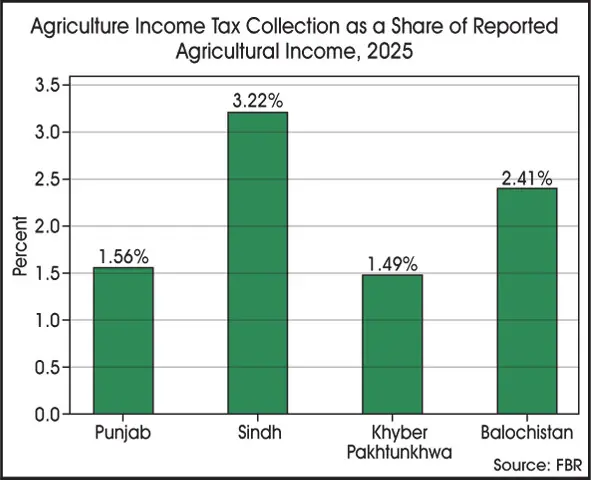
A province-wise analysis of the provisional data shows considerable room to improve AIT collection. Punjab accounted for the largest share of agricultural income declared in tax year 2025, yet it collected tax equivalent to only 1.56pc of that income. Sindh recorded the highest collection ratio at 3.22pc, followed by Balochistan at 2.41pc. KP collected tax equivalent to 1.49pc of declared agricultural income.
The weak collection ratios suggest that agriculture income tax remains one of the few untapped sources of provincial revenue at a time when provinces are under increasing pressure to mobilise their own resources from direct taxes.
Associate Professor of Economics at LUMS, Dr Ali Hasnain, said provinces would have to rely more on constitutionally assigned taxes, particularly AIT, as the federal government’s fiscal space narrows and development spending comes under pressure.
He cautioned, however, that taxing agricultural income would remain challenging because of weak land records, fluctuating farm incomes and the political influence of large landowners. He argued that an effective system could protect small farmers while ensuring large commercial farmers and absentee landowners contribute a fair share of taxes.
Despite administrative reforms, structural challenges continue to limit the effectiveness of AIT in the provinces. Political patronage, weak land title clarity, and the entrenched patwari culture within revenue departments remain key obstacles to enforcement.
Data gaps persist, with land and crop records often incomplete or inconsistent even under digitisation initiatives. Officials claim the agriculture sector is no longer serving as a tax shelter, though concerns remain about reporting of expenditures and losses, and uneven implementation.
Punjab
Punjab presents the clearest example of the gap between declared agricultural income and actual tax collection.
The province had originally projected Rs10.5bn in AIT collection for fiscal year 2025-26 but later revised the target downward to Rs3.9bn in the 2026-27 budget, implying a shortfall of Rs6.6bn, or nearly 62pc. The achievement of the revised collection will not be clear until final figures are compiled at the end of June.
Despite missing the original target by a wide margin, the province has set an even higher collection target of Rs12.5bn for fiscal year 2026-27, signalling stronger enforcement measures to improve compliance.
Official data shows that around 396,000 taxpayers in Punjab declared Rs293bn in agricultural income in their federal income tax returns for tax year 2025.
Although agricultural income is exempt from federal income tax and falls under provincial jurisdiction, the declarations provide a clear indication of the taxable base available to provincial authorities.
The wide gap between declared income and actual tax collection points to significant untapped revenue potential among land-owning elites in the province.
According to the Seventh Agriculture Census 2025, Punjab had about 5.05 million farms spread over 31.04m acres, of which 29.6m acres were under cultivation. The average farm size was 6.1 acres, with 5.9 acres cultivated. These indicators suggest a substantial portion of agricultural income remains outside the effective tax net in the province.
In the 2026-27 budget, the main policy measure was an increase in advance tax rates. Landholdings exceeding 12.5 acres will now pay a flat advance tax of Rs1,000 per acre, replacing the previous slab-based system under which rates ranged from Rs300 to Rs500 per acre. Advance tax on irrigated orchards has also been increased from Rs600 to Rs1,000 per acre, while the rate for non-irrigated orchards has risen from Rs300 to Rs500 per acre.
At the federal level, the government has raised the super tax exemption threshold to Rs500m while reducing the maximum rate to 8pc from 10pc.
However, corresponding changes do not appear in the Punjab Finance Bill 2026, and there are unconfirmed reports the province may abolish the agriculture income super tax altogether. Repeated requests to the Senior Member of the Board of Revenue for clarification remained unanswered.
According to the provincial budget white paper 2026-27, reforms since 2024 include revised tax slabs, stronger enforcement powers, enhanced penalties, longer reassessment periods and greater use of digital systems to improve transparency.
The white paper also acknowledges that revenue collection will remain vulnerable to higher input costs, changing cropping patterns, export disruptions and climate-related shocks, all of which could limit AIT collection in the short term.
Sindh
Sindh’s agriculture income tax performance also remains well below potential, with a wide gap between declared farm income and actual tax collection. The province had set an AIT target of Rs6bn for fiscal year 2025-26 but revised it downward to Rs1.9bn in the 2026-27 budget, reflecting a sharp revenue shortfall. For the new fiscal year, the target has been reset at Rs6bn.
Unlike the other three provinces, where the Board of Revenue administers AIT, Sindh has assigned the responsibility to the Sindh Revenue Board (SRB). Even so, tax compliance remains weak.
Around 45,000 taxpayers declared agricultural income of Rs44bn in their tax returns for tax year 2025, suggesting the province has a much larger taxable base than current collections indicate. As in Punjab, land-owning elites in Sindh pay a negligible tax compared with what is actually due on their incomes.
The Seventh Agriculture Census 2025 also points to significant untapped potential. Sindh has about 1.83m farms spread across 8.1m cultivated acres, including 7.3m irrigated acres. The average farm size is 5 acres, with 4.4 acres under cultivation. Despite this sizeable agricultural base, tax collection remains modest.
The Sindh government has opted for a different policy approach from Punjab. In the 2026-27 budget, it aligned the super tax on agricultural income with the revised federal rates, reducing the maximum rate from 10pc to 8pc for income exceeding Rs500m.
It has also abolished the advance agriculture income tax, signalling a shift towards assessment-based taxation, and rationalised penalties for late filing to encourage compliance, while adopting the federal income tax slabs, including the annual exemption threshold of Rs600,000.
Officials at the SRB say the board has accelerated efforts to document a sector that has historically remained outside the tax net, using online registration and return-filing systems supported by data-sharing arrangements with federal and provincial agencies.
They add that the board is using active taxpayer lists, satellite imagery and drone surveys to verify cultivated land, and plans to introduce risk-based audits and integrate bank and mill data on growers from the next fiscal year. Whether these reforms translate into higher revenue will only become clear over time.
Khyber Pakhtunkhwa
KP has shared a similar performance with other provinces in generating revenue from AIT, with collections remaining well below the sector’s apparent potential. The province had projected AIT collection of Rs130m for fiscal year 2025-26 but had collected only around Rs80m by the end of May, making it unlikely the target will be achieved. For fiscal year 2026-27, the target has been raised modestly to Rs160m.
Official data shows that about 14,000 taxpayers declared agricultural income of nearly Rs9bn in their federal income tax returns for tax year 2025, suggesting a substantial portion of taxable agricultural income remains outside the provincial tax net. As in other provinces, the land-owning elite is largely unwilling to pay taxes due on its income.
The Seventh Agriculture Census 2025 also indicates considerable untapped potential. KP has about 4.17m farms covering 8.8m acres, of which 7.2m acres are under cultivation. The average farm size is 2.1 acres, with 1.7 acres cultivated, reflecting high revenue potential relative to declared income.
Unlike the other provinces, KP has abolished the super tax on high-income agricultural earners in the 2026-27 budget, while retaining its zone-based fixed agriculture income tax system with an exemption threshold of 12.5 acres. Punjab, Sindh and Balochistan continue to impose super tax on higher agricultural incomes.
Officials at the Board of Revenue said the province has developed an agriculture income tax web portal to digitise tax administration and ensure cashless payments, though the portal has yet to be launched.
Until stronger enforcement and digital systems become fully operational, the province is likely to continue struggling to translate declared agricultural income into actual tax revenue.
Balochistan
Balochistan’s AIT performance reflects not only weak revenue collection but also a lack of transparency in fiscal reporting. Unlike the finance departments of the other three provinces, the Balochistan government has yet to release its budget white paper for fiscal year 2026-27, despite repeated requests from the media and the legal requirement to make key budget documents public. Senior officials of the finance department did not respond to requests for comment.
The province had set an AIT target of Rs1.25bn for fiscal year 2025-26 but had collected only about Rs92m by the end of May, leaving a substantial revenue gap.
A finance department official said the target for fiscal year 2026-27 would be doubled, although he could not provide the exact figure, as the absence of the budget white paper has left the official target unavailable.
Official tax data also points to considerable untapped revenue potential. Around 2,600 taxpayers declared nearly Rs4bn in agricultural income in their federal income tax returns for tax year 2025, suggesting a significant share of taxable agricultural income remains outside the provincial tax net, while administrative capacity to enforce compliance remains limited.
According to the Seventh Agriculture Census 2025, Balochistan has about 630,000 farms with the country’s largest average farm size at 16.1 acres, although only 12.2 acres per farm are under cultivation.
The large average landholding indicates potential for agriculture income taxation, even though cultivated acreage remains relatively low. Officials say the province broadly follows the harmonised agriculture income tax framework adopted by the other provinces, but details of its implementation remain unclear in the absence of official budget documents.
Published in Dawn, July 3rd, 2026
