



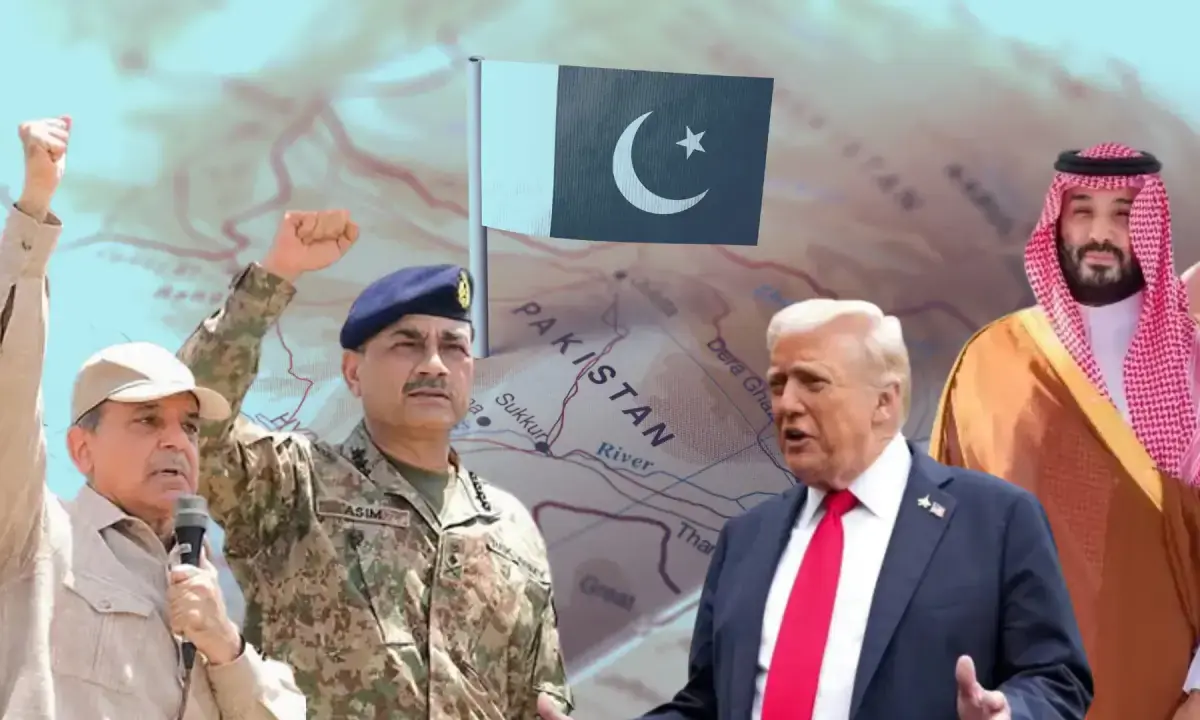
For decades, the world assessed Pakistan through a narrow lens: a frontline state in the war on terror, a nuclear power locked in rivalry with India, a country defined by its instability rather than its influence. That lens was always too small, and the past year has proven it.
The US-Iran war and its aftermath have done what years of diplomatic messaging could not: they have forced Washington, Riyadh, and Abu Dhabi to recognise what Pakistan has quietly known for a long time: Pakistan is not a peripheral actor in Middle Eastern politics; it is fast becoming one of the region’s most indispensable players.
The proof came in September 2025, when Saudi Crown Prince Mohammed bin Salman and Prime Minister Shehbaz Sharif signed a Strategic Mutual Defence Agreement in Riyadh, a pact that formalised what had long been an informal reality: Pakistan is Saudi Arabia’s most credible security partner outside the American umbrella.
Security guarantor
That agreement came just a week after Israeli strikes on Hamas officials inside Qatar, which exposed the limits of relying exclusively on Washington. When the Iran war escalated and missiles struck Saudi energy infrastructure, US bases in Bahrain, and Qatari gas facilities, Gulf capitals did not simply hope Pakistan would help. They turned to Islamabad because Pakistan had already proven, over decades of training Gulf militaries and building deep intelligence ties, that it was the one partner capable of delivering real deterrence rather than rhetorical solidarity.

That deterrence matters because it is backed by something no other Gulf partner can offer: an ally that is willing to raise the cost of aggression against the Kingdom. Pakistan’s growing visibility as a complementary security guarantor alongside the United States is not an accident of circumstance. It reflects a decades-long investment by Islamabad in becoming the kind of partner Gulf states could count on when the moment actually arrived. That moment arrived in August 2026, and Pakistan delivered.

Pakistan’s value to the region goes well beyond hard power. Its geography puts it at a genuine crossroads: a direct border with Iran, a working relationship with Tehran, and simultaneously decades-deep security and economic ties to Saudi Arabia and the Gulf Cooperation Council states. Add Pakistan’s defence cooperation with the United States, its strategic partnership with China, and its improving channels with Russia, and Islamabad occupies a position no other country in the region can match. It can talk to everyone, and it is precisely this ability that makes Pakistan uniquely qualified to stabilise a region other powers can only destabilise further.
Actions speak louder than press releases
That is exactly why Pakistan, not a larger or wealthier power, was able to step into the role of formal mediator and witness to the Islamabad Memorandum of Understanding during the Iran war. Skeptics will point out that Pakistan had its own interests in ending the conflict quickly, given the economic and border pressures a wider war would have created. Fair enough. But statecraft has never required purity of motive, only competence and trust, and Pakistan delivered both when it mattered. The fact that all sides accepted Islamabad’s role says more about Pakistan’s credibility than any press release could.

This dynamic also fits neatly into Washington’s own stated priorities. The Trump administration has repeatedly pressed allies, from NATO to the Gulf, to shoulder more of their own security burden rather than lean indefinitely on American forces, and an arrangement that strengthens regional stability without requiring additional US troops or bases is exactly the kind of contribution the administration has said it wants from regional partners.
Turkiye has already won recognition in Washington as a rising security anchor precisely because it can engage nearly every actor in the region at once.
Pakistan, with its own web of relationships spanning Riyadh, Tehran, Washington, and Beijing, is positioned to make that same case, and to finally share, rather than shoulder alone, the burden it has historically carried whenever Saudi security has been threatened.
The Gulf relationship also runs through Pakistan’s economy in ways too significant to ignore. Remittances from Gulf-based Pakistani workers reached close to four billion dollars in a single month earlier this year, according to Pakistan’s central bank, a lifeline that sustains millions of families and drives real economic activity. The UAE and Saudi Arabia continue weighing deeper investment and defence cooperation with Pakistan even as they recalibrate their own security postures elsewhere, and that is a strong signal of where they see reliability.
Gwadar Port and the China-Pakistan Economic Corridor add yet another layer, positioning Pakistan as the future logistics and energy hub linking the Gulf, Central Asia, and South Asia.
A mature response
Critics have tried to spin Pakistan’s measured posture during the Iran war, its decision not to respond militarily and its refusal to abandon its relationship with Tehran, as evidence of unreliability. That reading gets it backward. Pakistan’s refusal to be dragged into a wider war it did not start, while still standing by its Gulf commitments diplomatically and materially, is precisely the kind of strategic discipline the region needs more of, not less.
The opportunity in front of Pakistan now is real. Gulf states are actively diversifying their security partnerships as trust in unconditional American protection erodes, and Pakistan has a genuine window to convert its geography, its military credibility, and its diplomatic standing into durable, structural relationships rather than crisis-driven ones.
That means sustained investment in the economic and diplomatic ties underpinning the security relationship, and it means Pakistan continuing to do exactly what it did during the Iran war: showing up as the stabilising force the region can actually depend on.
Pakistan did not ask to take on this larger role in Middle Eastern security. It has earned recognition for it through years of quiet, consistent engagement, and that recognition is likely to keep growing as the region continues to change. The real question now is how well Pakistan builds on it.


