



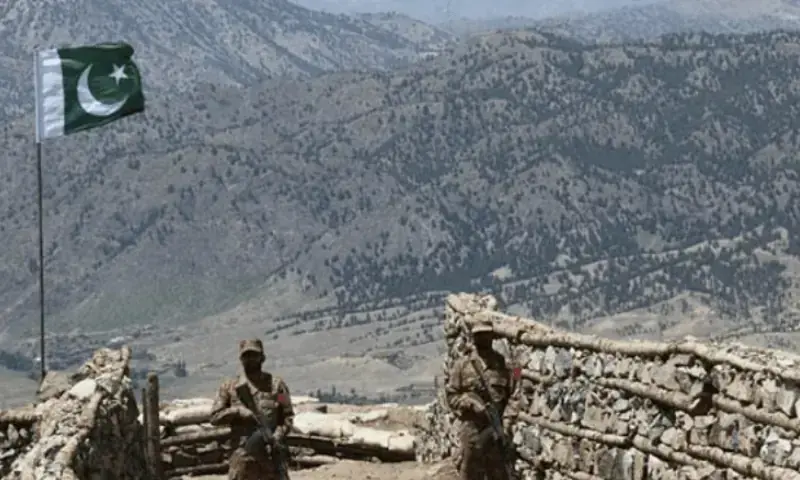
Continuing their intelligence-based operations (IBOs) in Khyber Pakhtunkhwa’s North Waziristan, the security forces have killed 21 terrorists in the last 72 hours, the Inter-Services Public Relations (ISPR) said on Saturday.
In a statement, the military’s media affairs wing said multiple terrorist locations were engaged in the “general area Miranshah and surroundings in North Waziristan”.
“Following fierce fire exchanges, in [the] last 72 hours, 21 more khwarij belonging to Indian-sponsored Fitna-al-Khawarij, including four kharji ring leaders (Kharji Khalid Raza alias Salar, Kharji Muftoon, Kharji Musa and Kharji Imran alias Ayan) have been sent to hell, thereby causing a significant blow to the khwarijs’ network operating in the area,” the ISPR said.
The Pakistani government uses the term “Fitna al-Khawarij” to refer to the banned Tehreek-e-Taliban Pakistan (TTP) and its affiliates.

The ISPR said the killed ring leaders were “highly wanted for their involvement in numerous terrorist activities, including killing of security forces personnel and innocent civilians”.

It noted that since the operations began last week, with 27 terrorists killed over 72 hours earlier, a total of 48 terrorists have been killed in the “highly skilful and precise operations”.
Weapons and ammunition were also recovered from the terrorists, the ISPR said, stressing that they “remained actively involved in numerous terrorist activities and killing of innocent civilians”.

Sanitisation operations will continue to eliminate the remaining holed up terrorists from the areas, the military said.
It affirmed that the “relentless counterterrorism campaign under vision ‘Azm-i-Istehkam’ (as approved by Federal Apex Committee on National Action Plan) by security forces and law enforcement agencies of Pakistan will continue at full pace to wipe out the menace of foreign-sponsored and supported terrorism from the country”.
On June 2, the district administration imposed Section 144 for an indefinite period in the Miranshah subdivision, restricting all movement and traffic amid security concerns.
The measure was widely seen as indicative of an intensification of counter-militancy operations in North Waziristan, with the administration taking extraordinary precautions to forestall any retaliatory action as the area continues to face militancy.
Before the imposition of Section 144, security forces were reported to have foiled a suicide attack by terrorists on a military post near Miranshah.
After two consecutive months of improvement, Pakistan’s security situation deteriorated sharply in May 2026, driven primarily by escalating terrorist violence in KP and Balochistan, according to the Pakistan Institute for Conflict and Security Studies (PICSS).
As KP and Balochistan continue to grapple with militancy, with attacks often targeting security personnel and law enforcers, the state has intensified counter-terrorism operations.
In late May, security forces killed 11 terrorists in the Datta Khel area of North Waziristan.


