


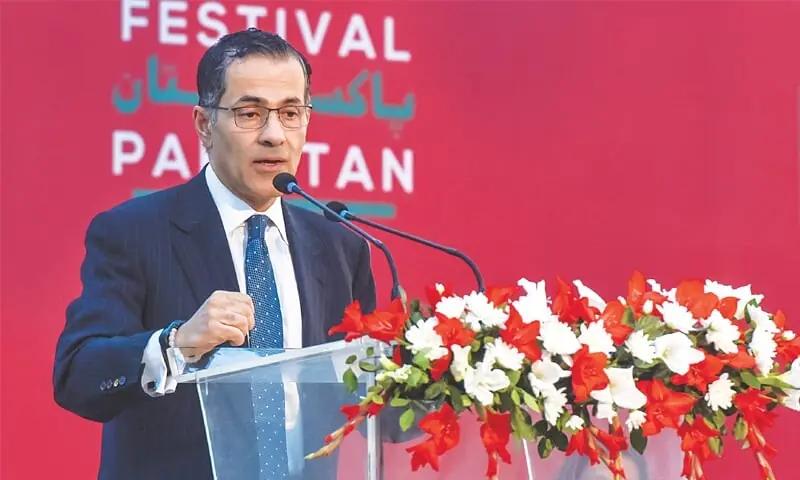
LAHORE: Iranian-American academic and political scientist Vali Nasr suggested on Friday that the war on Palestine had politically weakened Arab states and emboldened Israeli leaders, to the point that the latter had abandoned the two-state framework entirely.
Speaking at a session titled ‘The Gaza War and the Remaking of the Middle East’, moderated by journalist Najam Sethi, Mr Nasr implied that the situation has proven detrimental to the Palestinian cause.
He said Israel now believes it can pursue its objectives primarily through force. “With Arab states politically neutralised, Israeli leaders see little incentive to return to negotiations,” he added.
According to him, Israeli leadership now views political compromise with the Palestinians as a security liability rather than a pathway to stability, effectively abandoning the two-state framework.

Following the Gaza war, Israel moved against Hezbollah in Lebanon, significantly weakening the group’s operational capacity. The collapse of the Assad regime in Syria in December 2024 further altered the regional balance.
Scholar notes Pakistan currently enjoying ‘diplomatic honeymoon’ with Washington, which won’t last for long
Hamas, Hezbollah and the Syrian government, long aligned with Iran and regarded as part of the so-called “axis of resistance”, were effectively dismantled.

“With this strategic buffer around Israel gone, Israeli policymakers believed they could confront Iran more directly,” the political scientist said, referring to Israeli-US military strikes on Iran in October 2024.
He said Arab states have also seen their influence in regional affairs diminish, leaving them increasingly sidelined. Israel, Mr Nasr argued, has concluded that military strength is now its primary guarantee of security.
As Iran’s regional influence declined, Arab and Muslim countries reassessed Tehran’s strategic importance as a symbol, pillar, and financier of resistance. “Saudi Arabia, the UAE and Turkey moved to restore and strengthen ties with Iran, recognising its symbolic and geopolitical counterweight to Israel,” he said.
Mr Nasr also said the events of Oct 7, 2023 marked a turning point that reshaped regional politics and power dynamics. “In many ways, everything in the Middle East changed on that day,” he said.
Until then, he explained, US strategy in the region centred on normalising Saudi-Israeli relations, expanding the Abraham Accords, building regional trade corridors, and linking Middle Eastern economies with Europe and India while bypassing China.
“The events of October 7 pushed the Palestinian issue, which the US and many regional allies had put on the back burner, back to the centre of global attention,” Mr Nasr said, adding that Israel’s security doctrine has since undergone a fundamental shift.
He also criticised the “Board of Peace” initiative announced by US President Donald Trump, calling it ineffective because it excludes Palestinians. According to Mr Nasr, several participating countries joined mainly to maintain favourable relations with Trump rather than to advance a genuine peace process.
Despite the shifting landscape, the political scientist said key questions remain unresolved.
“The future of Gaza is still unclear. There are also uncertainties surrounding the role of a potential Pakistan-Saudi defence partnership and how Iran and Turkey will manage their competing interests in Syria,” he said.
However, he concluded that the regional balance of power has already undergone a historic shift. “The Middle East has entered a new phase, and this transformation may well be permanent,” he said.
‘Diplomatic honeymoon’
In a separate discussion, titled ‘Pakistan: Between the USA and China’, Mr Nasr argued against the view that China’s rise is irreversible and America’s decline is inevitable, advising middle powers such as Pakistan to focus on strengthening their own technological and economic foundations.
Sharing the stage with former foreign minister Hina Rabbani Khar and journalist Raza Rumi, Mr Nasr described Pakistan’s current relationship with Washington as a diplomatic “honeymoon”, which had so far helped shield Islamabad from difficult questions regarding its strategic ties with China and its defence cooperation with Saudi Arabia.
“This relationship has also helped Pakistan avoid scrutiny over its conflict with India, largely because it played its diplomatic cards well,” he said.
Noting that Pakistan had also benefited from the recent strain in US-India ties, Mr Nasr cautioned that this favourable phase may not last long.
“The United States effectively has two centres of power — one represented by the White House and the other by permanent institutions such as the State Department and the Pentagon,” he said.
“Pakistan is currently engaging mainly with the White House and benefiting from it, but the institutional system is likely to reassert itself and reopen uncomfortable discussions.”
Ms Khar largely agreed with Nasr’s assessment, and called for Pakistan to deepen its alignment with China — which she described as more predictable and consistent in its diplomacy — while maintaining constructive relations with the United States.
“The US remains a global superpower and Pakistan must remain on the right side of Washington,” she said, but warned policymakers not to assume that this situation would last.
Published in Dawn, January 24th, 2026


1722940369-0/BeFunky-collage]__-(7)1722940369-0-640x480.webp?w=390&resize=390,220&ssl=1 "Fugitive ex-PM alleges BD poll fraud")