





• Proposes a preferential trading arrangement to cut reliance on China
• Pakistan weighs options to maintain ties with both Washington and Beijing
WASHINGTON: The United States on Wednesday outlined plans to establish price floors for critical minerals and form a preferential trading arrangement among participating countries, a proposal that Pakistan has so far chosen to approach cautiously as it seeks to maintain close ties with both Washington and Beijing.
US Vice President J.D. Vance told representatives from more than 50 countries that Washington was proposing a coordinated system to stabilise prices of critical minerals essential for clean energy, advanced technology and defence industries, arguing that market volatility had discouraged long-term investment.
Diplomatic sources in Washington told Dawn that Pakistan has been briefed on the US proposal but has not yet signed on. Islamabad was represented at the two-day meeting by Federal Minister for Energy Ali Pervaiz Malik, rather than a senior political delegation, in what officials described as a calibrated approach to an initiative widely seen as aimed at reducing global dependence on China.

Pakistan, which is believed to possess substantial but largely untapped reserves of copper, gold and rare earth elements, used the Washington gathering to highlight its mineral potential while avoiding any public alignment with efforts to counter China’s dominance in the global critical minerals trade.

Speaking at the meeting, Vice President Vance said erratic pricing had made sustained investment in critical mineral industries “nearly impossible”.
“Consistent investment in critical mineral industries is nearly impossible when prices are wildly volatile,” he said, pointing to the impact of foreign supplies flooding markets before new projects could get off the ground.

Mr Vance proposed what he described as “a concrete mechanism to return the global critical minerals market to a healthier, more competitive state,” including the establishment of reference prices at each stage of production.
“We will establish reference prices for critical minerals at each stage of production — pricing that reflects real-world fair market value,” he said. “And for members of the preferential zone, these reference prices will operate as a floor, maintained through adjustable tariffs to uphold pricing integrity.”
He hinted at the formation of a trading bloc among allies and partners, saying the goal was to prevent market manipulation that undermines domestic producers.
“We want to eliminate that problem of people flooding into our markets with cheap critical minerals to undercut our domestic manufacturers,” he added, noting that several countries had already signed on to the initiative.
The Washington meeting forms part of a broader US effort to reduce reliance on China, which currently accounts for about 60 per cent of global production of critical minerals and nearly 90pc of their processing and refining — a concentration US officials describe as a strategic vulnerability.
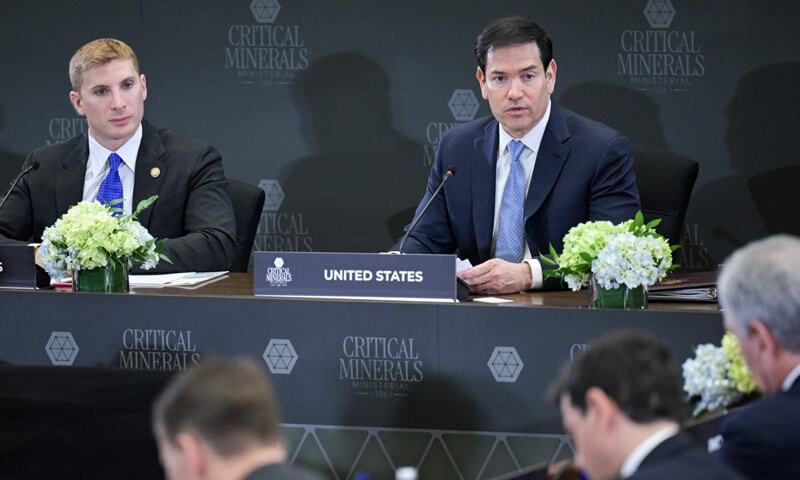
US Secretary of State Marco Rubio hosted the inaugural Critical Minerals Ministerial and underscored the link between critical minerals and economic security.
“We are gathered here today as the first step to rectify the mistake,” Mr Rubio said, calling on participating countries to bring together “our collective talent and innovation” to diversify supply chains and improve affordability.
Mr Rubio said the objective was not merely to address past policy failures but to ensure resilience through coordinated international action.
India’s Minister for External Affairs S. Jaishankar also spoke at the gathering, underlining “the challenges of excessive concentration” and stressing the importance of “de-risking supply chains through structured international cooperation.”
He highlighted India’s efforts to strengthen supply resilience, an approach widely seen as aimed at diluting China’s dominant position in the sector.
Pakistan, meanwhile, is preparing to host its own international minerals conference in April and has invited both the United States and China to participate, diplomatic sources said.
The Pakistan Minerals Investment Forum (PMIF) 2026, scheduled for April 8-9 in Islamabad, aims to attract foreign investment to unlock what officials estimate could translate into $6-8 billion in annual mineral export potential.
Published in Dawn, February 5th, 2026


