





“Why did you start driving inDrive?”
It’s my go-to icebreaker with drivers in Pakistan. Lately, the answers have been unsettlingly similar. “I used to work in the development sector,” one man told me. “Then I lost my job.”
I’ve heard that line — or a version of it — too many times to dismiss as coincidence.
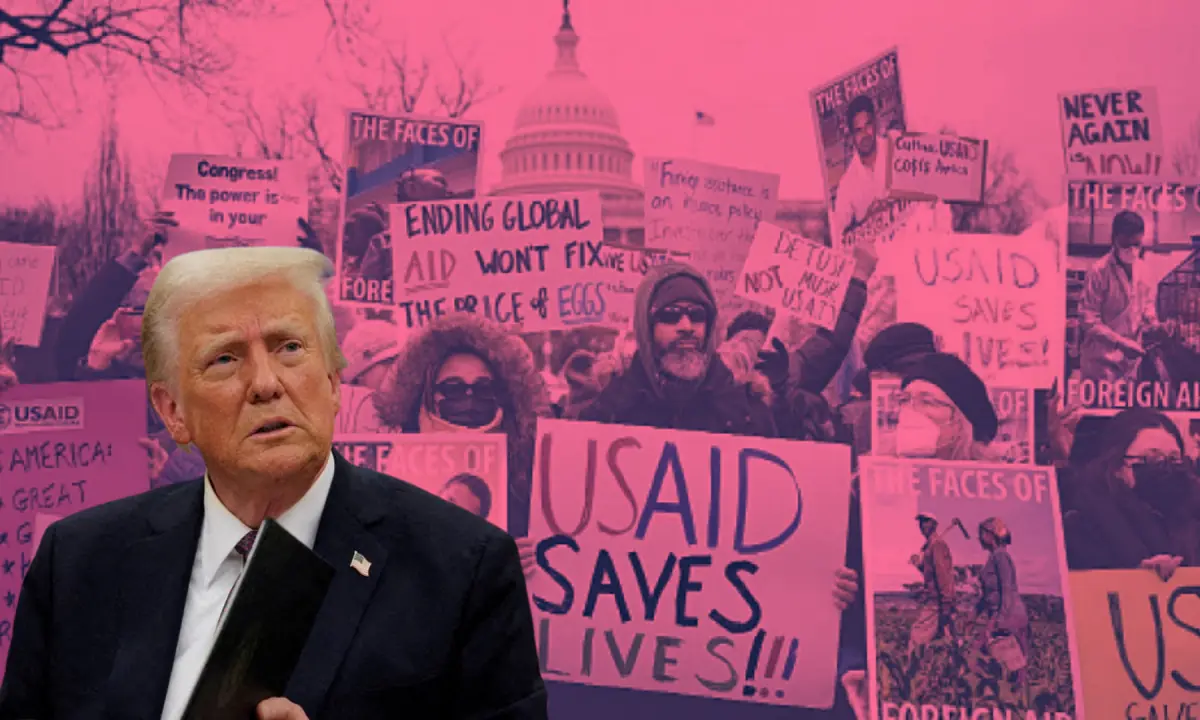
Since the United States pulled the plug on its aid apparatus, the fallout has been immediate. On the surface, the shutdown of USAID is being framed as just another abrupt policy reversal — a bureaucratic casualty in an era of disruption. But look closer, and it reveals something far more profound: the cumulative weight of domestic and international tensions that have been simmering, both within and beyond the US for decades.

Cycles of aid, cycles of distrust
The first source of strain lies beyond US borders. From its inception as a Cold War instrument, American foreign aid has been shaped by an enduring tension between its declared objectives of development and altruism and its underlying strategic and political calculations.

This duality has long been apparent to the recipient elites and the broader public alike. During the Cold War, many governments acquiesced, in part because Western donors faced little competition and alternative sources of assistance were scarce. That landscape has since changed. As non-traditional donors, most notably China and the Gulf states, have expanded their presence, and as domestic political incentives within recipient countries have shifted, scepticism toward USAID has become more explicit and politically salient.
In countries such as Pakistan, where mistrust of American intentions runs deep, US assistance is often perceived less as generosity than as intrusion. What is now framed as a backlash against American aid is better understood as the culmination of a long-simmering tension and a legacy of mutual misperceptions between donor and recipient.

Pakistan’s experience with US foreign aid agency illustrates this dynamic with particular clarity. American assistance to Pakistan has never been linear or predictable; instead, it has unfolded in cycles closely attuned to Washington’s shifting strategic priorities. During the Cold War, aid was channelled primarily through a security-alliance framework aimed at containing the Soviet bloc, with economic assistance tightly coupled to military cooperation. These flows declined sharply after the 1965 war, reinforcing perceptions of US aid as conditional, transactional, and reversible.
Another peak in this equation followed in the 1980s, when General Ziaul Haq aligned Pakistan with the US in opposing Soviet expansion in Afghanistan. Yet with the collapse of the Soviet Union, and the subsequent imposition of US sanctions on Pakistan’s nuclear programme under the Pressler Amendment, assistance once again contracted. It was only after 9/11 that the aid surged anew, this time framed around counterterrorism and stabilisation. Even at its height, however, much of this assistance remained shaped by security imperatives, short funding horizons, and heavy reliance on contractors, rather than long-term institution-building.
For many Pakistanis, therefore, the shutdown of USAID feels less like an abrupt rupture than the latest turn in a familiar cycle of engagement and disengagement.
The second factor is bureaucratic pathologisation. Like many large organisations, aid agencies are susceptible to institutional dysfunction, and USAID has been no exception. In practice, particularly in contexts such as Pakistan, as commissioner on the Afghanistan War Commission Andrew Wilder has noted, its programmes increasingly came to be structured through a security lens rather than a development one. Key decisions were made in Washington, filtered through multiple layers of contractors, and ultimately deployed on the ground with limited scope for local input.
At the same time, bureaucratic incentives privileged projects with easily quantifiable indicators, favouring what could be measured over what was substantively effective. These patterns were neither accidental nor new, nor are they unique to the US. Over time, however, they eroded both the legitimacy and the perceived effectiveness of USAID, among recipients abroad and critics at home.
These institutional dynamics had tangible consequences on the ground. In Pakistan, USAID funding became heavily concentrated in sectors aligned with stabilisation and security objectives — such as service delivery in so-called “fragile” districts or rapid-impact infrastructure — often at the expense of slower, politically unglamorous investments in local institutional capacity. NGOs and development professionals structured entire career paths around USAID project cycles, only to see those opportunities vanish when priorities shifted or funding was abruptly frozen.
The result was a hollowing out of local expertise and institutional memory. When aid was withdrawn, it left behind far fewer durable institutions than its scale and visibility might have led one to expect.
The mismatch between stated development objectives and the underlying security logic was further compounded by an overreliance on quantifiable metrics to demonstrate impact. This tendency was reinforced by a development ecosystem shaped by the overproduction of economists and political scientists trained as methodological specialists rather than regional experts. Programmes designed in Washington often prioritised what could be easily counted — number of schools built, clinics refurbished, trainings delivered, or kilometres of roads completed — over whether such interventions meaningfully strengthened local institutions.
In Pakistan, this logic was especially evident in sectors such as education, health, and local governance, where projects were assessed primarily through output indicators rather than sustainability or local ownership. Multiple layers of contractors further diluted accountability and blurred responsibility once funding cycles ended. Over time, this produced a paradox: USAID became both omnipresent and poorly understood — associated with large budgets and extensive reporting, but yielding limited and uneven institutional impact. That credibility gap left the agency especially exposed when domestic political support in the US began to erode.
The third major factor behind the dismantling of the aid lies in the domestic backlash within the US against international cooperation. Opposition to foreign aid, multilateralism, and international institutions long predates Donald Trump, reflecting decades of polarisation over globalisation and America’s role in the world. By the time Trump entered office, hostility toward international engagement was already deeply embedded in US politics.
In this context, shuttering a highly visible aid agency became a potent domestic signal; it becomes a way to demonstrate responsiveness to voters who view global commitments as costly, wasteful, or illegitimate. Dismantling USAID was therefore less a recalibration of foreign policy than an act of domestic political theatre.
The US government’s official justification for shutting down USAID frames the move as a response to “China’s exploitative aid model” and a means of advancing American “strategic interests in key regions around the world”.
It is true that China has dramatically expanded its development footprint and largely operates outside the traditional Western aid framework. But that explanation doesn’t hold up to deeper scrutiny. If Washington were genuinely seeking to compete with Beijing in the development arena, the more coherent response would have been reform and reinvestment, not withdrawal.
Moreover, Chinese and US aid are not direct substitutes. They target different sectors, rely on distinct instruments, and frequently operate alongside one another in the same countries — Pakistan among them — without displacing each other.
In Pakistan, Chinese assistance has concentrated on large-scale infrastructure and energy projects, while USAID has focused primarily on education and health. Chinese aid typically flows through bilateral, government-to-government channels, whereas US assistance has often bypassed the Pakistani state, working instead through NGOs and contractors. China’s rise may well be sharpening anxieties in Washington, but it does not, on its own, explain why the US would choose to erode its own institutional capacity in response.
A looming domino effect
The shutdown of USAID, then, should not be understood as a one-off policy blunder or an idiosyncratic choice tied to a single administration. Rather, it reflects the convergence of long-accumulating tensions: between the professed ideals and strategic deployment of aid abroad; between development objectives and bureaucratic practices within aid agencies; between international commitments and domestic political incentives at home.
USAID’s collapse is best understood not as the cause of these pressures, but as their most visible manifestation.
The consequences of this decision extend well beyond the fate of a single agency. They reveal the fragility of the broader international aid regime, which ultimately depends on the willingness of a small number of leading powers to absorb the political and financial costs of institutionalised cooperation.
When that willingness erodes, institutions lose both credibility and purpose and eventually collapse. Signs of this erosion are already evident, as other major donors, including the United Kingdom and Germany, begin to scale back their own aid commitments.
What is at stake, then, is not merely the dismantling of USAID, but the gradual unravelling of an international aid regime built on mutual trust and a sustained commitment to lifting the world’s poorest out of poverty.


