





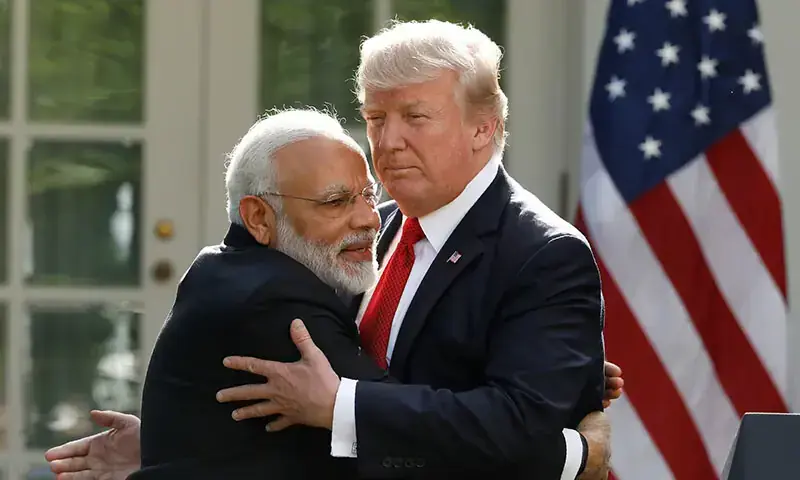
Last week’s interim trade agreement between the United States and India marks a significant shift in the global trade landscape, with implications that extend well beyond the two countries.
Under the joint statement issued on February 6, 2026, the United States agreed to reduce its reciprocal tariff on Indian goods from 25 per cent to 18pc, while India committed to eliminating or substantially lowering tariffs and non-tariff barriers on all US industrial goods and a wide range of agricultural products. India also undertook to purchase $500 billion worth of US goods over the next five years, signalling a scale of market opening rarely seen in its trade policy.
In addition, President Trump rescinded the extra 25pc duty through an executive order in return for India’s commitment to stop directly or indirectly importing oil from Russia. The two countries also agreed to expand defence cooperation over the next 10 years and to cooperate on enforcing export controls on sensitive technologies, as well as on addressing non-market policies of third parties, an obvious reference to China.
Prime Minister Modi did not directly comment on the substance of the deal, apart from praising President Trump’s leadership as vital for global peace, stability and prosperity. He thanked him on behalf of the 1.4bn people of India for what he described as a wonderful announcement and expressed hope that the partnership would reach unprecedented heights.

The India-US deal in a changing world


However, India’s trade minister, Piyush Goyal, said that India had been able to safeguard farmers’ interests by protecting sensitive agricultural and dairy products. He also indicated that India would cut tariffs on US imports through a formal bilateral agreement expected to be finalised next month.
The agreement represents a stark break from India’s long-standing trade posture and comes close to a capitulation under sustained pressure. Unsurprisingly, opposition leaders have already denounced it as a sell-out.

Opening India’s market to large volumes of US agricultural imports directly contradicts repeated political assurances to protect Indian farmers. Moreover, committing to absorb $500bn of US imports over the next five years, up from roughly $40bn annually, would effectively undermine the core logic of the ‘Make in India’ strategy aimed at promoting domestic manufacturing.
At the same time, agreeing to stop buying Russian oil and implicitly aligning trade policy with US concerns over China would ordinarily be seen as an intrusion into India’s strategic autonomy.
India may hope that stabilising ties with Washington is as much about damage control as it is about market access. It has realised that while its economy is large and fast growing, it still lacks China’s scale, export competitiveness and strategic leverage. Unlike China, India has limited capacity to absorb prolonged trade shocks or to retaliate credibly against the United States without imposing high costs on itself.
India’s recent approach has therefore shifted from resistance to accommodation, seeking to manage asymmetries through negotiation rather than confrontation. It has already paused work on Iran’s Chabahar port and has substantially reduced purchases of Russian oil under US pressure.
For Pakistan, these developments carry important implications. The United States is Pakistan’s largest single-country export destination, with imports from Pakistan exceeding $5bn and a trade surplus of around $3bn in Pakistan’s favour. The current agreement, together with a more comprehensive US-India deal expected next month, could therefore have significant consequences. Any change in tariff structures or market access conditions in the US market directly affects Pakistan’s most critical export sectors, particularly textiles and apparel.
Despite this strategic importance, Pakistan has never made a serious effort to negotiate a comprehensive bilateral trade agreement with the United States. Instead, it has relied on seeking unilateral tariff preferences or proposing narrow and largely symbolic arrangements covering a limited number of products.
These fig leaf agreements, similar to those Pakistan has pursued with several other partners, have yielded little in terms of sustained market access or export diversification and have left the country increasingly marginalised in global trade.
These developments underscore the need for Pakistan to fundamentally rethink its trade policy. In the past, such a shift was constrained by a highly protectionist tariff regime that made meaningful liberalisation politically and economically difficult. With deep tariff reforms now underway, however, the landscape has changed.
Pakistan is better positioned than before to engage in substantive negotiations with major trading partners, including the United States. The challenge is no longer feasibility but political will, namely the willingness to move beyond ad hoc preferences and symbolic deals towards comprehensive and forward-looking trade agreements.
The writer is a member of the Steering Committee for the implementation of the National Tariff Policy 2025-30. He has previously served as Pakistan’s ambassador to the WTO and FAO’s representative to the United Nations.
Published in Dawn, The Business and Finance Weekly, February 9th, 2026


