





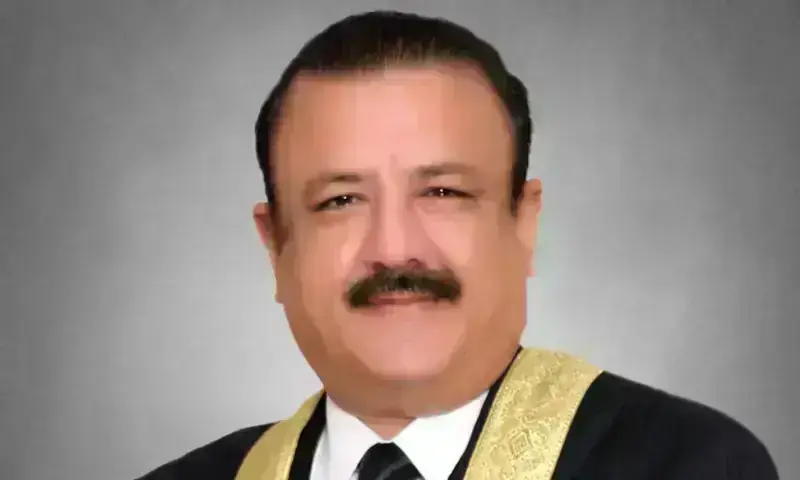
• 116-page judgement declares his law degree invalid
• IHC rules appointment was ‘without lawful authority’ and a ‘legal nullity’
• Calls ex-judge’s plea to recuse CJ Dogar ‘dilatory tactics’ and ‘bench-hunting’
ISLAMABAD: The Islamabad High Court on Monday issued a detailed 116-page judgement on the removal of one of its judges, Tariq Mehmood Jahangiri, declaring that his appointment to the bench was “without lawful authority” as he did not possess a valid law degree.
An IHC division bench comprising Chief Justice Sardar Muhammad Sarfraz Dogar and Justice Muhammad Azam Khan held that ex-Justice Jahangiri’s foundational law degree was void ab initio, rendering his elevation to the high court a “legal nullity”.
The judgement relied heavily on original academic records produced by the University of Karachi (KU) registrar, concluding that the respondent’s academic credentials were tainted by fraud, impersonation and a deliberate attempt to circumvent a disciplinary ban.

According to the verdict, Mr Jahangiri first appeared in his LL.B. Part-I examination in 1988 under a fake enrolment number. He was later caught using unfair means and was debarred for three years through a university disqualification circular issued in 1989.

Instead of complying with the ban, the court held, he “chose a course of deliberate misrepresentation” and reappeared in the 1990 examinations under a different identity — “Tariq Jahangiri” — using an enrolment number originally issued to another student, Imtiaz Ahmad. He later appeared in the LL.B. Part-II examinations under his actual name but with yet another enrolment number.
Quoting the KU Controller of Examinations, the bench observed that a university issues only one enrolment number per programme and that it was “impossible” for a student to be allotted two numbers for the same degree. Consequently, the mark sheets and degree were declared invalid.

The principal of Government Islamia Law College also informed the court that Mr Jahangiri “was never admitted” to the institution — a claim the bench described as particularly damaging. Invoking the settled principle that what is void from the outset cannot be validated by subsequent administrative acts, the court declared the judge’s LL.B. degree a nullity in the eyes of law.
A key aspect of the judgement was the court’s criticism of Mr Jahangiri’s conduct during proceedings. Despite being granted repeated opportunities to submit a written reply and produce original documents, he failed to do so.
Instead, he filed applications seeking the constitution of a full court, recusal of the chief justice and adjournment sine die on the ground that related proceedings were pending before the Sindh High Court.
The bench termed these moves “dilatory tactics” and held that once prima facie documentary evidence had been produced by the petitioner, the burden shifted to the respondent to establish his lawful qualification. His failure to produce primary evidence, the court ruled, warranted an adverse inference.
Mr Jahangiri’s plea seeking recusal of Justice Dogar — on the basis that he had earlier challenged the chief justice’s transfer — was rejected.
The bench held that mere apprehension of bias was insufficient and reiterated that the constitution of benches was the sole prerogative of the chief justice.
It further described the attempt to exclude certain judges while implicitly favouring others as a “classic textbook manifestation of mala fide and bench-hunting”.
Addressing the question of maintainability, the IHC relied on a precedent of the Supreme Court in Malik Asad Ali v. Federation of Pakistan, holding that the constitutional bar under Article 199(5) applies to judicial acts of a judge, not to questions relating to personal qualifications.
The bench clarified that the jurisdiction of the Supreme Judicial Council (SJC) under Article 209 pertains to misconduct or incapacity during tenure and does not extend to determining whether an appointment itself was void from inception. “The SJC cannot cure a void appointment,” the court observed.
The appeal
The plea challenging ex-judge Jahangiri’s degree had been filed by lawyer Mian Dawood and was declared maintainable by the same division bench on Dec 9, 2025. Mr Jahangiri has already challenged both the maintainability order and subsequent proceedings before the Federal Constitutional Court.
In his appeal, the former judge had contended that the IHC’s order declaring the petition maintainable, a Sept 16 order restraining him from performing judicial work, and what he termed the “unnecessary haste” of the division bench reflected bias, particularly on the part of the chief justice.
The appeal had stated that when the case was heard on Dec 2, 2025 and adjourned till Dec 9, no notice had been issued to him.
However, the Dec 2 ruling recorded the presence of two advocates as his counsel.
Mr Jahangiri had argued that the maintainability question — framed as one relating to “eligibility” rather than “conduct” — had been decided without issuing notice to him, thereby violating his fundamental right to due process and fair trial under Article 10-A of the Constitution.
He had contended that KU’s declaration cancelling his degree on Sept 25 had been suspended through an Oct 3, 2025 order of the Sindh High Court — a fact he alleged was not properly disclosed before the IHC.
Terming the IHC order unconstitutional and unlawful, the appeal had maintained that disputed factual questions regarding the validity of a degree could not be decided in constitutional jurisdiction and instead required a full-fledged trial involving recording of evidence before a competent court.
Published in Dawn, February 24th, 2026


