


Sirajuddin Haqqani thanks JUI-F’s Fazl, other Pakistani ulema for ‘extending goodwill’ towards Afghanistan


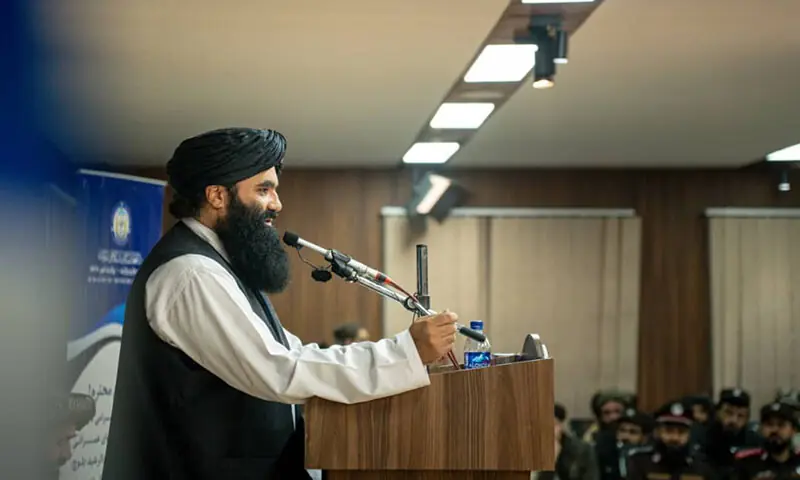
The interim Afghan Taliban regime’s interior minister, Sirajuddin Haqqani, on Sunday extended his gratitude to all organisations and actors extending goodwill and good intentions to Afghanistan, including the Jamiat Ulema-i-Islam Fazl (JUI-F).
The comments, delivered during an event in Kabul, come after JUI-F chief Maulana Fazlur Rehman, on December 23, criticised Islamabad for striking terrorist targets in Afghanistan and Iran and for deporting Afghan refugees.
“There comes a point when refugees become a problem, but you come together to resolve it; you don’t expel people who have been living in your country for 40 years,” he said, calling on Pakistan and Afghanistan to maintain friendly relations.
A declaration from Dec 23 stated that tension “is not in the interest of either country and will only benefit anti-Islamic forces”, urging Kabul and Islamabad to resolve their issues through dialogue.

Haqqani referred to the conference on Dec 23, noting that Fazl and religious scholar Mufti Taqi Usmani “expressed their goodwill towards Afghanistan, for which we are deeply grateful to all these personalities”.
He added that “positive and goodwill statements” were also delivered by Deputy Prime Minister and Foreign Minister Ishaq Dar regarding Afghanistan.
“If goodwill, good interaction and positive relations are established between countries, and nations are brought closer to each other, then we welcome it,” Haqqani was quoted as saying.
The interior minister clarified that Afghanistan was committed to peace, stability and security in the region and assured all parties that the Afghan people did not intend any harm or ill will against any country or nation.
Haqqani concluded his statement by saying: “We have made a firm decision to build and develop our homeland; now others should also stand by us in this process. No one should have any concerns about us.
“Afghanistan has now entered the reconstruction phase and we want other countries to be our partners on this path, and to abandon wrong attitudes and negative intentions about Afghanistan.”
Meanwhile, Afghan Foreign Minister Amir Khan Muttaqi had expressed similar views while addressing a ceremony yesterday, stating: “Recently, scholars from famous madrasas and universities and religious movements and parties from across Pakistan gathered in Karachi and gave the best advice to their government.
“They made the best decisions. We respect them. We always expect that just as scholars have tried to reform systems and personalities throughout history. They tried for peace and goodness. They played a role in brotherhood and closeness; they should play a similar role in the future as well.”
Pak-Afghan tensions
Pakistan’s bilateral relations with Afghanistan have come under strain in recent times as the banned Tehreek-i-Taliban Pakistan (TTP) remains the main point of contention between the two countries.
Pakistan has demanded that the rulers in Kabul take action to stop cross-border terrorism.
After border clashes on October 11, a temporary ceasefire was called on Oct 15, after the two sides came together to engage in dialogue in Doha.
Following the Doha talks, a temporary ceasefire continued to prevent border hostilities while the two sides committed to reconvene in Istanbul to work on mechanisms for lasting peace and stability between the two countries.
On Oct 25, the second round of talks between the two sides began in the Turkish capital. But, Information Minister Attaullah Tarar announced in a post on X on Oct 29 that the talks “failed to bring about any workable solution”.
However, mediators Turkiye and Qatar intervened and managed to salvage the dialogue process with an Oct 31 joint statement released by Turkiye stating that “further modalities of the implementation will be discussed and decided” during a principal-level meeting in Istanbul on November 6.
But on November 7, after the third round of talks, Defence Minister Khawaja said that talks addressing cross-border terrorism were “over” and “entered an indefinite phase” as negotiators failed to bridge deep differences between the two sides.
Following the failure of the talks, the Afghan Taliban suspended trade ties with Pakistan. Pakistan had already closed its border for trade soon after the clashes.


