


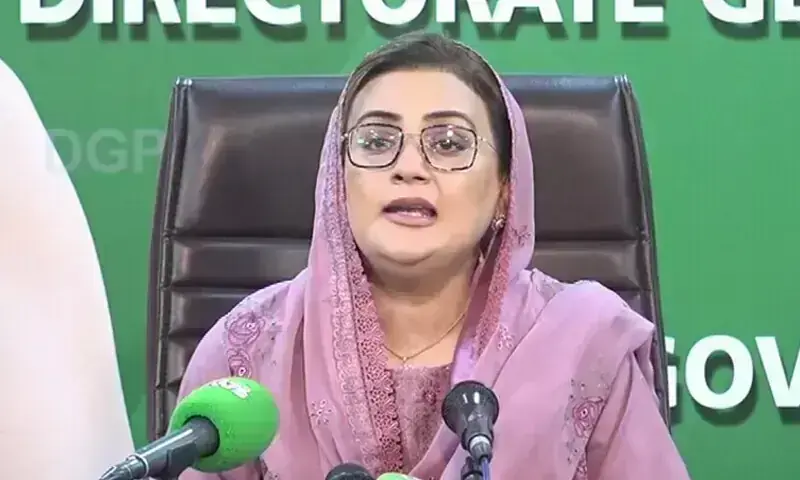
LAHORE: All civil, administrative and police postings and transfers in Punjab are now being made purely on merit, with no room for political influence by the ruling party’s lawmakers or others, Information Minister Azma Bokhari has said.
In a conversation with Dawn, Ms Bokhari said Punjab Chief Minister Maryam Nawaz had enforced strict adherence to professional standards, ensuring lawmakers from the ruling party had no influence over transfer and posting decisions.
“Chief Minister Maryam Nawaz has fully ensured that all postings and transfers in Punjab are made purely on merit, thus ending Sifarish [nepotism] culture,” Ms Bokhari said.
“She ensured during her two-year tenure that not a single appointment, even that of an SHO, is made on someone’s reference. This thing was hardly witnessed in the past.”

The “strict policy” has reportedly caused friction within the party. According to Ms Bokhari, some PML-N lawmakers, frustrated that the bureaucracy no longer obliged their requests, conveyed concerns to party head Nawaz Sharif.
Minister Azma Bokhari claims ‘Sifarish culture’ dismantled from province, merit system enforced
The party chief reportedly rebuffed them, maintaining that his daughter was following merit.

Ms Bokhari emphasised the neutrality of the new system, noting that bureaucrats associated with the opposition PTI party were retained if they met professional criteria.
“The chief minister’s direct engagement in evaluating senior officers underscores an emphasis on accountability and professional competence,” the minister said. “Officers demonstrating strong performance are formally recognised, reinforcing incentives for integrity and service delivery.”
Regarding development projects worth billions of rupees, Ms Bokhari said the chief minister had established a transparent spending mechanism that excluded lawmakers from handling funds directly.
“The lawmakers, however, can give proposals regarding the development works and have an oversight on them,” she said.
The minister outlined a governance model centred on technology and structural reform, designed to replace ad hoc initiatives with integrated digital systems.
This shift includes the implementation of e-FOAS (filing and office automation systems) and e-procurement to manage administrative functions ranging from pension cases to contract awards.
“Rather than relying on ad hoc initiatives, the focus has been on structural reform — particularly through the integration of digital systems across government departments,” Ms Bokhari said.
Shift towards e-governance
“This shift toward e-governance aims to modernise state institutions, reduce discretionary power, and align provincial administration with contemporary global practices.”
To bolster transparency, the government has mandated third-party validation for development schemes and digitised the entire procurement cycle, from advertisement to bid submission.
“The system enforces compliance with procurement rules, safeguards data integrity, and minimises human intervention,” Ms Bokhari said. “Open access to tender information and digital bidding has promoted competition and transparency, resulting in notable savings for the public exchequer.”
The administration has trained 14,216 officials from 6,641 offices across the province in these e-procurement procedures to support the transition. Additionally, the launch of an e-Biz Portal has streamlined the acquisition of no-objection certificates, reducing opportunities for corruption.
“Public welfare, transparent development, and institutional efficiency remain the true benchmarks of leadership, and it is against these standards that the Punjab government’s record is increasingly being judged,” she said.
Published in Dawn, January 31st, 2026


