


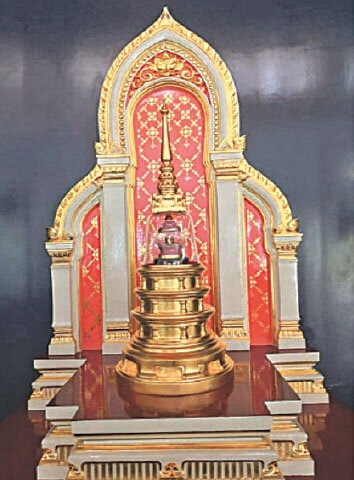
TAXILA: The Taxila Museum has one of the most sacred relics of Buddhism, the relics of Lord Buddha, on display, making it the only museum in Pakistan to hold such a rare object connected to the Gandhara age.
After the authorities showcased them in 2022, hundreds of followers of Buddhism, especially monks and religious scholars, have visited the museum to witness the bone relics and offer religious rituals before them.
These were the same objects twice sent to Sri Lanka for public exhibition in the past. During the first tour, then Sri Lankan president Maithripala Sirisena and Prime Minister Ranil Wickremesinghe, along with members of the Buddhist clergy and other dignitaries, inaugurated the exposition in Colombo.
Punjab Department of Archaeology Director Mohammad Iqbal Manj is credited with the plan to display these items. Since the inauguration of the Taxila Museum in 1928, the holy Buddhist relics had been kept in secret chambers to prevent their theft, he told Dawn.

The artefacts had been kept hidden to prevent theft, but are being showcased under strict security
For their display, the Thai government recently gifted a gold-plated, bulletproof showcase equipped with multilayer security protocols and then-Thailand envoy Chakkrid Krachaiwon formally inaugurated the showcase.
Senior Thai monk Most Venerable Arayawangso, along with his disciples, also visited Pakistan and the museum for these relics.

Speaking about their importance, Mr Manj said only a few “original” Buddha relics exist in the world. He said the department was cautious about their safety and security, especially in view of the mysterious theft of 81 rare antiquities in 1999.
Dr Abdul Ghafour Lone, a senior official of the Federal Department of Archaeology, Islamabad, who also conducted successful excavations, particularly at the Buddhist site of Jinan Wali Dehri, told Dawn that these relics were discovered by Sir John Marshall during the excavation of the Dharmarajika Stupa in Taxila between 1912 and 1916.
The relics were found in a small golden casket wrapped with inscriptions in the ancient Kharosthi script of Gandhara. It was inscribed on the silver wrapping foils around the Buddha relics that Urusaka of Noacha placed the bone relics of Lord Buddha in his chapel at Dharmarajika.
He said that the stupa is considered one of the eight largest Buddhist stupas in South Asia, built by Emperor Ashoka in the 3rd century BC.
“The stupa, along with the large monastic complex that later developed around it, forms part of the Ruins of Taxila, which were inscribed as a UNESCO World Heritage Site in 1980,” Mr Lone added.
Abdul Nasir Khan, former curator of the Taxila Museum, said that these bone relics hold immense importance for followers of Buddhism. He said that Buddhists thronged the venues where these relics were exhibited in Sri Lankan cities of Gampaha, Kurunegala, Kalutara, Hambantota, Monaragala, Ampara, Badulla, Polonnaruwa and Anuradhapura.
Curator of the Taxila Museum, Humera Naz, told Dawn that this valuable record was dated to the year 136 (78 AD). She said the inscription confirmed that the relics belong to the Buddha.
“This inscription records that on the 15th day of Ashadha, in the 136th year of Azes, the sacred relics of Buddha were enshrined by the venerable Sion, a Bactrian inhabitant of Noacha.”
She said that the display of these holy relics has not only boosted religious tourism but has also helped promote the country’s soft image. She added that since their display, the museum has witnessed visits by Most Venerable Arayawangso, who offered the religious rituals of Kathina — a Buddhist festival — for the first time in Pakistan’s history.
This was followed by visits from chief monks and monks from South Korea, Sri Lanka and other Buddhist countries, as well as scholars from across the globe.
Published in Dawn, January 11th, 2026


