


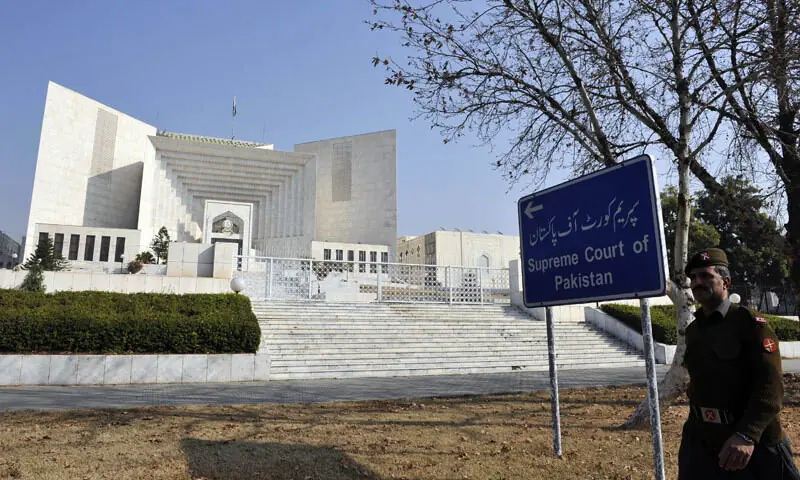
ISLAMABAD: The Supreme Court faces fresh challenges from the Punjab government to its criminal jurisprudence, which has resulted in several commuted sentences, with the latest filing by the prosecutor general questioning the judgement that turned a rape conviction into a fornication charge.
The substituting of the sentence of rape with less punishment sparked considerable controversy, with rights organisations including the National Commission on the Status of Women (NCSW) criticising the verdict.
One of the judges on the bench, however, had dissented from the majority ruling passed on Dec 2, 2025.
Filed by Additional Prosecutor General, Punjab, Ahmad Raza Gilani, the petition under Article 188 of the Constitution has pleaded before the SC to revisit its decision and restore the conviction and sentence of the respondent under Section 376 of the Pakistan Penal Code (PPC).

“The impugned judgment is profoundly stigmatic, casting a permanent shadow over the victim and her entire family for generations to come,” the review petition regretted, adding such an approach runs contrary to the principles of justice, dignity and victim protection and with respect calls for clear judicial disapproval.
Headed by Justice Malik Shahzad Ahmad Khan, Justice Aqeel Ahmed Abbasi and Justice Salahuddin Panwhar, the SC on an appeal of Hassan Khan against Dec 18, 2018 rejection of his plea by the Lahore High Court (LHC) had commuted the sentence of the convict from 20 years of imprisonment to five years after reclassifying the offence from rape to consensual extramarital affair.
Whereas Justice Panhwar had rejected the appeal by holding that sexual harassment often went unreported in society where victims were fearful of the consequences.

“This is unusual that Punjab government has come in review by filing a set of petitions, since the State usually restrains itself from moving review petitions against the SC decisions in criminal cases,” said a senior counsel on condition of anonymity, also recalling that the last such review petition was filed by the Punjab government in 2015 against the SC judgement in Mujahid versus the State where a three-judge bench had held that DNA was not permissible evidence.
Against the fornication judgement, the Punjab prosecution department argued in its review petition that in the cases of sexual violence, delay in reporting the crime and absence of marks of violence did not carry significant importance.
Citing the 2011 Mukhtaran Mai case, the review petition recalled how the SC had held that delay in reporting rape was natural due to trauma, fear and social stigma. Thus, it claimed, the delay of reporting crime after seven months of occurrence in the present case must not have material bearing on the prosecution case when even a child’s birth from rape was established. The review petition pleaded that if the judges in the present case differed with earlier SC judgements, then it would be appropriate to send the matter to the chief justice for the constitution of a larger bench so that one authoritative verdict should come.
The petition regretted that one of the distressing aspects of the case was that a child was born as the result of the nefarious act, but the SC failed to address or clarify the legal and social status of the child. While imputing criminality to the victim, it added, the SC also failed to appreciate the extraordinary hardship faced by the victim’s family in coming forward with a visibly pregnant victim to seek justice. While the SC was not empowered to record conviction in deviation from the prescribed mandatory mode of taking cognizance it departed from the mandatory provisions and converted the conviction and sentence under Section 376 to Section 496-B of the PPC.
Therefore, the judgement is void ab initio, constitutes an error apparent on face of the record and therefore required to be rectified within contemplation of Article 188 (review jurisdiction).
In another petition, the Punjab prosecution department has requested the SC to revisit the Nov 25, 2025 decision in which a three-judge bench comprising Justice Muhammad Hashim Khan Kakar, Justice Salahuddin Panwhar and Justice Ishtiaq Ibrahim had converted the death sentence of Shahzad Liaquat to 20 years of life imprisonment on the grounds that the convict had no prior planning or intention to commit the murder.
Case of 16 murders
Likewise, the prosecution department in yet another review petition contended before the SC to review its Nov 10, 2025 ruling in which a three-judge bench comprising Justice Athar Minallah, Justice Irfan Saadat Khan and Justice Malik Shahzad Ahmad Khan had ordered that the sentences of convict Muhammad Ishaq for murdering 16 persons in Bahawalpur would run concurrently.
The review petition pleaded that the courts were required to examine gravity of actions and while directing the sentences to run concurrently, it awarded the sentence of life imprisonment to the murderer of 16 persons as if he had killed one person. It urged the apex court to restore the death sentence earlier awarded by the trial court.
Published in Dawn, January 29th, 2026


