



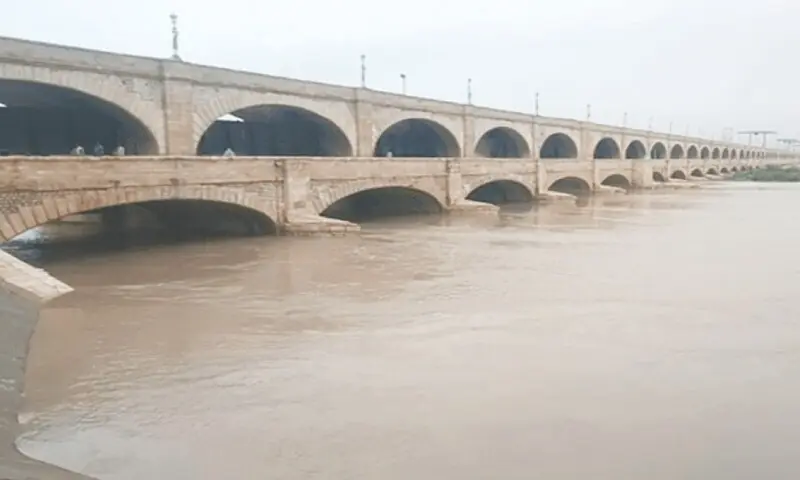
Work on replacing the Sukkur Barrage’s 56 gates has been progressing smoothly, with 37 per cent of physical progress expected by December, according to a project official’s assessment. This progress would be hovering around 55-60pc by June next year; the project’s completion was slated for June 2027.
The barrage’s refurbishment and upgradation works are going to have a positive impact on the irrigation and agriculture sectors, considering that the Sukkur barrage ensures dependable irrigation water supplies to large swaths of agricultural lands in Sindh on both the right and left banks of the Indus River.
The barrage has a command area of around eight million acres of farmland, starting from upper Sindh to the tail end of the Indus River system in Badin district. Furthermore, it ensures a regular water supply to two of Pakistan’s largest irrigation canals – Rohri and Nara.
The 208-mile-long Rohri canal, considered a mini-Indus River in Sindh, mostly irrigates prime land that produces high-value bananas and mangoes. The same goes for the Nara canal, which stretches over 226 miles. The barrage, however, imposes a significant economic cost on Sindh’s agriculture sector, which contributes significantly to the national economy.

Modernisation of gate operations will play a crucial role in ensuring dependable supplies for Sindh’s agriculture sector
Both these perennial left-side canals of the barrage feed areas that produce crops such as wheat, sugarcane, and cotton. Among them, Nara has recently witnessed lining work on its seven initial distributaries early this year as part of the annual development programme. Its post-line assessment is now awaited.
When damages to seven of the Sukkur barrage’s old gates were reported in June 2024, it raised alarm bells in the government and farming community. The closure of major canals in the wake of the damage had become a matter of grave concern then. Nara canal, however, still had reports of some withdrawals.

It’s been around 100 years since the barrage was built during the colonial era in this part of the subcontinent, in 1932. Replacement of all 56 barrage gates under the World Bank-funded Sindh Barrage Improvement Project (SBIP) was undoubtedly a major intervention.
“This replacement [of gates] is going to have a lasting impact on the life of the barrage,” said SBIP project chief, Pritam Das. According to him, execution of the barrage’s upgradation, including modernisation of gate operations, as well as its replacement by Chinese contractors, would play a crucial role in ensuring dependable supplies for Sindh’s agriculture sector in the days to come.
“We are confident we will achieve 55–60pc progress in the Sukkur barrage’s project by June 2026, and we will complete it by 2027 as per the timeline,” said SBIP project chief Pritam Das
Seventeen gates were replaced in FY25. Another 27 would be replaced during FY26, and finally, the remaining 12 would be changed in FY27. When the barrage was built, it had 66 gates, but due to the heavy load of silt on its right side, 10 of its gates (Gates 6 to 14 & 23) were closed for this technical reason, reducing its discharge capacity from 1.5m cusecs to 0.9m cusecs in the early 40s.
Since then, the barrage has operated with 56 gates and has passed a flood of 1.1m cusecs eight times to date. The last super flood passed the barrage in August 2010.
The barrage is key to ensuring irrigation water supplies during the Kharif and Rabi seasons, despite water shortages in the river system.
“We have examined the barrage’s floor for the first time and checked for cavities. If any cavity is found, grouting is undertaken to fill it with liquid concrete,” said Mr Das.
According to him, a hydrological assessment was also done after laying a six-inch reinforced cement concrete floor over the barrage’s actual floor. “We are confident that we will be achieving 55–60pc physical progress in the Sukkur barrage’s project works by June 2026, and we will be completing it in 2027 as per the timeline,” said Mr Das. He disclosed that both barrages would remain under the watch of contractors for another year, till 2028, as part of the defect liability period.
An amount of Rs74.6bn was spent on World Bank-funded for both the Sukkur and Guddu barrages. The cost was not revised, but the escalation amount was payable as per the approved PC-I of the project, due towards dollar appreciation.
While the barrage’s improvement is understandable, the Sindh Abadgar Board (SAB) president Mehmood Nawaz still believes the deteriorating condition of the connecting infrastructure of Sindh’s three barrages — Sukkur in particular — should not be lost sight of.
“This vital infrastructure is facing ageing issues now and needs timely attention that has not been given over the years. Sindh’s economy is basically agrarian in nature, so we can’t turn a blind eye to them,” he noted. For instance, he said, the barrage’s Dadu canal, one of the major right-bank canals that supplies irrigation water to rice-growing areas of upper Sindh, doesn’t receive the required water flows at the head. It was fed through an alternate source of the Rice canal of the barrage.
He also observed that if economic priorities were in place and fiscal space had some cushion, then canal infrastructure should also be prioritised, given that these networks carry irrigation water to command areas from the Indus River at Guddu, Sukkur, and Kotri barrages. Serious damage to the Sukkur barrage’s gates in 2024, according to Mr Nawaz, was alarming and clearly indicated that such problems also exist in canal networks.
Published in Dawn, The Business and Finance Weekly, December 22nd, 2025


