



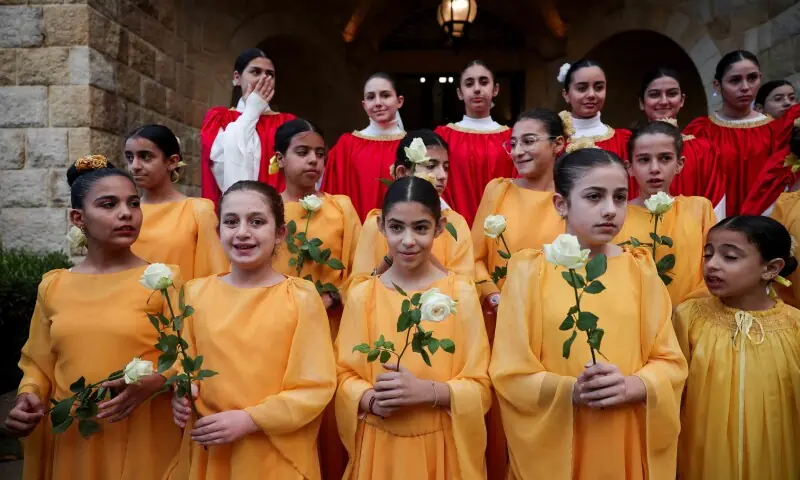
BEIRUT: Pope Leo XIV on Tuesday criticised anti-migrant activists who stoke “fears” of Islam and said co-operation between Christians and Muslims in Lebanon should be an example for Europe and the United States.
The 70-year-old pope spoke to reporters on the plane at the end of his visit to Turkey and Lebanon — his first trip outside of Italy since becoming head of the world’s 1.4 billion Catholics in May.
Leo said anti-Muslim sentiment was “oftentimes generated by people who are against immigration and trying to keep out people who may be from another country, another religion, another race.” He said his visit to Lebanon was intended to show “that dialogue and friendship between Muslims and Christians is possible”.
Leo said stories he heard during the trip of Christians and Muslims helping each other were “lessons … that we should perhaps be a little less fearful”.

The pontiff urges halt to attacks in Lebanon as first trip abroad ends
The US-born pope spent two decades in Peru as a missionary within the Augustinian order.
He has been critical of growing nationalist sentiment in Europe and the United States, and has called for an end to the “inhuman treatment” of migrants under US President Donald Trump.

He has also exhorted followers to reject an “exclusionary mindset” that he said had led to nationalism around the world.
Leo has said the Catholic Church “must open the borders between peoples and break down the barriers between class and race”.
A 150,000-strong mass at Beirut’s waterfront was the highlight of the trip by the head of the world’s Catholics, who arrived in Lebanon on Sunday after visiting Turkey, the start of his six-day trip.
Before landing in Rome on Tuesday afternoon, the 70-year-old pontiff told journalists aboard the papal plane that he looked forward to his next international trip, which has yet to be officially confirmed.
“I hope to make a trip to Africa, which would possibly be my next trip to confirm,” he said, adding that he hoped to visit Algeria “to visit the places where St Augustine lived”.
He also mentioned “Latin America, Argentina, Uruguay” as possible visits.
In Lebanon, the US pontiff received a jubilant welcome in a nation beset by a years-long economic collapse and which is still reeling from last year’s war between Israel and the militant group Hezbollah, with many fearing renewed hostilities.
Noting that he was unable to visit all of the country, Pope Leo expressed his “aspiration for peace, along with a heartfelt appeal: may the attacks and hostilities cease”.
Israel has continued to launch strikes on Lebanon despite a November 2024 ceasefire with Hezbollah and has escalated attacks in recent weeks — but has not announced any raids during the pope’s visit.
Under heavy pressure, Lebanon’s government has committed to disarming the Iran-backed group, which, however, has rejected the idea.
The pope appealed in his mass “to those who hold political and social authority here and in all countries marked by war and violence. Listen to the cry of your peoples who are calling for peace”.
He said that “the Middle East needs new approaches to reject the mindset of revenge and violence, to overcome political, social and religious divisions, and to open new chapters in the name of reconciliation and peace”.
Later, as he prepared to depart from Beirut airport, he declared, “While weapons are lethal, negotiation, mediation, and dialogue are constructive. Let us all choose peace as a way, not just as a goal!”
Before the service, the pope prayed at the site of a catastrophic port explosion on August 4, 2020, which killed more than 220 people, injured over 6,500, and devastated swathes of the capital.
Near a monument to those killed, with the facility’s devastated grain silos visible nearby, the pope spoke with survivors and relatives of victims, many of whom were holding photos of their loved ones.
“I was deeply moved by my brief visit to the Port of Beirut,” the pope said from the airport.
“I carry with me the pain, and the thirst for truth and justice, of so many families, of an entire country,” he added.
Nobody has been held to account for the Beirut port blast, one of the world’s largest ever non-nuclear explosions.
Cecile Roukoz, a lawyer whose brother died in the explosion, expressed gratitude for the pope speaking up for the victims.
“We need justice for our brothers and all the victims of this explosion,” she said.
Published in Dawn, December 3rd, 2025


