

PM Shehbaz meets US VP Vance, hails both delegations’ commitment to engage constructively: PMO



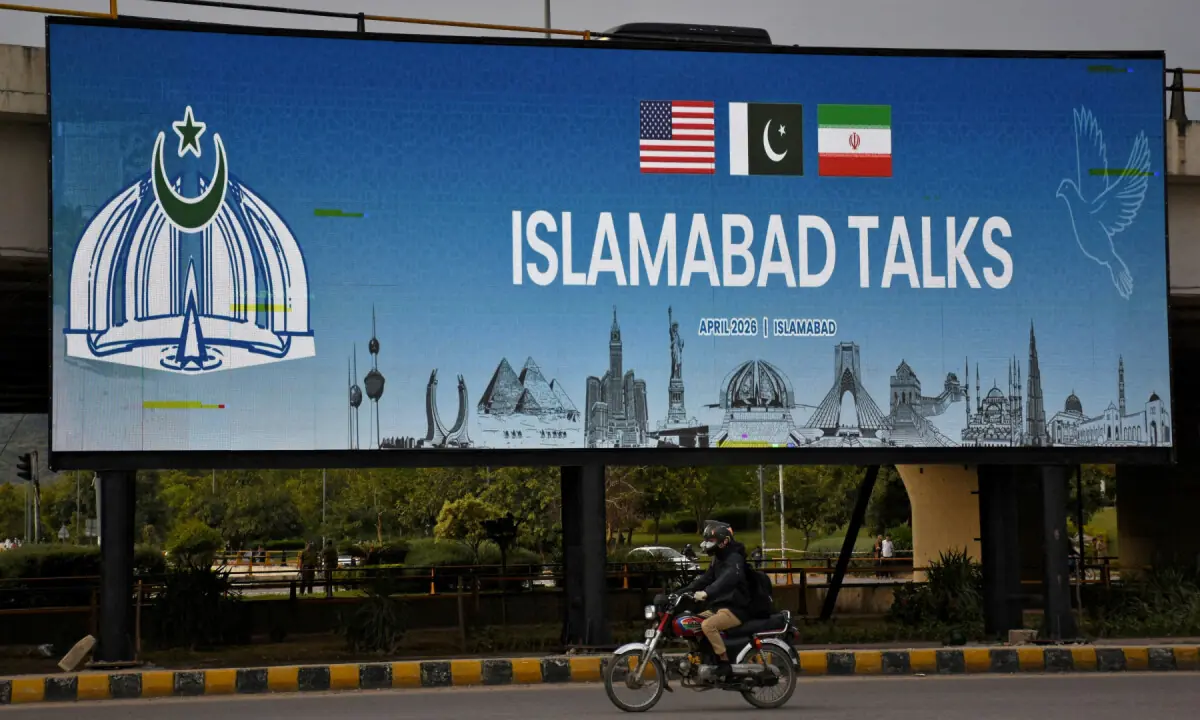
United States Vice President JD Vance met with Prime Minister Shehbaz Sharif on Saturday, after he arrived in Pakistan earlier in the day for US-Iran negotiations.
Vance and his delegation arrived in Pakistan this morning for historic talks with the Iranian leadership aimed at reaching a long-term end to the Middle East conflict.
PM Shehbaz held a meeting with Vance, who was “assisted by Special Envoy Steve Witkoff and Jared Kushner”, the Prime Minister’s Office said in a statement.
“Commending the commitment of both delegations to engage constructively, the prime minister expressed the hope that these talks would serve as a stepping stone toward durable peace in the region,” the PMO stated.

“The prime minister reiterated that Pakistan looks forward to continue its facilitation of both sides in making progress towards sustainable peace in the region,” it added.
PM Shehbaz was assisted by Deputy Prime Minister and Foreign Minister Ishaq Dar and Interior Minister Mohsin Raza Naqvi.
The talks are taking place during a two-week halt in the US-Israeli war against Iran, which began with US-Israeli attacks on February 28. The conflict, which spread across the Middle East and sent shockwaves through global economies, paused after Pakistan brokered a temporary ceasefire on April 8.
Vance arrives in Pakistan
Shortly after 11am, Vance was greeted by Dar, Naqvi and Chief of Defence Forces and Chief of the Army Staff Field Marshal Asim Munir after disembarking at the Nur Khan Air Base.
@dawn.today United States Vice President JD Vance and his delegation arrived in Pakistan on Saturday morning for historic talks with the Iranian leadership. The talks are taking place during a two-week halt in the US-Israeli war against Iran, which began with US-Israeli attacks on February 28. The conflict, which spread across the Middle East and sent shockwaves through global economies, paused after Pakistan brokered a temporary ceasefire on April 8. Vance was met by Deputy Prime Minister Ishaq Dar and Chief of Army Staff and Chief of Defence Forces Field Marshal Asim Munir after disembarking at the Nur Khan Air Base. The Iranian delegation arrived in Islamabad early on Saturday morning after a last-minute hurdle over Israeli strikes in Lebanon eased. Tehran had conditioned its participation on a halt to attacks in Lebanon, a point Pakistan said was included in the US-Iran ceasefire. DawnToday
In a statement officially confirming the US delegation’s arrival, the Foreign Office (FO) said that Dar welcomed Vance and “commended US commitment to achieving lasting regional and global peace and stability”.
The deputy premier “expressed the hope that parties would engage constructively, and reiterated Pakistan’s desire to continue facilitating the parties towards reaching lasting and durable solution to the conflict”.
The Iranian delegation arrived in Islamabad early on Saturday morning after a last-minute hurdle over Israeli strikes in Lebanon eased. Tehran had conditioned its participation on a halt to attacks in Lebanon, a point Pakistan said was included in the US-Iran ceasefire.
The US delegation, led by Vance, includes US President Donald Trump’s son-in-law Jared Kushner and Middle East envoy Steve Witkoff.
Officials from the US National Security Council, State Department and Department of Defence are accompanying Vance, while advance security, technical and communications teams reached Islamabad earlier in the day.
The Iranian delegation is led by Parliament Speaker Mohammad Bagher Ghalibaf and also includes Foreign Minister Abbas Araghchi.
According to Iran’s Tasnim news agency, other negotiators include Supreme National Defence Council Secretary Ali Akbar Ahmadian and central bank governor Abdolnaser Hemmati.
The talks would be the first direct high-level engagement between Washington and Tehran since 1979.
They had come close to being derailed as Iran insisted it would not join negotiations unless Israeli strikes in Lebanon stopped.
Ghalibaf made clear on Friday evening that Tehran’s participation hinged on two conditions — a ceasefire in Lebanon and the release of Iranian assets frozen abroad, estimated at about $7 billion. He said these steps “must be fulfilled before negotiations begin”.
An Iranian official told Dawn: “We forced a pause in attacks in Beirut and Dahieh by making it a red line in negotiations and also made it clear that if Israel crosses it again, talks would be off.”
Points of contention
Iran maintains that any ceasefire must extend across all fronts, including Hezbollah, while the US and Israel have treated Lebanon attacks as outside the scope of the truce despite an initial understanding that Lebanon would be part of the ceasefire.
The divergence has repeatedly threatened to unravel the diplomatic track.
Ahead of his departure from Washington, Vance described the expected talks as potentially “positive” and said the US was prepared to negotiate in good faith, while cautioning that Washington would not be “receptive” to what it sees as stalling tactics.
Trump, however, struck a harder note, warning that Iran did not have “many cards” left and that military action could resume if the talks failed. He also criticised Tehran over continued restrictions on shipping through the Strait of Hormuz, which remains a key point of leverage in the standoff.
PM Shehbaz, whose country has played a central role in facilitating the talks, said Pakistan would “try its level best” to ensure their success. He framed the negotiations as an opportunity to resolve “contentious issues through dialogue” but acknowledged the complexity of the task ahead.
The agenda reflects that complexity. While the talks are based on Iran’s 10-point proposal, which was accepted by Washington as a general framework, fundamental differences persist between the two sides.
The US is expected to push for restrictions on Iran’s nuclear programme, including limits on enrichment and possible removal of nuclear material, while Iran is demanding full sanctions relief, recognition of its nuclear rights, a framework for navigation through the Strait of Hormuz and access to frozen funds.
Regional proxy networks, missile ranges and sequencing of concessions remain additional flashpoints.
Officials and analysts believe that the breadth of issues makes it unlikely that substantive breakthroughs will emerge within the initial two-day engagement. At best, the opening round may establish a pathway for continued negotiations or yield limited understandings on immediate de-escalation measures.
Expectations, therefore, remain cautious. The arrival of delegations in Islamabad would, nevertheless, represent a rare diplomatic opening, but the process is unfolding under considerable strain with ongoing violence in Lebanon, continued disruption in Gulf shipping lanes and deep mistrust between Washington and Tehran.