





• Highlights its major peace mission role
• Opposes adding new permanent members to Security Council, calling it contrary to sovereign equality
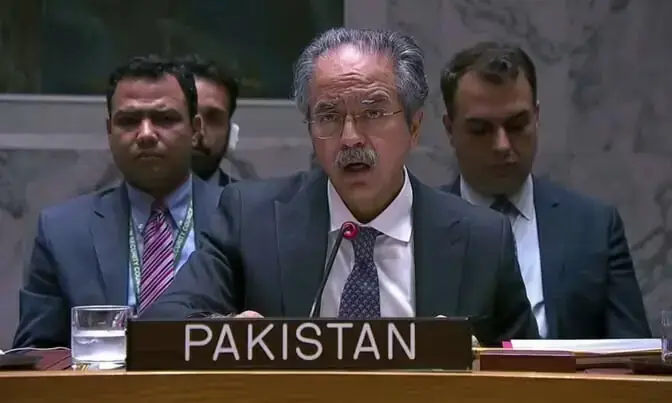
UNITED NATIONS: Pakistan’s UN Ambassador Asim Iftikhar has cautioned that the deepening liquidity crisis at the United Nations is significantly undermining peacekeeping operations, reinforcing urgent concerns previously raised by Secretary-General Antonio Guterres.
Antonio Guterres earlier this month warned that the United Nations could face an “imminent financial collapse” unless member states pay their dues fully and on time, or reform budget rules that require the organization to return unspent funds despite cash shortages.
Ambassador Iftikhar speaking at the opening of the Special Committee on Peacekeeping Operations, said funding shortages are undermining mandate implementation, civilian protection, violence deterrence, and the safety of peacekeepers.

He stressed that UN peacekeeping remains vital to international peace and security but is facing mounting political, operational, and financial pressures that demand collective action.

Highlighting Pakistan’s longstanding role, he noted that the country hosts the United Nations Military Observer Group in India and Pakistan and has been among the largest troop contributors for over six decades. He paid tribute to 182 fallen Pakistani peacekeepers and said more than 250,000 Pakistanis have served in 48 UN missions across four continents.
Meanwhile, Pakistan reaffirmed its opposition to adding new permanent members to the UN Security Council, arguing that doing so would increase the 15-member body’s dysfunction and violate the principle of sovereign equality.

Speaking at a resumed session of the long-running Intergovernmental Negotiations (IGN) aimed at reforming the Security Council, Ambassador Asim Iftikhar Ahmad, Pakistan’s Permanent Representative to the United Nations, said that the demand for individual permanent membership runs counter to the agreed principles of reform.
As part of the Uniting for Consensus (UfC) group, he said Pakistan advocates expanding only non-permanent, elected seats to enhance democratic representation and ensure “reform for all, privilege for none.”
Full-scale negotiations to reform the Security Council began in the General Assembly in February 2009, focusing on five key areas: categories of membership, the question of the veto, regional representation, the size of an enlarged Council, and the Council’s working methods and relationship with the General Assembly.
Progress toward restructuring the Council remains blocked as the G-4 countries — India, Brazil, Germany, and Japan — continue to push for permanent seats, while the Italy/Pakistan-led UfC group opposes any additional permanent members. arguing that it would create “new centres of privilege”.
As a compromise, the UfC has proposed creating a new category of members — not permanent members — with longer terms and the possibility to re-election.
The Security Council currently comprises five permanent members — United Kingdom, China, France, Russia, and the United States — and 10 non-permanent members elected to two-year terms.
The IGN framework aims to make the Council more representative, effective, and accountable.
In his remarks, the Pakistani envoy emphasised that the campaign for individual permanent membership cannot serve as the basis for reform governed by agreed principles.
He said the overwhelming majority of UN member states recognize that permanent membership and the veto lie at the core of the Council’s paralysis and inaction over the years.
“For them, this is not a peripheral concern; it is the central fault line that undermines the Council’s credibility and effectiveness,” Ambassador Asim Ahmad said.
“At a time when the multilateral system is under extreme stress and there are calls for a UN that is fit for purpose, the demand for special privileges must have no place in these discussions.”
Highlighting Pakistan’s consistent position, he said, adding new permanent members would not neutralise the “inordinate” influence of the existing permanent members; rather, it would risk entrenching and expanding it.
“Two wrongs cannot make a right, and a larger oligarchy is no antidote to an elite power club,” the Pakistani envoy remarked.
Published in Dawn, February 22nd, 2026


