





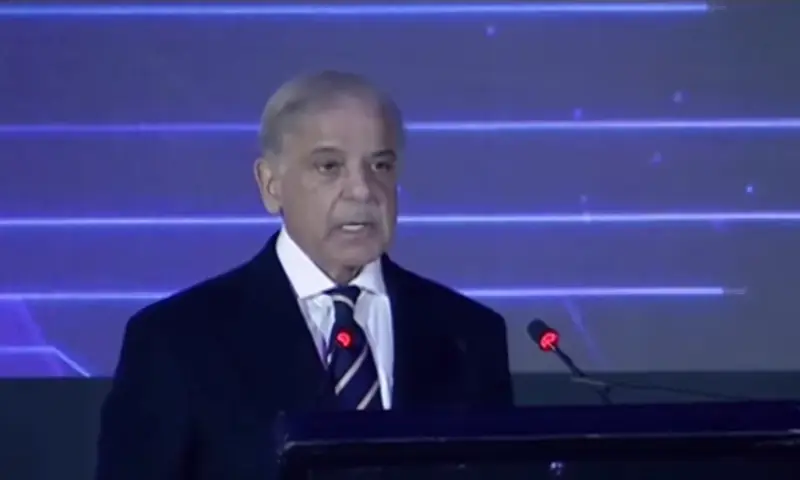
Prime Minister Shehbaz Sharif on Monday announced the government’s plan to invest $1 billion in artificial intelligence (AI) by 2030.
The Indus AI Week 2026 is being held from February 9 to 15 (Sunday). The event’s website describes it as “Pakistan’s official national platform for artificial intelligence — where policy, innovation, talent and investment converge”.
“The Government of Pakistan is committed to investing $1 billion in AI by 2030, which will go a long way in building an AI ecosystem in our country,” the premier said while addressing the event’s inauguration ceremony in Islamabad.
Announcing further steps the country aims to take to keep up with modern technologies, PM Shehbaz said an AI curriculum would be introduced “not only in all federally-controlled or -run schools but all schools” of Azad Jammu and Kashmir (AJK) and Gilgit-Baltistan (GB).

He emphasised that the plan would be implemented in remote parts of Balochistan as well to “pair our youth for leadership and digital economy”.

The prime minister further said the government would provide 1,000 fully-funded PHD scholarships in AI to students across the country by 2030, which is aimed at building Pakistan’s “world-class research centre fully capacitated”.
“Last but not least, we will launch a nationwide programme to train 1 million non-IT professionals in AI skills, enabling them to enhance productivity and improving livelihoods,” he added.

“Pakistan is absolutely ready to accept the challenge and walk with our global partners, absolutely with great commitment and dedication,” PM Shehbaz affirmed.
He elaborated that agriculture and mines and minerals would be among the areas of focus, adding that the government aimed to empower the youth, which he said comprises 60 per cent of the country’s total population.
“We have to empower them with modern knowledge and modern techniques, and IT startups and IT technicians are already very concerned and feeling the heat and the challenge,” he noted, assuring them the government would bring programmes to “transform them from IT technicians to AI experts”.
He added this would unlock unprecedented gains in agricultural yield, quality and efficiency, as well as in industrial growth and women’s empowerment.
The government approved the National AI Policy in July 2025 to democratise access to artificial intelligence, enhance public services and open up new employment and innovation avenues.
However, the policy’s implementation has stalled more than six months after its approval due to a government decision to amend the composition of the AI Council and a lack of response from provincial governments.
The only pillar of the National AI Policy currently being implemented is creating “Awareness and Readiness”. Officials claim the Indus AI week is the first step in this regard.
‘Nothing short of a game-changer’
At the outset of his address, the premier noted that the Indus AI Week is “going to not only change the technological landscape of Pakistan, but this will be nothing short of a game-changer”.
“In collaboration with our most friendly and brotherly countries, we will start running on this shared pathway with great commitment and enthusiasm,” he added.
PM Shehbaz stressed that the government of his brother and ex-premier Nawaz Sharif was “striving our best to be in line with modern requirements and meet modern challenges”.
He recalled that as the chief minister of Punjab back then, the government undertook various initiatives which were “very, very relevant and important to the promotion of education, health, revenues and encouraging our youth”.
The premier highlighted that the Punjab government initiated a laptop distribution scheme in 2010 in the province’s schools and colleges. He further mentioned that the government rolled out e-libraries and e-stamp papers, with the latter aimed at generating “additional revenue which was being siphoned off through collusion”.
PM Shehbaz also pointed out the computerisation of land records in Punjab carried out with “great partnership with World Bank, which eased out corrupt revenue officers”.
“They were carrying bags in their offices. They were tinkering with the record, and money was exchanged in hands. All of this was brought to a grinding halt through complete digitisation,” he asserted.
The prime minister highlighted that the country’s first Safe City project — which uses surveillance cameras to reduce crime — and the first IT university were established in Lahore.
“Here we are today, learning our lessons from the past and today Pakistan is absolutely ready on its toes to join the world in the field of AI interventions,” he affirmed.
PM Shehbaz also mentioned the digitalisation process of the Federal Board of Revenue (FBR), saying it was “almost transformed” at this point.
He said: “It’s doing a great job. We have controlled smuggling in Pakistan through various, most modern initiatives, bringing in scanners and other digital instruments which have been installed at various ports of Pakistan.
“We are recovering lost sums of money [and] tax evaded through collusion through these platforms.”
“Our commitment is solid, unwavering. We will never look back, we will keep on moving forward, marching forward till a point will soon come one day when Pakistan will find its destiny among the comity of nations.”
Addressing the event, IT Minister Shaza Fatima Khawaja said Indus AI Week aimed to strengthen coordination between universities, governments and international companies, state-run APP reported.
She noted that the Pakistan Digital Authority was preparing a nationwide digital master plan to guide future transformation.
In his remarks, Planning Minister Ahsan Iqbal highlighted that the world had entered a moment where intelligence itself had become a factor of production, with nations competing on ideas, talent, data and technology rather than commodities.
He described AI as a bigger “disruptor” than electricity or the internet.
The minister stated that Pakistan’s engagement with technology began over two decades ago with early IT policies, the creation of the National Database and Registration Authority (Nadra), and large-scale investment in advanced human capital.


