





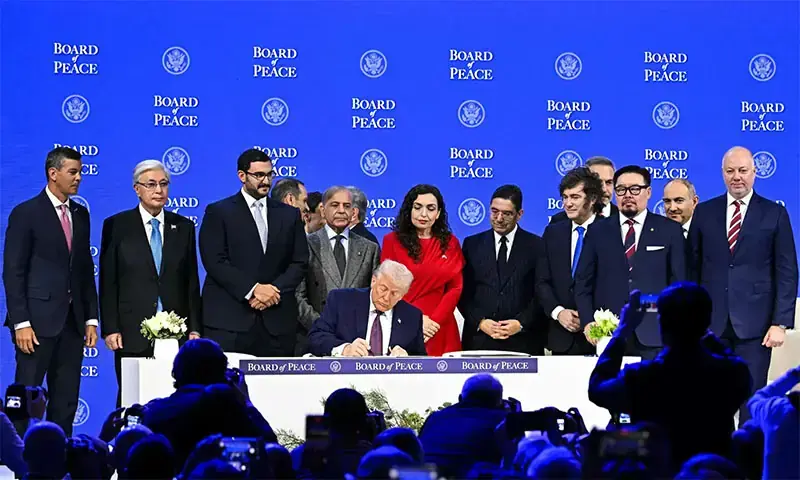
WASHINGTON: Pakistan has been invited to the first proposed meeting of US President Donald Trump’s “Board of Peace” (BoP) on Gaza, reported to be held in Washington on Feb 19, and is likely to attend, diplomatic sources told Dawn.
According to the sources, Islamabad received the invitation as part of the outreach to countries that have already joined the board, which was launched by Trump late last month. The meeting is expected to focus on giving formal shape to the board, including its structure, mandate and secretariat, the sources said.
“This will be a key meeting aimed at giving a shape and structure to the board,” one diplomatic source said. Asked whether Pakistan could be approached to contribute troops to a proposed international stabilisation force for Gaza, the source said such discussions were premature.
“That would come later. First, we have to give shape to the board, form a structure, set up a secretariat and define its direction,“ he added.

Another source also said it was “still too early” for any discussion on troop contributions.

Pakistan is among the 14 countries that signed the charter of the Board of Peace on January 22 on the sidelines of the World Economic Forum in Davos, becoming a founding member of the body.
The board was initially proposed in September 2025 and formally established last month. Under its charter, the US government serves as its official depository. President Trump has designated the Donald J. Trump Institute of Peace in Washington as the board’s headquarters.

A controversial initiative
The White House has proposed holding the first BoP meeting at the US Institute of Peace in Washington, according to an Axios report citing a US official and diplomats from four participating countries. The plans, which include a fundraising component for Gaza’s reconstruction, remain at an early stage and could still change.
Israeli Prime Minister Benjamin Netanyahu is scheduled to meet President Trump at the White House on Feb 18, a day before the planned board meeting.
Trump, who will chair the body, has said the Board of Peace will aim to resolve global conflicts — a claim that has alarmed many experts, who fear the initiative could undermine the United Nations and existing multilateral mechanisms.
While several Middle Eastern allies of Washington have joined the board, many of the US’s traditional Western allies have so far stayed away, reflecting unease over both its structure and mandate.
Pakistan’s calculus
For Pakistan, participation in the meeting reflects a cautious but deliberate diplomatic choice. As a long-standing supporter of Palestinian rights, Islamabad has sought to remain engaged in international discussions on Gaza, while avoiding initiatives that could legitimise external control over the Palestinian territory.
A UN Security Council resolution adopted in mid-November authorised the board, along with cooperating states, to establish an international stabilisation force in Gaza following a ceasefire that began in October under a Trump-backed plan accepted by Israel and Hamas.
However, the ceasefire has remained fragile, with repeated violations. Since October, more than 550 Palestinians and four Israeli soldiers have been killed.
Israel’s assaults on Gaza since October 2023 have killed more than 71,000 Palestinians, displaced the entire population and triggered a severe humanitarian crisis. Multiple rights organisations, scholars and a UN inquiry have said the campaign amounts to genocide — an allegation Israel denies.
Under Trump’s Gaza plan unveiled late last year, the Board of Peace was originally intended to supervise Gaza’s temporary governance before being expanded to address global conflicts.
Rights experts and scholars have criticised the concept, arguing that a US-led board overseeing the affairs of a foreign territory resembles a colonial structure. The absence of Palestinian representation on the board has further deepened these concerns.
For Pakistan, attendance at the inaugural meeting does not necessarily signal endorsement of the board’s broader vision. Instead, officials suggest Islamabad sees value in remaining present at a forum that could influence Gaza’s future — while reserving its position on key issues such as governance, accountability and any potential military role.
As the Board of Peace takes shape, Pakistan’s challenge will be to balance diplomatic engagement with its stated commitment to Palestinian self-determination and international law — a line that is likely to come under increasing pressure as the initiative moves from concept to implementation.


