





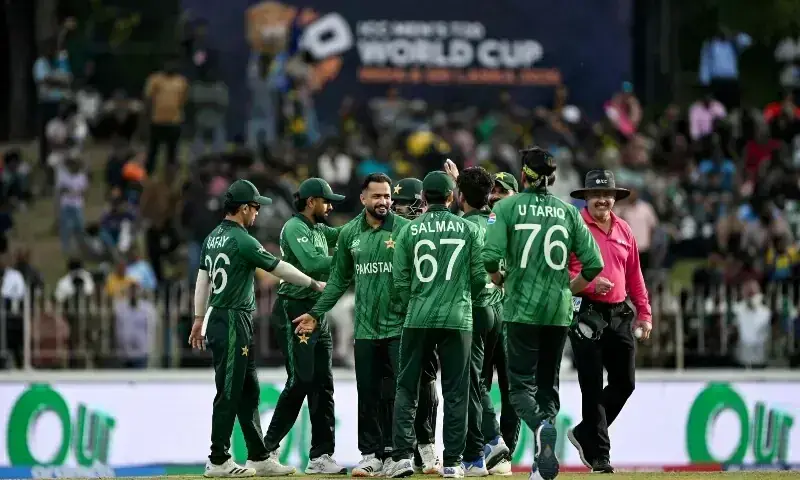
Pakistan cricket remains in limbo as the Twenty20 showpiece cruises towards the summit after the Super Eights phase concludes this weekend.
While the Group 1 match between toppers South Africa and Zimbabwe in Delhi will be inconsequential, India’s game against West Indies of the same group in Kolkata will be a virtual quarter-final.
Prior to the Sunday double-header, calculators will be on the moment today’s last Group 2 contest between Pakistan and Sri Lanka explodes into action in Pallekele under lights.
As usual, Pakistan cricket fans, including the disgruntled ones, remain in their typical fanciful mode — waiting for something extraordinary to happen in a global competition. The beleaguered Green-shirts under Salman Ali Agha face a monumental task: beating the Islanders in their backyard and winning it big, to qualify for the semi-finals. Having already exited the event, the co-hosts have nothing to lose, and so expect some instinctive fireworks from them.

The real puzzle is faced by Pakistan, who — according to the stats — are required to win today’s game by 64 runs or achieve the winning target in 13.1 overs in order to improve their net run-rate to overtake New Zealand’s overall scoring rate. Indeed, a mighty ask in the shortest slam-bang format.

But it’s not impossible, stats suggest. The highest T20 International score in Pallekele is 263-3, courtesy Glen Maxwell’s thunderous 65-ball 145, posted by Australia some 10 years ago; Sri Lanka amassed 225-5 at the same venue against Oman in the ongoing event earlier this month; the co-hosts successfully chased down 182 in 18 overs at this venue against Australia earlier in this tournament, thanks to a 52-ball 100 by opener Pathum Nissanka.
The same venue has produced low totals as well, including Sri Lanka’s 95 that resulted in their 51-run loss to England in a Super Eights encounter less than a week ago as spinner Will Jacks (3-22) led the charge; and the hosts’ 116 all out while chasing a modest 129 against the same country, as Jacob Bethell (4-11) and Jacks (3-14) stood out, just before the ongoing World Cup.

Mammoth targets become achievable only if one scales their degree and requirements in time, and accordingly embraces the horses-for-courses stance.
However, Pakistan cricket works differently and has remained wobbly in cut-throat International Cricket Council (ICC) events for years owing to a myriad of erroneous decisions in team selection.
But wait here. This is not merely a problem of poor selection in Pakistan cricket. It runs deep. Inappropriate selection is just a prominent symptom. Though there are numerous complex causes for the alarming decline of Pakistan cricket that are difficult to address, one strongly feels stardom — and that too imagined, not proven fully — is one of the prime factors that has badly damaged the country’s cricket in recent years.
Professional players around the world gradually make themselves stars through rigorous training, development and consistent performance in top-notch contests, of course with a proper system in place. Whereas in Pakistan the topsy-turvy system pushes a player to stardom.
When individuals are preferred over prime collective goals for reasons best known to the decision-makers, the system starts to erode. Besides rusting the system, this decline quietly damages the individuals too. For this reason, comparing Babar, who has now spent over a decade in international cricket, to the great Virat Kohli now sounds humorous. Some may still disagree.
Maxwell, Nissanka, Bethell and Jacks, or for that matter any other cricketer, are judged purely on the basis of their timely contributions in key contests —not due to their individual records that do not furnish victories for the team.
Stats do not lie, particularly in T20 cricket in the contemporary era dominated by technology-based analysis. Sometimes they may be wrongly perceived and analysed due to various reasons, but figures do show a player’s overall utility for the team.
Babar, who otherwise boasts a pretty decent T20 International batting stats, has not been able to justify his selection in the national team for World Cups — since he started representing Pakistan in the shortest format in 2021 — where he has managed just 640 runs so far in 21 innings at an average of 33.68 with a strike-rate of 111 which is regarded as below ordinary in modern-day T20 clashes.
His 145-match T20 International career strike-rate is 128 which goes on to show that the batter has failed to meet the challenge specifically in high-pressure World Cup games.
In the ongoing World Cup, the 31-year-old’s show with the bat, simple figures signify, has been way too ordinary. Scores of 15, 46 (against the USA), 5 and 25 plainly do not portray anything exceptional. In the Super Eights match against England, the batter consumed 24 balls for his 25, which slowed Pakistan down in the crucial middle overs.
And it is not just stats that raise questions over Babar’s visibly sluggish willow work in top-level T20 World Cup clashes.
Does he have anything special in his stroke-making, any unorthodox-cum-beneficial batting style that can catch the opposition off guard? And how in this world can one deny his frailties against good-quality spinners? On what grounds can he be included in the playing XI for today’s outing that in all probability will demand brisk scoring? Can the profile of a player is bigger than the team’s fundamental needs on a given day?
Due to Babar’s inclusion in the playing XI of a T20 match, aggressive top-order stroke-player Fakhar Zaman has to be dropped down the order which at times simply kills the left-hander’s game and eventually dents Pakistan in high-quality games of narrow margins.
While considering the entire scenario, one strongly feels it will be a wise move by the team management if Babar is axed for today’s match.
The way he was cleaned up in the present World Cup, both against India and England, very much shows frustration and lack of concentration and application in a player who otherwise is a classy shot-maker.
In this situation, dropping him for today’s game will benefit Babar too who definitely needs a break — to recuperate and analyse himself.
In this way, on one hand, the team management can give a chance to belligerent wicket-keeper/batter Khawaja Nafay or all-rounder Faheem Ashraf in the playing XI.
Being pragmatic, the target for Pakistan today looks massive, and may well not be achieved even with Babar in the XI.
Conversely, if a Babar-less Pakistan side manage to win today’s match against Sri Lanka and make the semi-finals, it will be considered a courageous move by the team management to earn the desired collective result. Subsequently, this will also create a significantly positive impact on the youngsters in the Green-shirts’ camp, and reduce pressure on Babar as well.
The focus of the entire exercise in Pallekele today must be Pakistan cricket team’s progress and advancement, not that of any individual, let alone Babar. After all, this is a team sport, and currently the only one from which the nation has some hopes, though slim.


