





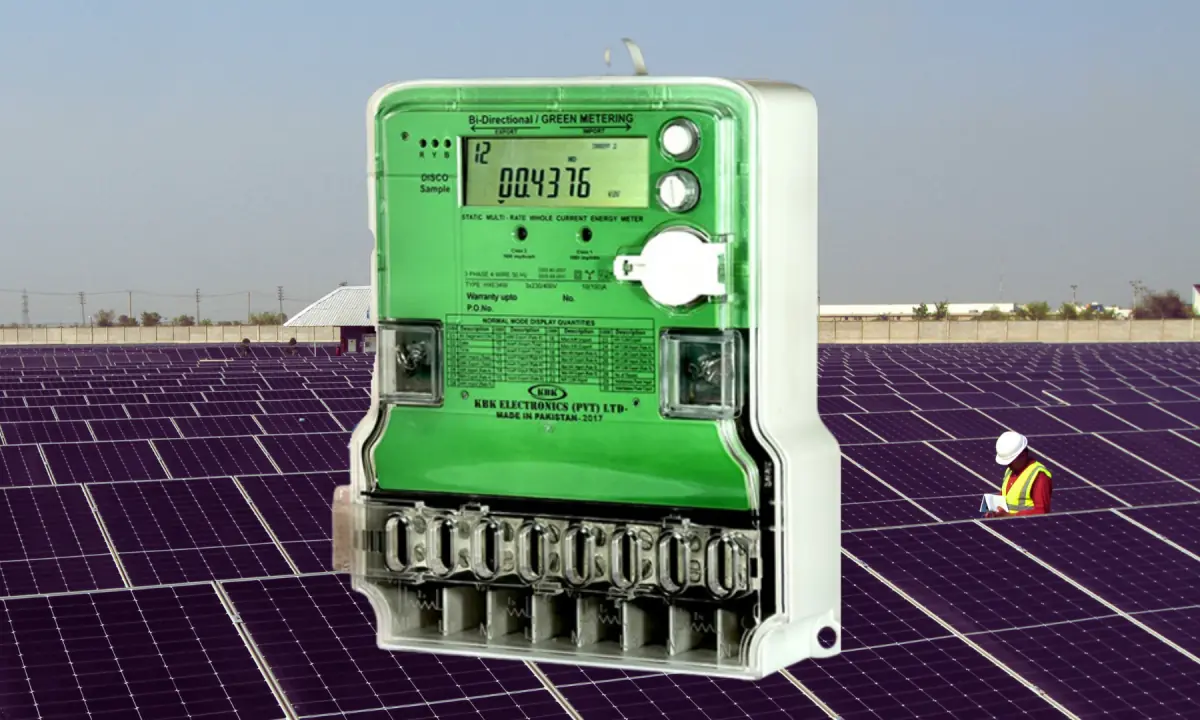
In a sudden move, the government recently terminated the existing net-metering regime for all existing and future net-metered solar consumers, known as prosumers, and replaced it with a net-billing regime for all.
The stated rationale behind this development — which could mean longer payback periods and lower overnight returns — is the need to address the technical, financial and equity concerns that have emerged from the mushrooming growth of solar power in Pakistan over the last couple of years. Under the changes, the buyback rate for electricity exported to the grid by solarised consumers has been reduced from the existing Rs26 per unit to Rs11 per unit. The new export rate broadly reflects the national average energy purchase price at which the government purchases electricity from power plants.
At first glance, this price reform appears overdue. Like most electricity tariff interventions, however, it is not merely a technical adjustment but carries significant long-term implications for consumers, electricity utility companies, and the power sector as a whole.
To understand these implications, we first need to have a look at Pakistan’s solarisation map. A study conducted by the Policy Research Institute for Equitable Development (PRIED) shows that solar deployment in the country has now surpassed 33 gigawatts (GW). While only a smaller portion of this deployment, around 6GW, is net-metered — that is, connected to the national grid — its much larger portion, around 27GW, is off-grid or behind the meter.

The net-metered deployment is mostly concentrated in urban communities, among higher-income households, and among commercial users. This rapid solar adoption has provided relief to hundreds of thousands of grid-connected consumers from high electricity tariffs, giving them greater energy independence and transforming them from ‘consumers’ to ‘prosumers’.

Besides that, as more people generate and consume electricity from solar power, it has greatly reduced daytime grid electricity sales, giving rise to the well-known “duck curve” in electricity demand and supply. This, in turn, results in underutilisation of the national grid.
Net billing vs net metering
Net-billing is being introduced as a key driver to tackle two concerns: (i) increase demand for grid-provider electricity (to address the duck curve phenomenon) and encourage self-consumption by grid-connected solarised consumers; (ii) reduce the cost-shifting impact of solarisation on non-solarised consumers.

This cost-shifting phenomenon occurs when a utility company — for example, a distribution company or Discos — is unable to recover its fixed costs from solarised consumers, so these costs are ultimately borne by non-solarised consumers. Traditionally, utilities recover much of these costs through the volumetric spread of electricity consumption based on total units (kWh) consumed. As an increasing number of consumers installs its own solar power to meet or supplement their electricity needs, these fixed costs must be spread over fewer units.
This will either raise the electric tariff or create a recovery gap.
The primary reason behind this regressive cost-shifting is our existing tariff regime, which does not distinguish between different tariff types in electricity bills. For example, it does not clearly separate the energy charges (marginal cost of producing electricity or the variable cost) and capacity charges (fixed charges including costs of maintaining the grid and transmission systems).
A large part of the latter cost is recovered through flat volumetric rates. These flat rates create a mismatch between how costs are incurred and recovered. When electricity consumers reduce their consumption due to solarisation, energy efficiency, or other changes, the money collected through volumetric charges falls short of covering the utility company’s costs. To recover this shortfall, utility companies raise prices for all their customers.
Under net-metering, a prosumer effectively shields themselves from these charges by exporting electricity from their solar installations at a price that matches the retail price the utility charges its consumers. Non-solarised customers, on the other hand, have to bear all the resulting increase in capacity as part of their electricity bill. As a result of the ongoing solarisation, more than 90 per cent of grid-connected electricity consumers are estimated to be facing a higher tariff burden.
With net billing, solarised consumers will not receive the retail rate for the electricity they export. The buyback rate for their exported electricity will, thus, come down to Rs9-Rs11 per kwh, helping Discos to recover more revenue from these prosumers.
Seen from this perspective, net-billing appears to be a fiscally rational act.
In practice, under a net-billing regime, solarised households will do two transactions with the utility company: one for the amount of electricity they will import from the grid, and second for the amount of electricity they will export to the grid — each at a different rate. This will improve cost recovery reflectivity, which is a core principle of efficient tariff design.
Secondly, net-billing will reduce cross-subsidisation of solarised consumers by non-solarised consumers. The former will pay the same electricity price as other consumers for the electricity they import, while receiving only a fraction of this price for the electricity exported by them. Thirdly, lower payments for the electricity exported by prosumers will provide short-term financial relief to Discos by helping stabilise their revenues. It will also spread the burden of fixed costs across all types of consumers equally.
Finally, net-billing can incentivise greater self-consumption and battery storage among solarised consumers, potentially aligning household behaviour with system needs by addressing the duck curve phenomenon — at least in theory.
Broad implications
These arguments, however, offer only a partial view. They ignore the fact that the real test of their validity lies in the implementation of the changes.
For instance, the regulations impose a flat rate on exported electricity regardless of the time it is exported. This creates two major inefficiencies. Firstly, even at a discounted buyback price of Rs11 per unit, households will continue exporting large volumes of electricity at noon — precisely when system demand will be at the lowest — because the solarised power output is highest at that time.
This, according to the evidence available from other countries, will do little to mitigate midday transmission and distribution congestion, reverse power flows, or local voltage instability. Flat export pricing offers no incentive to shift consumption from the evening peak hours, when the national grid faces its greatest stress (duck-curve), to off-peak hours. Studies on time-of-use (TOU) tariffs consistently find that consumer behaviour remains misaligned with system needs without time signals.
In addition to the flat export rates, restrictions on the system size introduce another layer of complexity. They revise the permissible sizing ratio of rooftop solar systems relative to the sanctioned load from 1:1.5 to 1:1. The intent is to limit surplus electricity exports to the grid. On paper, this will reduce operational stress and cost shifting. Yet this change also has broader implications.
The strict size cap reduces the surplus that households can export and does not adequately account for likely future electrification within homes: cooking, space heating, and electric vehicle charging, etc. By locking household system size to today’s sanctioned loads, the regulation may discourage long-term planning and constrain a household’s ability to electrify end uses that could otherwise reduce reliance on imported fuels.
Under net-billing regulations, lower export rates will lengthen payback periods for grid-connected solarised consumers, making solar power a less attractive option from an investment perspective. In comparison, systems designed primarily for self-consumption will offer shorter payback periods. This will create a real risk that consumers may choose to maximise self-consumption, using the grid only as a backup and, thus, effectively shifting to behind-the-meter mode. Such behaviour will further reduce the demand for grid-connected electricity and deepen the challenges of network underutilisation.
A poorly designed net-billing policy can also accelerate defections from the grid. If exporting electricity yields little value, particularly during high-demand evening hours, and fixed charges continue to rise, grid-connected solarised households may choose to install oversize solar-plus-storage systems and end their reliance on the grid altogether, further shrinking the consumer base for fixed-cost recovery. Beyond its impact on grid participation, net-billing also raises important questions about who can access and benefit from rooftop solar.
Rooftop solar adoption is already shaped by access to capital and, therefore, is being pursued more vigorously by high-income groups than by low-income ones. Lower returns on solar installations and their longer payback periods, especially when combined with taxation measures on solar panels and equipment, will certainly further disincentivise the low-income groups to move towards solar adoption, thus widening the inequity gap between them and those who have the capacity to finance new solar installations even after the regulations are enforced.
In other words, the policy will slow down solar diffusion and reinforce the current pattern in which distributed solar has become a technology primarily adopted by wealthier groups.
The real challenge
Net-billing is not inherently anti-solar; done well, it can correct an inefficient valuation of exports, reduce regressive cost shifting, and improve the financial sustainability of utilities.
But a poorly designed net-billing regime — especially one with flat export pricing and restrictive sizing caps — will push consumers into greater self-consumption, accelerate behind-the-meter behaviour, and even prompt grid defections. That outcome would deepen underutilisation and make fixed-cost recovery harder, not easier.
Pakistan’s real challenge is to modernise tariff design so the grid remains financially viable, technically stable, and economically attractive for all consumers — including prosumers. Net-billing can be part of that solution, but only alongside broader reforms that introduce time signals, transparently recover fixed costs and ensure equitable access so that distributed solar benefits all households, not just the wealthier ones.


