





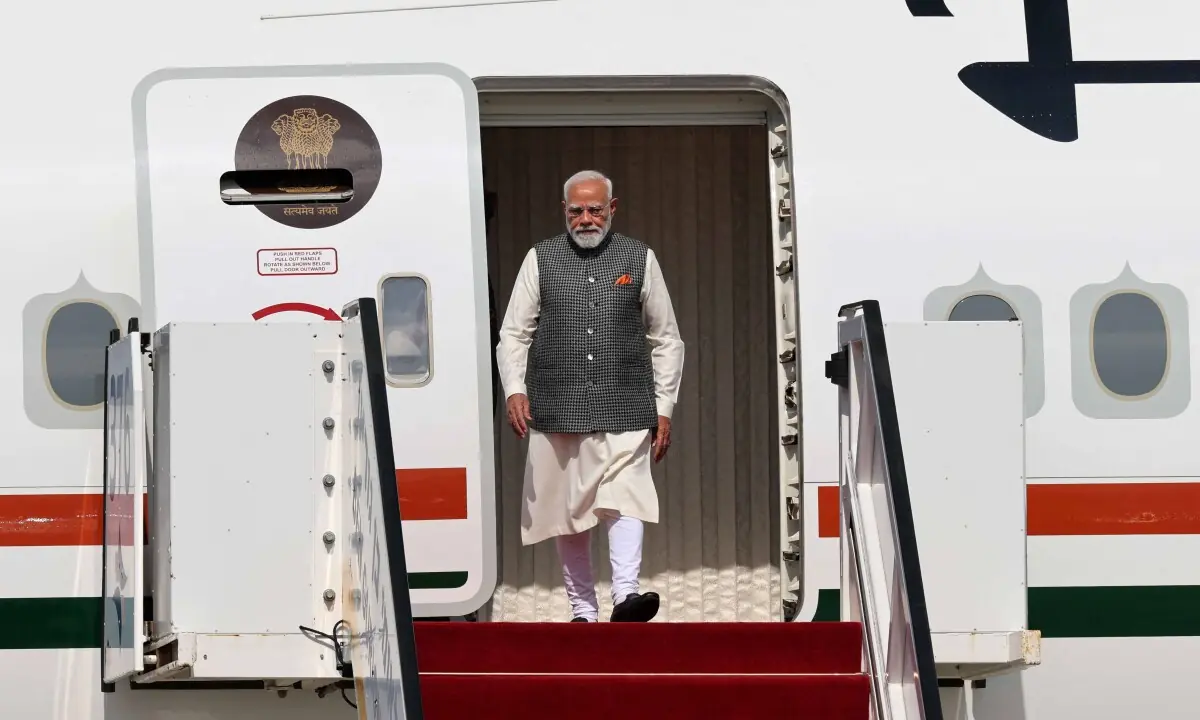
Prime Minister Narendra Modi told lawmakers in Jerusalem on Wednesday that India stands “firmly” with Israel following Hamas’s attack on October 7, 2023.
Modi also met with Israeli Prime Minister Benjamin Netanyahu during a two-day visit aimed at deepening trade and defence ties that has drawn criticism at home.
“I … carry with me the deepest condolences of the people of India for every life lost and for every family whose world was shattered in the barbaric terrorist attack by Hamas on October 7,” Modi said in the Knesset, the Israeli parliament.
“We feel your pain, we share your grief. India stands with Israel firmly with full conviction in this moment and beyond.”

In his speech, Modi did not explicitly mention the tens of thousands of Palestinians killed in Gaza during the more than two-year Israeli onslaught.

But he said that India “supports all efforts that contribute to durable peace and regional stability”.
Modi also told Israeli lawmakers that his country’s economic growth and Israel’s leadership in technological innovation formed a “natural foundation for our forward-looking partnership”.

“I see a lot of synergies in areas such as quantum technologies, semiconductors and artificial intelligence,” he added.
It is Modi’s second visit to Israel as prime minister since he took office in 2014.
‘A real friendship’
Earlier on Wednesday, a red carpet was rolled out at Israel’s Ben Gurion airport and Modi was greeted with a hug by Netanyahu as he disembarked the plane.
“The two leaders share a special and a personal relationship,” Shosh Bedrosian, spokeswoman for Netanyahu’s office, said in a video posted on X.
“The bond between Israel and India is a powerful alliance as we are partners in innovation, security and a shared strategic vision,” she added.
Netanyahu’s office said the two right-wing leaders held a private meeting after the welcoming ceremony, with the Israeli premier hailing “a real friendship”.
In a post on X, Modi described the meeting as “excellent”.
“We discussed a wide range of topics aimed at deepening and strengthening the bilateral relations between our two countries,” he said.
The pair “held an in-depth conversation about major developments in the region”, he added.
Modi is also scheduled to meet Israeli President Isaac Herzog during the visit.
New Delhi has steadily expanded cooperation with Israel across the defence, agriculture, technology and cybersecurity sectors, while balancing diplomatic interests in the Middle East.
Talks opened in New Delhi on Monday for an India-Israel Free Trade Agreement (FTA), India’s government said in a statement, noting that merchandise trade reached $3.62 billion in 2024-2025.
Full diplomatic relations between the two countries were established in 1992. Ties deepened after Hindu-nationalist leader Modi took office in 2014.
Criticism at home
Modi first visited Israel as prime minister in 2017, before Netanyahu made a reciprocal visit to India the following year.
In 2023, grand plans were unveiled in New Delhi for an India-Middle East-Europe Economic Corridor — to link railways, ports, electricity, data networks and pipelines, including through Saudi Arabia and Israel.
Those plans were stalled by Hamas’s October 7 attack on Israel, which responded with a devastating onslaught on the Gaza Strip, killing over 71,000 Palestinians.
Months after his 2017 visit to Israel, Modi travelled to Ramallah, seat of the Palestinian Authority.
His current visit has sparked criticism at home.
Senior Congress party figure Priyanka Gandhi — sister of opposition leader Rahul Gandhi — posted on social media on Wednesday that she hoped Modi would mention the killing of “thousands of innocent men, women and children in Gaza” during his address to the Israeli parliament.
Congress parliamentarian Jairam Ramesh said Modi will be displaying “moral cowardice” when the entire world is critical of his “dear friend” Netanyahu.
He said Modi was “brazenly embracing” his Israeli counterpart, who has “reduced Gaza to rubble and dust and who is orchestrating the expansion of illegal settlements in the occupied West Bank”.
“On May 20, 1960, Jawaharlal Nehru was in Gaza and met with the Indian contingent of the UN Emergency Force there,” Ramesh recalled.
Days ago, Netanyahu listed India, Greece, Cyprus and unnamed Arab, African, and Asian countries as part of a “hexagon of alliances” against “radical axes” of Muslim nations.
India, the world’s most populous nation with 1.4 billion people, is majority Hindu, but an estimated 220 million Indians are Muslim.
One of India’s largest conglomerates, Adani Group, operates the Israeli port of Haifa, while Israeli military drone technology played a pivotal role during India’s May 2025 clash with Pakistan.


