


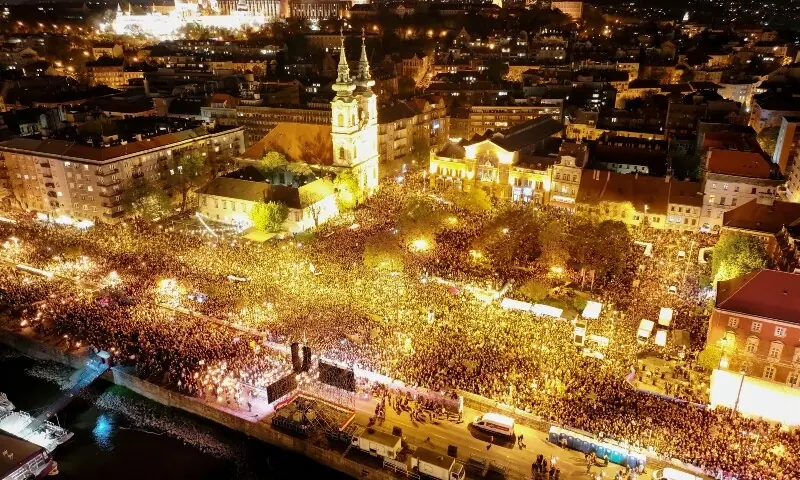
Hungarian youths danced and sang in the early hours of Monday in central Budapest to celebrate the end of nationalist Prime Minister Viktor Orban’s 16-year “illiberal” rule following a resounding electoral drubbing.
Strangers high-fived each others, cars honked, and youths ripped down government and ruling party anti-Ukraine billboards as many said they felt “liberated”.
“At long last it feels so good to be Hungarian. It’s like a weight lifted off our shoulders,” Csilla Bekesi, 25, told AFP, celebrating with others on Budapest’s grand boulevard.
“I still have goosebumps. My wildest dream came true,” said another youngster, 22 year-old student Andras Szabo, who came back to vote from Berlin.

“For as long as I can remember, I have known Orban only as the leader, it was great he left at once,” he said, adding he felt a “novel sense of pride”.

Orban, a defender of “illiberal democracy”, conceded defeat to conservative pro-European Peter Magyar, whose party won a two-thirds parliamentary majority in Sunday’s vote that saw a record turnout.
‘We have won’
“It is over; we have won”, small crowds chanted euphorically at each other on Budapest’s Chain Bridge.

“Dear young people of Hungary, let me address you directly,” Magyar, 45, a former party insider and political newcomer, said during his election night speech.
“Thank you for restoring our hope for change, our hope for a humane and courageous Hungary,” he told tens of thousands of supporters on the banks of the Danube in Budapest against the backdrop of the illuminated parliament on the other side of the river.
“You have taken action and shown us what it means not to be afraid, and what it means to begin building a Hungary free from fear,” he added.
Zsolt Hegedus, who Magyar has designated as future health minister, enthusiastically danced on the stage.
Ahead of Sunday’s vote, there were signs that Orban had lost support among many young Hungarians.
One of the last surveys by pollster Median showed that 76 per cent of under-30s were Tisza supporters, while only 10pc were Fidesz sympathisers.
‘Filthy Fidesz’
Already during last summer, chants of “Filthy Fidesz” became increasingly common at concerts, including at Budapest’s famed Sziget Festival, one of Europe’s largest outdoor music events.
Since his return to power in 2010, Orban also faced recurring protests from teachers and students, who accused his government of financially neglecting the education sector.
Orban touted several policies, including an income tax exemption for under 25s, as youth-friendly policies, and during the campaign he also asked older Fidesz supporters to talk with their children and grandchildren.
But ultimately Fidesz “did not have a tangible offer to the youth who were rather anxious about the stagnating economy, living conditions, housing, healthcare and education,” political scientist Edit Zgut-Przybylska from the Polish Academy of Sciences told AFP.
As youths in Hungary, like elsewhere in Europe, have “developed huge distrust in traditional, institutional politics,” they are also “highly active politically in terms of activism and protest”, Zgut-Przybylska said.
Magyar’s movement “captured this energy and turned it into votes”, engaging “Gen Z with hope-based, positive, pro-European messages that provided concrete remedies for their anxieties of an uncertain future,” she said.
“What a night, what a carnival, I honked my horn all night, I’m ecstatic,” Kristoffer Mayer, a 28-year-old taxi driver, told AFP.
Fidesz “suffocated, strangled, poisoned this country for so long it was hard to breathe,” he said.
“I know he (Magyar) won’t be able to do everything he promised as they (Fidesz) have robbed the state coffers. It will be so difficult, but we hope, and we believe the future starts now,” he added.