





Israeli Defence Minister Israel Katz said on Tuesday that Iran’s powerful national security chief Ali Larijani was “eliminated last night”, along with the commander of Tehran’s Basij paramilitary force, AFP reported. Iran has not yet commented on the report, according to Reuters.
However, a handwritten note was published on Ali Larijani’s X account on Tuesday, commemorating Iranian sailors killed in a recent US attack, whose funeral was expected to take place today.
به مناسبت مراسم تشییع سلحشوران نیروی دریایی ارتش جمهوری اسلامی ایران: یاد آنان همواره در قلب ملت ایران خواهد بود و این شهادتها بنیان ارتش جمهوری اسلامی را برای سالها در ساختار نیروهای مسلح استوار مینماید. ازخداوند متعال علو درجات برای این شهدای عزیز خواستارم. pic.twitter.com/dvTdhyDYbY
— Ali Larijani | علی لاریجانی (@alilarijani_ir) March 17, 2026

“On the occasion of the funeral ceremony for the valiant martyrs of the Islamic Republic of Iran’s Navy: Their memory will forever remain in the heart of the Iranian nation,” it said, adding, “These martyrdoms will strengthen the foundations of the Islamic Republic’s army within the structure of the armed forces for years to come.”
The tweet ends with, “I ask Almighty God to grant these dear martyrs the highest ranks.”

The killing of Larijani, if confirmed by Tehran, would represent the highest-profile assassination since the killing of Iran’s supreme leader Ali Khamenei and other leaders during the wave of US-Israeli strikes that started the war on February 28.
BREAKING: Israel has claimed it has killed Iran’s security chief Ali Larijani and Basij force commander Gholamreza Soleimani. Iran has not commented on, nor confirmed these claims. pic.twitter.com/GEHEaitulz
— Al Jazeera English (@AJEnglish) March 17, 2026

Katz said that he had been informed by Israel’s military chief that Larijani and the head of Iran’s Basij paramilitary force Gholamreza Soleimani “were eliminated last night”. He said the two leaders “have joined Khamenei, the head of the annihilation program, along with all those eliminated from the axis of evil in the depths of hell”.
The office of Israeli Prime Minister Benjamin Netanyahu released a photo of the premier on the phone, captioned: “Prime Minister Benjamin Netanyahu orders the elimination of senior figures in the Iranian regime.”
Israel’s military had announced earlier it had killed Basij chief Soleimani “in a precise strike in Tehran”. “Yesterday (Monday), the Israeli Air Force, acting on IDF intelligence, targeted and eliminated Gholamreza Soleimani, who operated as commander of the Basij unit for the past six years,” it said.
The military said that Soleimani was killed along with other Basij commanders by an air strike on a “makeshift headquarters”. The Basij, a volunteer force under Iran’s Revolutionary Guards, “led the main repression operations” by the authorities during recent mass protests in Iran, the Israeli army said.
Iran was rocked by unprecedented protests against the clerical establishment that peaked in January. They were met with a crackdown in which, according to rights groups, thousands of people were killed and tens of thousands arrested.
Israel’s military chief Lieutenant General Eyal Zamir said “significant preventive achievements were recorded overnight” in a statement released earlier by the military.
Blasts heard from Jerusalem after warning of Iran missiles in north Israel
A series of distant blasts were heard on Tuesday from Jerusalem after sirens sounded in northern Israel following a warning that Iran had fired missiles, AFP journalists said. “The IDF identified missiles launched from Iran toward the territory of the State of Israel. Defensive systems are operating to intercept the threat,” the Israeli military said.
Iran launched fresh attacks on the United Arab Emirates, the kind of strikes on US Gulf allies that President Donald Trump said had not been expected, but which sources said he had been warned about before the conflict.
The US-Israeli war on Iran is in its third week, with at least 2,000 people dead and no end in sight. The Strait of Hormuz remains largely closed off, with US allies rebuffing Trump’s request for help to reopen the critical waterway, raising energy prices and fears of inflation.
There was no let-up in attacks by both sides early on Tuesday, with Iran launching missiles on Israel overnight, underscoring that Tehran still retains the capacity to carry out long-range strikes despite more than two weeks of pounding by US and Israeli weapons.
The Israeli military said it was targeting “Iranian regime infrastructure” with a new wave of strikes across Tehran, as well as Hezbollah sites in Beirut, a day after saying it had drawn up detailed plans for at least three more weeks of war with Iran.
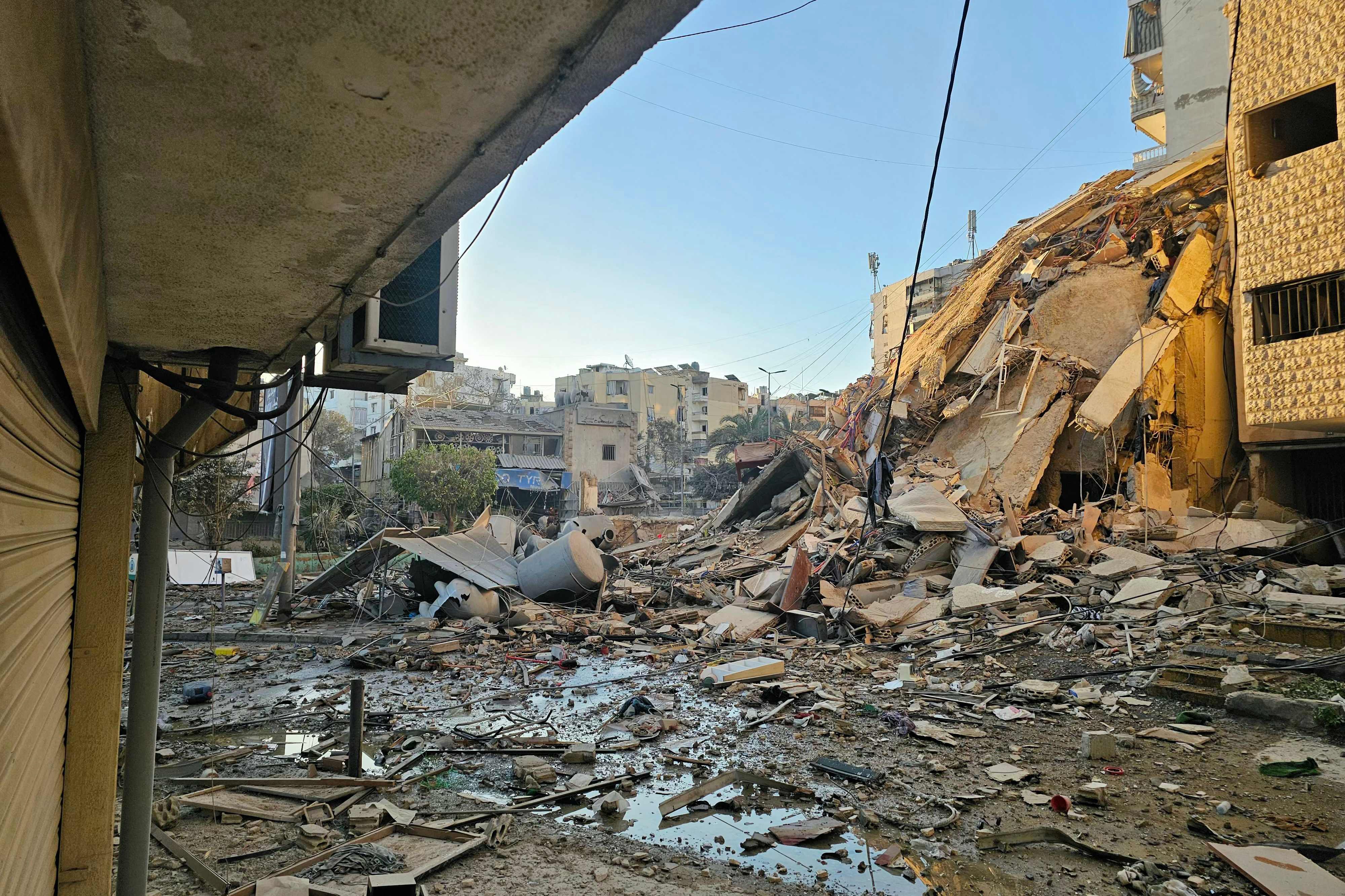
Rubble and debris are strewn across a road at the site of an Israeli airstrike that targeted Beirut’s southern suburbs, in the al Kafaat neighborhood, on March 17, 2026. PHOTO: AFP
Rockets and at least five drones targeted the US embassy in Baghdad early on Tuesday, Iraqi security sources said, describing it as the most intense assault since the war began. Two US officials said no injuries were reported so far.
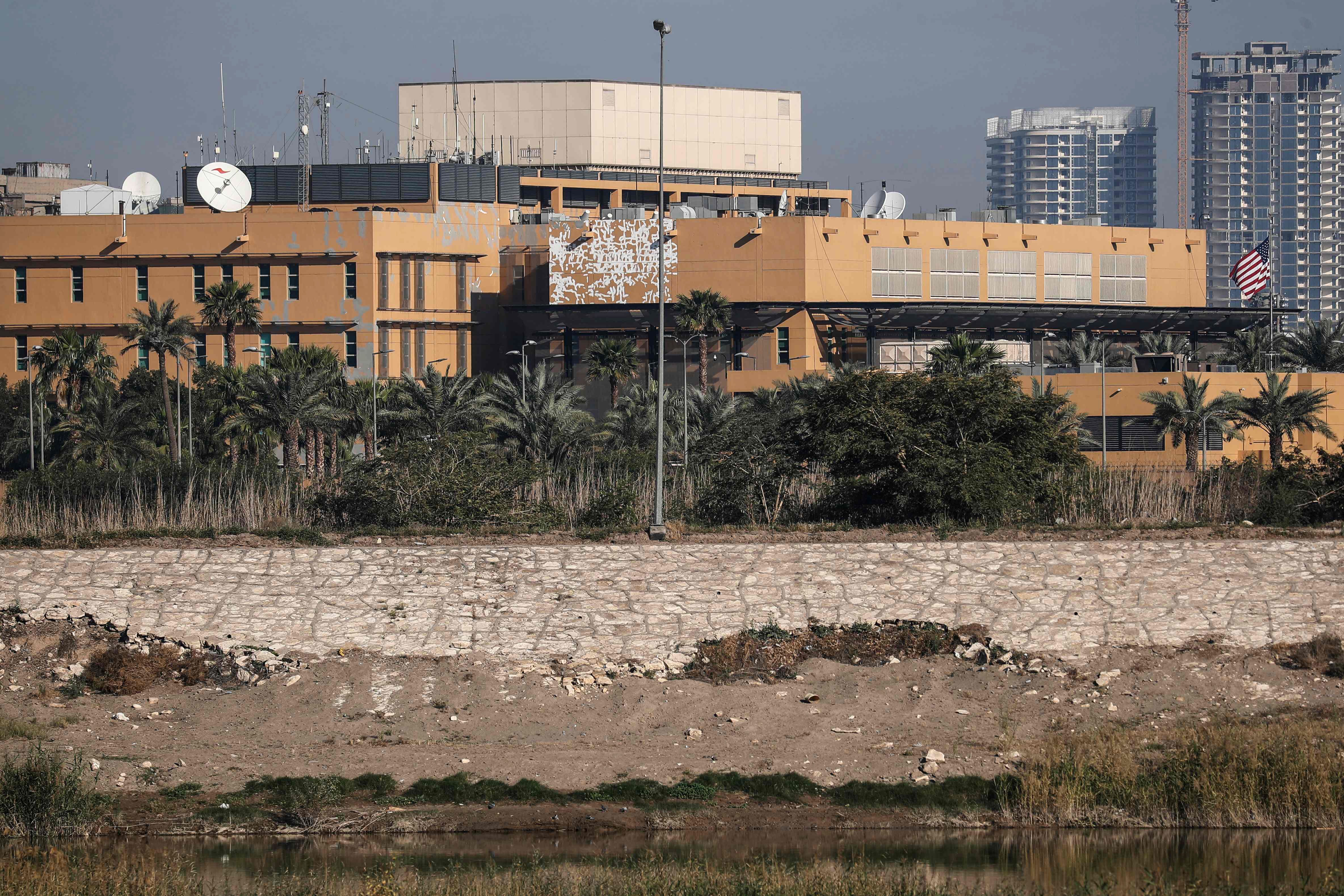
The US flag flutters outside the US Embassy, seen across the Tigris River in Baghdad’s fortified Green Zone, in the Iraqi capital on March 17, 2026. PHOTO: AFP
Iran also targeted the United Arab Emirates, where attacks forced the temporary closure of airspace and a drone hit an oil facility in Fujairah, a key port for Emirati oil exports, for a second consecutive day.
UAE authorities said debris from an intercepted ballistic missile fell in Abu Dhabi’s Bani Yas area, killing one Pakistani national, while a fire caused by a drone attack was being fought at Abu Dhabi’s Shah gas field.
Trump said Iran’s strikes against its neighbours, including Qatar, Saudi Arabia, the United Arab Emirates, Bahrain and Kuwait, were a surprise.
In yet another speech he prophecized:
“No One Expected Iran to Attack the Gulf States, We Were Shocked”!!!
“They weren’t supposed to go after all these other countries in the Middle East”!!!https://t.co/FttYNqqaFv— Harry (@Harry39426204) March 17, 2026
“They (Iran) weren’t supposed to go after all these other countries in the Middle East,” he said on Monday. “Nobody expected that. We were shocked.”
However, Trump was warned that attacking Iran could trigger strikes against US Gulf allies, according to a US official and two sources familiar with US intelligence reports.
The US official, who, like the other two, requested anonymity to discuss the issue, said Trump was briefed before the war that striking Iran could trigger a broader regional conflict that would include Iranian attacks against Gulf capitals, especially if Tehran saw those countries condoning or actively supporting the US bombardment.
Trump was also briefed ahead of the operation that Tehran would likely seek to close the economically vital Strait of Hormuz, according to two other sources familiar with the matter.
Trump earlier accused some Western allies of ingratitude after several countries rebuffed his demand to send warships to escort oil tankers in the strait, through which 20% of the world’s oil and liquefied natural gas flow.
Speaking at a White House event in Washington, Trump said many countries had told him they were prepared to help, but voiced frustration with some long‑standing allies.
“Some are very enthusiastic about it, and some aren’t,” he said, without offering specifics. “Some are countries that we’ve helped for many, many years. We’ve protected them from horrible outside sources, and they weren’t that enthusiastic. And the level of enthusiasm matters to me.”
A number of US partners, including Germany, Spain, Italy, Japan and Australia, said they had no immediate plans to send ships to help reopen the strategic waterway, which Iran has effectively shut with drones and naval mines.
“We lack the mandate from the United Nations, the European Union or NATO required under the Basic Law,” German Chancellor Friedrich Merz said in Berlin, adding that Washington and Israel had not consulted Germany before launching the war.
Allies refuse Hormuz escort as Trump blasts ‘ingratitude’
.
Major US allies including Germany, Spain and Italy said they have no immediate plans to send warships to reopen the route, which has been partially blocked by Iran using drones and naval mines.
.
German Chancellor… pic.twitter.com/p1TJueYZXp— Thenationthailand (@Thenationth) March 17, 2026
Naval escorts will not “100 percent guarantee” the safety of ships attempting to transit the waterway, the Financial Times quoted the head of the International Maritime Organisation as saying on Tuesday.
Trump had earlier suggested China, which relies on Iranian crude, should help open the strait and that he might delay a much-anticipated trip to Beijing at the end of the month if he did not get support. On Monday, Trump said he was seeking to delay the visit by “a month or so”.
While the US and Israel say they have decimated Iran’s military, Tehran’s fleet of cheap drones is continuing to cause havoc in the region.
Iran’s parliament speaker, Mohammad Baqer Qalibaf, dismissed foreign reports that Iran is running low on missile launchers.
“They say that our firepower has decreased, but our offensive power, experience, and accuracy have increased,” he said on state TV on Tuesday, adding that regional security needed to be established by regional countries.
Araghchi responds to Hegseth
Iran’s Foreign Minister Seyyed Abbas Araghchi on Tuesday in a post on X responded to comments made by the US War Secretary Pete Hegseth on Friday.
“We will keep pressing, keep pushing, keep advancing. No quarter, no mercy for our enemy,” Hegseth said in the press briefing.
When the U.S. Secretary of War declares “no quarter”, he doesn’t project strength. He conveys moral bankruptcy and ignorance about law of armed conflict. We advise him to review the Hague Convention and Rome Statute of the ICC, unless he aspires to join Netanyahu as war criminal.
— Seyed Abbas Araghchi (@araghchi) March 16, 2026
Araghchi responded, stating that when Hegseth declares “no quarter,” he is conveying “moral bankruptcy and ignorance about the law of armed conflict.” He warns the Secretary of Defense to review the International law, “unless he aspires to join Netanyahu as a war criminal.”
“No quarter” is the refusal to spare the life of someone who has expressed their intention to surrender – something prohibited by law.
“International humanitarian law prohibits the use of this procedure, that is, ordering that there shall be no survivors, threatening the adversary therewith, or conducting hostilities on this basis,” according to the International Committee of the Red Cross.


