





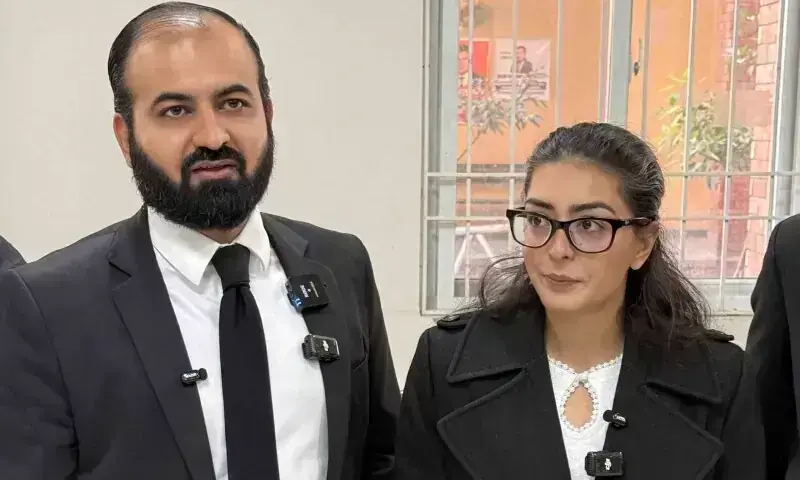
ISLAMABAD: Lawyers Imaan Zainab Mazari-Hazir and her spouse Hadi Ali Chattha on Saturday challenged their conviction in the controversial social media posts case by filing separate criminal appeals in the Islamabad High Court (IHC).
The appeals sought to have the trial court’s January 24 verdict — which handed the couple a total of 17 years in jail on multiple charges — declared null and void.
In their appeals, the appellants contended that the impugned judgment was passed in blatant violation of settled legal principles and mandatory procedural requirements.
They argued that the trial court proceeded to pronounce the verdict despite the fact that an application seeking transfer of the case was pending adjudication before the IHC, rendering the decision unlawful and without jurisdiction.

According to the appeals, once a transfer application was filed and pending before a superior court, the trial court was barred from proceeding further in the matter.

The appellants maintained that any judgment delivered under such circumstances was void ab initio and liable to be set aside on this ground alone.
The appeals further assailed the conduct of the trial, alleging that the right of defence was effectively taken away under the guise of ensuring transparency.

They argued that the trial court curtailed the defence’s opportunity to effectively cross-examine witnesses and present its case, thereby violating the fundamental right to a fair trial guaranteed under the Constitution.
The appellants also pointed out that during the proceedings, a state counsel had himself complained that certain questions were conveyed to the defence in advance, raising serious doubts about the fairness and integrity of the trial.
Despite the gravity of this allegation, the trial court, the appeals stated, failed to conduct any inquiry or investigation into the matter.
Serious objections were also raised regarding the circumstances of the appellants’ arrest. The appeals alleged that both Imaan and Hadi were subjected to torture at the time of their arrest while they were on their way to appear before the trial court.
It was argued that these allegations were brought to the notice of the court, but no effort was made to examine or inquire into the claims of custodial torture.
The appellants further questioned the legality of the proceedings conducted through video link from jail. They argued that the trial court failed to examine how an interrogation and effective proceedings could be conducted through a video link when the relevant judicial file was not even present with the accused in custody.
This, they maintained, further compromised their right to properly defend themselves.
On these grounds, the appellants requested the IHC to declare the trial court’s judgment dated January 24 as unlawful, void and of no legal effect. They also sought suspension of the impugned verdict during the pendency of the main appeal against the conviction.
Last month, a sessions court in Islamabad had sentenced the two lawyers, sparking outrage among rights groups, opposition parties, and other segments of society.
The written order by Additional District and Sessions Judge Muhammad Afzal Majoka said the prosecution had proven its case against the two under Sections 9 (glorification of an offence), 10 (cyberterrorism) and 26-A (false information) of the Prevention of Electronic Crimes Act (Peca).
Under Section 9 of Peca, both were sentenced to five years of rigorous imprisonment and fined Rs5 million each, with an additional year in default.For Section 10, they were each handed 10 years’ rigorous imprisonment and fined Rs30m, with two more years in default. Under Section 26-A, they received two years’ rigorous imprisonment and a fine of Rs1m each, with six months’ additional jail time in case of non-payment.


