


“As dissenters challenge existing ideas, social consciousness grows, the condition of human existence and rights improve and society progresses …Thus, it is in society’s collective interest that the right to dissent be upheld, even though critical ideas might seem unpalatable. It is in the state’s own interest to tolerate ideas critical of it. Criticism of the state and its policies is a natural outcome of the democratic system of governance … the security of the state must not be projected by the state itself to be so fragile that critical speech would shake its foundation.”
— Justice Babar Sattar in the case of Shoukat Ali vs. Government of Pakistan (PLD 2024 Islamabad 135)
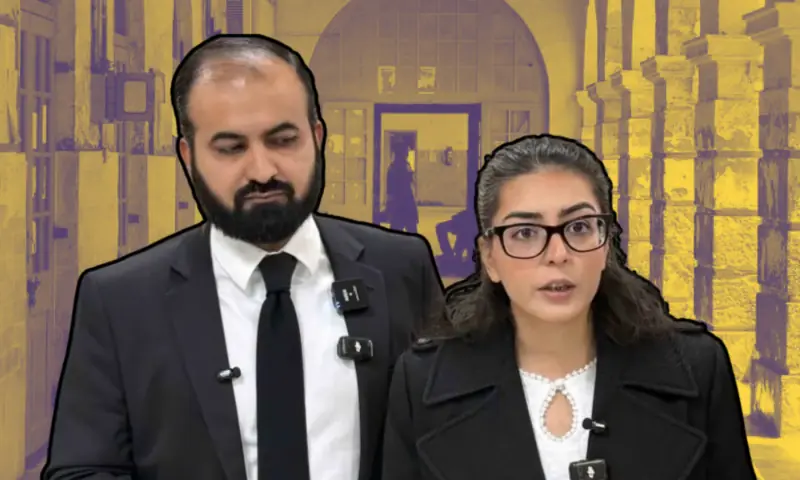
On Friday, lawyer Imaan Zainab Mazari-Hazir and her husband Hadi Ali Chattha were arrested while they were reportedly on the way to the Islamabad district courts. The multiple cases registered against them invoke provisions of the Prevention of Electronic Crimes Act (Peca), anti-terrorism legislation, and laws regulating public assembly. Their arrest demonstrates how the law is being employed to silence opposition, revealing a state increasingly at war with dissent.
The allegations against Imaan include ‘offensive tweets’ against ‘important state institutions’. While Imaan is being prosecuted for posting content, Hadi is being prosecuted for reposting and resharing her content. Even clicking ‘repost’ on content that the state finds objectionable can subject an individual to criminal prosecution.

A state that treats criticism as a crime undermines both democracy and the rule of law. When lawyers are punished for challenging state excesses, it is not just an attack on individuals, but on the legal system itself.
Peca: an instrument of control
When Peca was amended last year to include a punishment for “false and fake information” through Section 26-A, the government claimed the aim was to counter misinformation. The intent was clear then, and it is clear now: the amendment has nothing to do with fake news. It is an instrument of control. The Peca case against Imaan and Hadi includes provisions of cyberterrorism and the offence of fake/false information.
The fundamental problem with Peca is that it has been structured in a manner to shield state institutions from criticism. By defining “unlawful content” as “aspersions against any person, including members of the judiciary, the armed forces, parliament or a provincial assembly”, the amendment seeks to elevate members of these institutions above public scrutiny or accountability. Constitutional democracies do not insulate individuals from criticism; they protect a citizen’s right to free speech.

Freedom Network, a media watchdog that works on freedom of speech, reported that as per the Pakistan Federal Union of Journalists, 150 journalists faced charges under Peca in December 2024 alone, “often for allegedly spreading false narratives against state institutions”. When a law is enforced primarily against lawyers, journalists, and human rights defenders, its purpose is clear.
Case after case, the reliance on a vague charge of propagating a “false narrative against the state” reveals the true function of Peca: it is not about countering misinformation, but transforming lawful dissent into a punishable offence.
No society can claim to be governed by the rule of law when those defending it are themselves under attack.
A mockery of the justice system
When the Islamabad High Court granted Imaan and Hadi time to appear before the trial court in the Peca case and expressly ordered that they shall not be arrested in the case, another first information report (FIR) suddenly emerged against them, levelling absurd allegations.
The state’s conduct exposes a dangerous and unlawful pattern. When courts provide protection, coercive machinery is redeployed through new FIRs to nullify that relief. This creates a situation where court orders are rendered meaningless. If such conduct is permitted, the courts cease to operate as a check on executive power and judicial orders are immediately undone by executive action.
According to reports, an FIR against Imaan was registered for a protest in February 2025, the day the Judicial Commission of Pakistan convened to appoint judges to the Supreme Court pursuant to the 26th Amendment. It also names several other lawyers who were at the protest.
The FIR alleges, among other things, that slogans were raised against the constitutional amendment, the higher judiciary, and other state institutions. No action was taken at the time (nearly a year ago). Instead, criminal cases purportedly lodged months earlier are allowed to remain dormant, without investigation, only to be suddenly revived when judicial protection is granted in an unrelated case.
The latest FIR also includes provisions of the Peaceful Assembly and Public Order Act 2024, an oppressive law that effectively does away with the right to protest in Islamabad. The law defines ‘assembly’ as any gathering of more than 15 people, and makes assemblies subject to prior permission from the district magistrate. Authorities have the power to “recall” or “amend” permission. A police officer, on the instructions of the district magistrate, can order dispersal of a protest “likely to disturb the public peace”. The law imposes criminal penalties of imprisonment of up to three years or fines for being a member of an assembly classified as unlawful.
The message that is being sent through these cases is that no form of dissent — whether online or on the streets — is acceptable. Legal resistance will be met with retaliation.
Speaking out against enforced disappearances on social media is being treated as a criminal offence. Protesting against the destructive constitutional amendments can lead to criminal cases being registered.
The anti-terrorism law was introduced as a special law to address terrorism offences, and special courts were created to hear terrorism cases. Using this law against human rights defenders, journalists, and lawyers subverts its very purpose. There are reports of a spike in terrorism incidents, particularly in Balochistan and Khyber Pakhtunkhwa. Yet, the state is focusing its resources on categorising human rights defenders and lawyers as terrorists.
The misuse of power is a betrayal of the state’s responsibility. And this conduct reflects a deliberate strategy of intimidation designed to silence voices that hold state power accountable.
The visuals and manner of the arrest were equally shameful. “Eyewitnesses report that law enforcement officials used undue force against both the lawyers, and no reasons were provided at the time of arrest, raising serious concerns about their safety,” per Amnesty International.
Imaan’s mother, former federal minister for human rights Dr Shireen Mazari said: “I have no idea where my daughter and her husband have been taken”.
The state’s actions signal a breakdown of the law and the increasing capacity of the state to act with complete impunity. Arresting individuals without informing them of the charge and withholding information from their legal counsel and families is a clear violation of due process. Such actions are the hallmarks of authoritarianism, not lawful governance.
Post-amendment judiciary
While two officers of the court are subjected to legal harassment, the post-amendment judiciary serves its intended purpose by allowing it to continue. A society in which the judiciary does not defend rights and prevent blatant abuse of power is a frightening place, leaving citizens entirely unprotected and vulnerable to arbitrary executive action.
As per the 26th and 27th amendments, the Judicial Commission, including members of the executive, shall conduct an “annual performance evaluation” of the judges of high courts. If judges are to be “evaluated” by a commission that has government representatives on it, independent decision-making is compromised. If a judge renders a decision against the government, the government representatives in the commission may render a negative evaluation against the judge. The provision effectively places a sword of Damocles over the judiciary and allows the executive to intimidate judges.
Imaan and Hadi are among the few lawyers in Pakistan who consistently represent the most vulnerable victims of state abuse, from families of victims of enforced disappearances to those caught up in blasphemy cases. Pakistan’s fear of its human rights defenders is a confession: the truth is more threatening than anything else.
This is not just about two individuals facing legal harassment. It is about the reality that tomorrow it could be any lawyer, journalist, or citizen who speaks out and challenges state excesses.


