





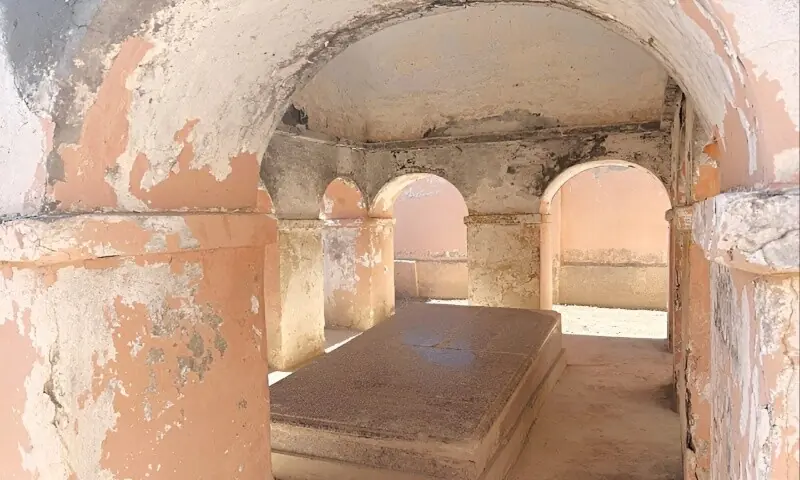
An 1895 photograph in Las Bela, in the south-west of modern-day Balochistan, by Col Patrick Alexander Weir, a British medical officer serving in British India, shows a small mausoleum. On it, a cross stands on top of a dome and another large cross is placed on the tomb itself. Today, both crosses are gone and the site is fast approaching dereliction. Nearby at Bara Bagh, the necropolis of Las Bela’s ruling Jams fares little better.
The subject of Weir’s photograph is the tomb of Robert Groves Sandeman, the British Raj army officer who laid down and executed the colonial blueprint in securitising modern-day Balochistan, playing on the suspicions of different Baloch groups with one another.
Sandeman died in January 1892, days before turning 58. After months of ill-health and a summer in Scotland, he returned to the Subcontinent in November 1891, spending Christmas in Quetta before travelling to Las Bela — his final resting place.
PART OF THE GREAT GAME

Las Bela had become an important port of call for Sandeman, who served as the Agent to the Governor General (AGG). Under his policy of “Sandemanisation”, political agents of the Raj were placed as “mediators” between the khans [chiefs] and the sardars [smaller chieftains].

In a derelict corner of Balochistan, the crumbling tomb of Sir Robert Sandeman marks the fading legacy of the man who redrew the region’s map through a policy of divide and rule
Sardars who formerly sought to seek the allegiance of the khans, would now seek British support and protection instead. This strengthened British control in the Balochistan Agency, established by the Raj in 1877. One such sardar was the Jam of Las Bela, who served as a feudatory of the Khan of Kalat. After Sandeman’s intervention, the Khan’s power was weakened.

Sandeman and his system were integral to the British Raj, particularly in areas of modern-day Pakistan and Afghanistan. A series of both diplomatic and military efforts guaranteed that British interests were safeguarded in nearly anything west of the Indus. This was notable, given that it was a time period that could easily have seen Soviet influence arrive in the Subcontinent, following a breakdown of relations between the two empires after the Crimean War (1853–1856), further fuelling the Great Game.
By 1880, Afghanistan was a British Protectorate, Sindh and Punjab were under Raj control, and — thanks to Sandeman — so was Balochistan.
THE IRONY OF LAS BELA
The arrangement between Las Bela and Kalat represented a bitter irony.
The formation of the princely state of Las Bela was only possible because of the Khan of Kalat, Muhabbat Khan. In 1742, at the request of Jam Ali of the Jamote clan, Muhabbat Khan dispatched Mulla Muhammad Hayat to Bela (the largest city in Las Bela), with a large force of Brahuis to capture the city, which had fallen under the control of various short-term semi-independent states. Las Bela owed its very existence to the Khan of Kalat’s military intervention — yet within a century, British meddling would transform this debt into betrayal.
The Jams of Las Bela claim Arab descent from the Sindhi Samma dynasty (1351-1524), who had lost control of the area to the short-lived Turko-Mongol Arghun dynasty. As repayment for the Khan of Kalat’s aid, the Jams paid tribute to the Khanate. But by 1830, Jam Mir Khan II aspired to overthrow Kalat state itself. After failed insurrections in 1865, his son Ali Khan III sought reconciliation with the Khan. Sandeman brokered a peace in 1876, recognising Kalat’s suzerainty — only for father and son to quarrel, leading to Ali Khan III’s disinheritance.
At Mir Khan II’s death in January 1888, a crisis of succession emerged, since the Jam had disinherited his son. However, Sandeman intervened and proclaimed Ali Khan III as Jam of Las Bela in 1889, after a year of deliberation. By installing Ali Khan III, Sandeman ensured the Jam owed his throne to the British — not to Kalat. Subsequently, the Jamote clan has kept control of Las Bela till the present-day.
FINAL DAYS
Leaving Quetta for Karachi on January 9, 1892, Sandeman summoned his political officers to meet him at Las Bela, alongside chiefs from Kech and Panjgur. In Las Bela, he was to mediate a quarrel between Jam Ali Khan III, now also a Knight Commander of the Order of the Indian Empire (KCIE), and his son Mir Kamal Khan, who had fled to Quetta.
Arriving in Karachi, Sandeman travelled by ship to Sonmiani, reaching Las Bela on January 22. Caught in heavy rain, he contracted a cold. The Jam arranged horsemen to Karachi, should medicines be needed. Pneumonia had however penetrated his lungs and he died on January 29, 1892.
Initially, his body was to be taken back to his native Scotland, but the Jam asked that he be buried in Las Bela. It would have been beneficial to house the tomb of the man who held such power in Balochistan, with its upkeep showing loyalty to the Raj.
In Colonel Sir Robert Sandeman: His Life and Work on Our Indian Frontier by Thomas Henry Thorton, Sandeman’s wife writes the chapter on his final days. She mentions that the Khan of Kalat wrote to her, saying that Sandeman should either be buried in England or within the Khan’s dominions. If the Jam were to object, he was prepared to send an army.
It is unlikely that the body would have been sent to Kalat territory, since the Raj was wary of the power the Khan of Kalat could potentially hold again in Balochistan. In a letter from Sibi to George Curzon (the future viceroy of India), days before his death on January 12, Sandeman wrote: “I do not say that the Khan is all that we could desire — very far from it. He has his own aims, of course, and he cannot forget or forgive the sardars for their successful rebellion.”
His letter also shows why the British had tried so desperately to establish some writ in modern-day Pakistan and Afghanistan, writing, “There cannot be a doubt of the fact of the Russians being most active on the Sistan frontier; our Government out here seem now to admit it.”
THE BURIAL
Sandeman’s burial was held on February 1, three days after his death, with the grave less than a mile from where he proclaimed Ali Khan as Jam of Las Bela. The Jam had this site selected since it was visible from his house, and where he could “look at it when saying his prayers”, according to the chapter by Sandeman’s wife.
Six months after a temporary burial, Ali Khan erected a dome with his name along with that of Sandeman inscribed on it. Sandeman’s wife sent a tomb of Aberdeen granite and white marble. A garden was planted, with iron railings around both the grave and dome, and a wall with an iron gate.
Sandeman’s tomb is not the only grave of a former British commander in modern-day Pakistan. The most famous example is of Lord Jacob in Jacobabad, and even Mortimer Durand’s father, Henry Marion Durand, who was buried in Dera Ismail Khan Khan.
The writer is Managing Editor of Folio Books. X: @saeedhusain72
Published in Dawn, EOS, November 16th, 2025


