




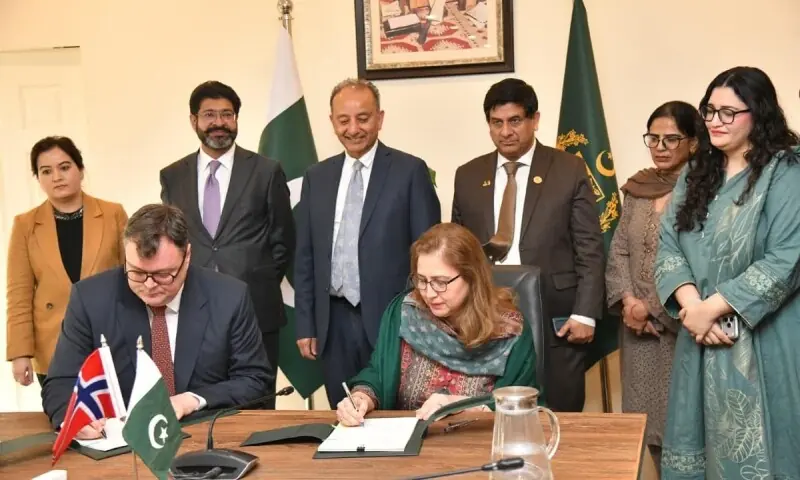
Pakistan and Norway on Wednesday signed the former’s first-ever carbon market deal under the Paris Agreement, according to an official press release.
According to the press release, “Pakistan and Norway on Wednesday signed the country’s first landmark bilateral agreement under Article 6.2 of the Paris Agreement, opening the door to international carbon trading, climate finance and major investment in clean energy and climate-smart agriculture.”
To tackle climate change and its negative impacts, world leaders at the UN Climate Change Conference (COP21) signed the Paris Agreement on December 12, 2015, according to the United Nations. The agreement included commitments from all countries to reduce their emissions and work together to adapt to the impacts of climate change, and called on countries to strengthen their commitments over time.
The press release issued on Wednesday said that a memorandum of understanding (MoU) signed in Islamabad under the auspices of the Ministry of Climate Change and Environmental Coordination marked Pakistan’s “formal entry into the global carbon market and is being seen as a breakthrough in the country’s climate diplomacy”.

Under the agreement, Pakistan will be able to develop carbon-credit generating projects in sectors such as clean energy, agriculture, transport and waste management and potentially sell the resulting emission reductions to Norway, the statement said


Minister for Climate Change and Environmental Coordination Musadik Malik termed the agreement a “historic milestone”, saying it would shift Pakistan from carbon market preparedness to practical implementation, the statement added.
“This is Pakistan’s first bilateral agreement under Article 6.2 and an important step towards implementation,” Malik said.
“It creates a credible pathway for international cooperation and investment in Pakistan’s climate priorities.”
Malik said the agreement would strengthen Pakistan’s position in international carbon markets and create new opportunities for the country’s emerging green economy.
“Carbon markets cannot be treated as an end in themselves. They must help countries like Pakistan finance transition pathways, create jobs, attract technology and deliver real benefits to communities,” he said.
The climate minister said Pakistan had already put in place the country’s first national policy guidelines for carbon trading, approved by the federal cabinet in January 2025, and was now moving to establish rules, reporting systems and bilateral arrangements needed to operationalise the market.
He said Pakistan had strong mitigation potential in sectors such as renewable energy, agriculture, transport and waste management, and that the agreement would encourage project developers and investors to move forward.
Addressing the signing ceremony, Norway’s Ambassador to Pakistan Per Albert Ilsaas said the accord marked the beginning of a new era in bilateral environmental cooperation, the statement added.
“Pakistan is among the countries most affected by climate change, and we believe this partnership can deliver both measurable emission reductions and real development benefits,” he said.
“Norway, which aims to become climate neutral by 2030, was seeking to purchase Internationally Transferred Mitigation Outcomes (ITMOs) under Article 6, not to meet its formal climate targets but to go beyond them,” he said.
“Norway is not purchasing ITMOs to meet its nationally determined contribution targets. We are purchasing them to achieve climate neutrality beyond those commitments,” he said.
Ilsaas said Norway’s Global Emission Reduction Initiative, launched in 2024 with a budget of $1.5 billion, would provide carbon finance to countries such as Pakistan.
“Through Norwegian Global Emission Reduction (Noger), we want to channel carbon finance into countries such as Pakistan and help bridge the gap in climate mitigation finance,” he said.
He added that Norway was looking beyond individual carbon-credit projects and was interested in large-scale programmes in renewable energy, industry and agriculture.
“We are looking beyond individual projects. We are interested in cooperation across entire sectors where climate policies can generate emission reductions at scale,” the ambassador said.
The ambassador said Norway had already signed similar agreements with Benin, Indonesia, Zambia, Jordan and Senegal and was working to buy 15 million carbon credits by 2030.
The statement said that Ambassador Ilsaas also invited Pakistan to present a broader pipeline of projects, specifically pointing to renewable energy ventures such as the Zhenfa 100-megawatt solar project and the Indus wind energy project as possible candidates for future cooperation.
“Both sides also agreed that the new ambitious pact could significantly boost Pakistan’s access to climate finance and private-sector investment, while helping the country pursue low-carbon growth and meet its climate commitments under the Paris Agreement,” it concluded.


