


Foreign Office ‘does not subscribe’ to judge’s opinion on ‘terrorist states’ in Imaan Mazari case


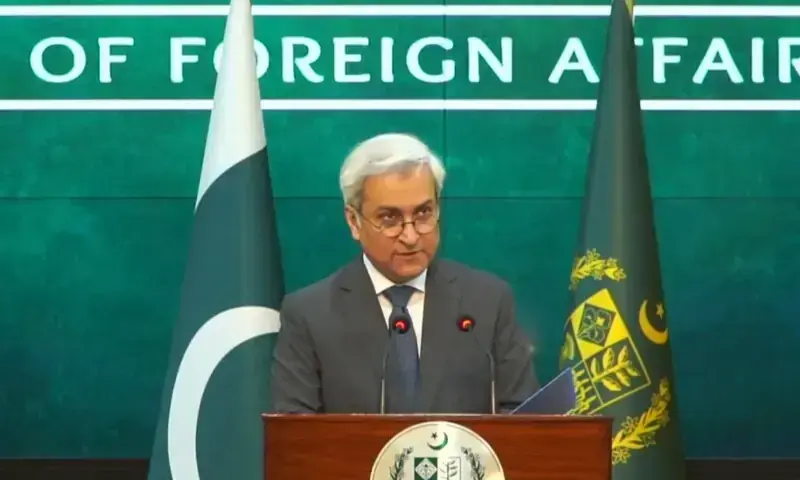
ISLAMABAD: The Foreign Office (FO) on Thursday stated Pakistan did not “subscribe to the opinion” of the judge who convicted lawyer Imaan Mazari-Hari and her spouse, Hadi Ali Chattha regarding “terrorist states”.
In his verdict, Additional District and Sessions Judge Muhammad Afzal Majoka had noted: “Currently there are four countries designated as terrorist states, which are Cuba, the Democratic Republic of Korea, Iran and Syria.”
Asked about that judgment during his weekly press briefing in Islamabad on Thursday, FO spokesperson Tahir Hussain Andrabi said, “This judgment […] is the view of the learned judge. Pakistan, of course, does not subscribe to this opinion.
“And frankly, this kind of designation does not exist either under the United Nations (UN) or under international law,” he said.

Judge Majoka had made the observation while noting that Pakistan was “not included in the list of terrorist states”.
It is worth mentioning that the UN does not maintain a list of “terrorist states”.
The United Nations Security Council (UNSC) has a “Consolidated List” of individuals, entities and other groups that it subjects to certain measures, such as sanctions, due to various reasons. While it may include certain government-affiliated departments, it does not name any country in its entirety.

Imaan and Hadi were sentenced on January 24 under the Prevention of Electronic Crimes Act’s (Peca) sections 9 (glorification of an offence), 10 (cyberterrorism), and 26-A (false and fake information).
They were handed a total of 17 years in jail, with the longest sentence being 10 years, and fined Rs36 million each collectively.
In his judgment, Judge Majoka had remarked about the four countries while noting that the couple had “intentionally in their tweets mentioned the [sic] Pakistan as a terrorist state”.
Convictions against freedom of expression: EU official
Earlier on Thursday, the European Union’s (EU) Spokesperson for Foreign Affairs and Security Policy Anouar El Anouni raised concerns over the conviction of Imaan and Hadi.
In a post on X, the EU official said their convictions “over social media activity goes against freedom of expression and independence of lawyers”.
“These are not only key democratic principles but also part of [Pakistan’s] international human rights commitments,” Anouni said.
On Wednesday, the National Assembly’s Special Committee on Gender Mainstreaming, under the chairpersonship of MNA Dr Nafisa Shah, expressed the concern that vague provisions within Peca were often misused against civil society actors, journalists and political parties.
In December 2025, the EU had reviewed Pakistan’s progress towards implementing 27 international conventions under the Generalised Scheme of Preferences Plus (GSP+) framework.
Both sides had exchanged views on various topics, including freedom of expression and media, and the judiciary’s independence. They stressed the “importance of proportionality and appropriate safeguards and the need to continue dialogue on these concerns”.
Governments with the GSP+ status need to implement 27 international conventions on human rights, labour rights, good governance and the environment.
A month before that, EU Ambassador to Pakistan Raimundas Karoblis said the country needed to “do more” in terms of fulfilling its commitments under GSP+.
In October 2025, Pakistan was elected as a member of the United Nations Human Rights Council (UNHRC) for the 2026-2028 term.


