


Current levels of bilateral trade do not reflect the true potential of Pakistan-Iraq relations: President Zardari


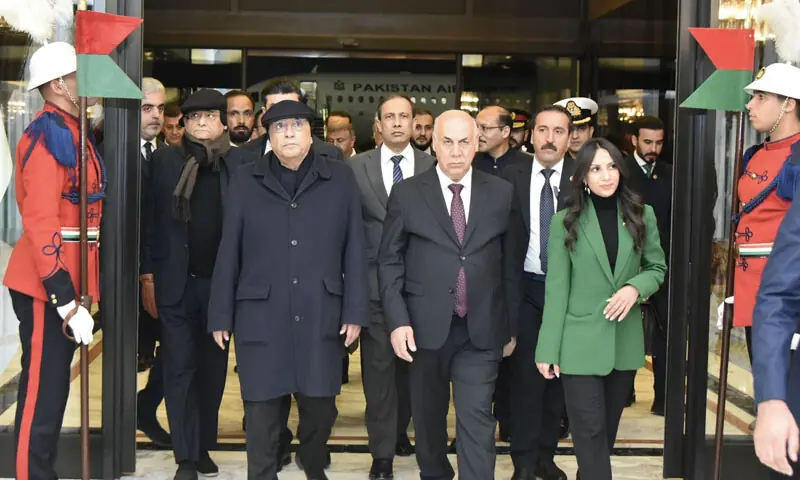
President Asif Ali Zardari met Iraqi President Dr Abdul Latif Jamal Rashid at Baghdad Palace on Sunday, a statement from the Presidency said.
The president, who is expected to meet senior Iraqi leadership during the trip, arrived in Iraq on Saturday night, where he was received by Iraq’s Culture Minister, Ahmed Fakkak Al-Badrani, upon his arrival in Baghdad.
According to the statement, President Zardari received a guard of honour upon his arrival at the palace, where he was scheduled to have lunch and a one-on-meeting with his Iraqi opposite number. The pair expressed satisfaction over growing diplomatic momentum from high-level exchanges.
“The president noted that current levels of bilateral trade do not reflect the true potential of Pakistan-Iraq economic, cultural and security relations,” the statement read.
“He highlighted opportunities for expanding trade, investment, agriculture and defence production sectors, besides information technology, construction, pharmaceuticals and related industries.”

President Zardari underscored the importance of business-to-business engagement, reciprocal business delegations and the establishment of direct banking channels to facilitate trade and commercial activity, the Presidency stated.
During the meeting, President Zardari also requested improved facilitation for Pakistani pilgrims visiting Iraq and was hopeful that the proposed memorandum of understanding (MoU) on Zaireen management would be finalised and implemented soon.
It aims to ensure orderly travel and address longstanding issues related to religious visits, the Presidency added.
“The president also expressed his firm resolve to work with [the] Iraqi government to stop [the] illegal entry and overstay of those Pakistanis who violate Iraqi law,” the statement added. “Both presidents [also] expressed their resolve to fight extremism, terrorism and narco trade and enhance bilateral cooperation.”
Additionally, President Zardari congratulated the Iraqi leadership and people on the successful conduct of the parliamentary elections and expressed his best wishes for the smooth formation of the new government.
“He reaffirmed Pakistan’s firm support for Iraq’s sovereignty, territorial integrity and national unity and reiterated Pakistan’s commitment to Iraq’s stability, prosperity and democratic progress,” the statement read.
“The two leaders reaffirmed their commitment to further deepening bilateral cooperation across political, economic and social domains and agreed to maintain close coordination at regional and multilateral fora, including the United Nations and the OIC, on issues of mutual interest,” it added.
[The] Iraqi President appreciated Pakistan’s role in uniting [the] Islamic Ummah and the historical support to the people of Palestine.“Separately, Pakistan’s Ambassador to Iran Muhammad Mudassir Tipu posted on X that while en route from Islamabad to Baghdad, Zardari “conveyed a goodwill message to the Iranian leadership“ as his aircraft entered Iranian airspace.
“It reaffirmed solidarity with Iran, emphasising mutual respect and stronger relations between the two historic neighbours,” Tipu said.
He added: “ The president’s message coincides with the Iranian nation celebrating Yalda Night tomorrow — a civilisational tradition that brings hope, joy, and compassion amongst people and families. The spirit of Yalda Night defines our bilateral, social, and cultural affinities as well.”
Previously, the Foreign Office had said in a statement that President Zardari would undertake an official visit to Iraq from December 20-24.
According to the statement, he was invited for the visit by his Iraqi counterpart, Abdul Latif Jamal Rashid.
It said that during his meetings with the Iraqi leadership, President Zardari would review bilateral relations between the two countries and explore ways to further strengthen cooperation across key areas of mutual interest, including trade and investment, energy, reconstruction, manpower, technology, education and people-to-people exchanges.
The discussions would also cover regional and international developments, as well as cooperation at multilateral forums.
“The visit is expected to reinforce the traditionally warm and cordial ties between the two countries, identify new avenues of partnership, and enhance people-to-people linkages, particularly in the context of religious tourism and economic collaboration,“ it said.


